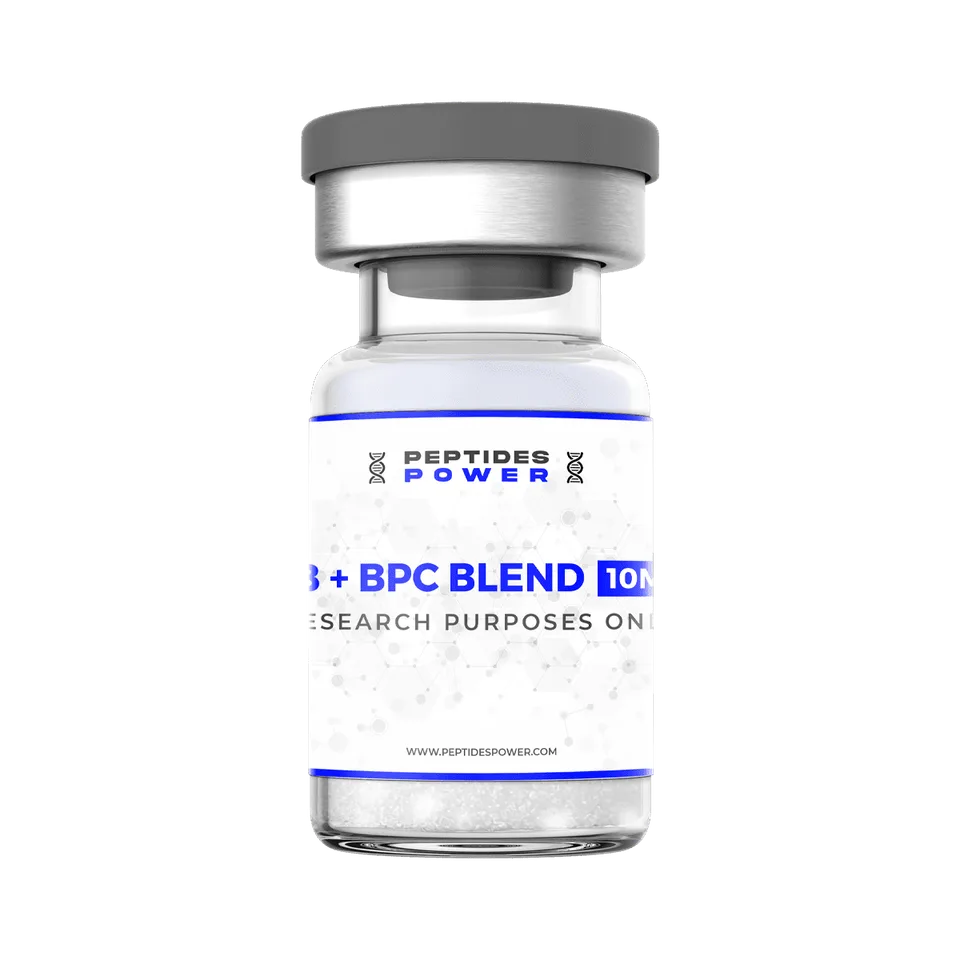
Wolverine Stack (BPC-157 + TB-500)
$60
In stock
View product
Profile
The Wolverine stack is a nickname for one vial holding two lab-made peptides, neither FDA-approved: BPC-157, 15 amino acids based on a gastric juice protein, and TB-500, an acetylated 7-amino-acid piece of thymosin beta-4.12 The pair has been tested in one rat study and in 3 patients without a control group; 4 more got BPC-157 with thymosin beta-4.354
This page summarizes published sources for information only. It is not medical advice and does not tell anyone to use a product. Questions about your own health belong with a licensed clinician. For questions about an order or a product, contact us.
| Class | Blend of two synthetic peptides: BPC-157 (15 amino acids) and TB-500 (an acetylated 7-amino-acid fragment of thymosin beta-4)12 |
|---|---|
| Also known as | Wolverine peptide, Wolverine blend, BPC-157 + TB-500 blend, BPC-157/TB-500, BPC 157 TB 500 |
| Forms we sell | One 10 mg (5 mg + 5 mg) vial of freeze-dried powder, for research use only |
| US regulatory status | Neither peptide is FDA-approved or part of an approved drug; July 2026 advisory votes on pharmacy compounding await FDA action1267 |
| WADA status | Prohibited at all times: BPC-157 under S0 (non-approved substances), TB-500 under S2.3 (growth factors)8 |
| Studies of the pair | One controlled study in 32 rats; 3 patients given both and 4 given BPC-157 with thymosin beta-4, uncontrolled; no registered trial as of October 24, 2026345910 |
Wolverine stack, Wolverine peptide and Wolverine blend are marketing names for one pairing, BPC-157 with TB-500, not for a single compound.
| Component | Per vial | What it is | Formula and molar mass |
|---|---|---|---|
| BPC-157 | 5 mg | 15 amino acids (GEPPPGKPADDAGLV), described as part of a protein in human gastric juice151 | C62H98N16O22, 1419.5 g/mol, PubChem CID 994195716 |
| TB-500 | 5 mg | 7 amino acids (Ac-LKKTETQ), copying positions 17 to 23 of thymosin beta-4 with an acetyl group added1718 | C38H68N10O14, 889.0 g/mol, PubChem CID 6270766219 |
Equal weights do not mean equal numbers of molecules. At PubChem's free-base molar masses, 5 mg of BPC-157 is about 3.5 micromoles and 5 mg of TB-500 about 5.6 micromoles.1619 That is roughly 1.6 TB-500 molecules per BPC-157 molecule. The listing does not say whether either peptide is a free base or an acetate salt, forms FDA treats as separate substances.12
Several websites treat "TB-500" and "thymosin beta-4" as one compound, but FDA's 2026 review says they are not the same substance.2 Thymosin beta-4 is a 43-amino-acid protein first isolated from calf thymus.2 TB-500 copies 7 of its amino acids and adds an acetyl group.18 FDA adds that results for the plain, non-acetylated sequence cannot be directly extrapolated to TB-500.2
Ingredient profiles: What is BPC-157? and What is TB-500?. The Glow Peptide Stack and KLOW Peptide Blend add GHK-Cu to the same two peptides, and KLOW also adds KPV; see Peptide blends and stacks. This vial is listed as Wolverine Stack (BPC-157 + TB-500) for sale.
A 2026 study in 32 male rats is the only controlled test of the combination found in PubMed.320 After surgical repair of an Achilles tendon, 8 rats per group were assigned to a control group, BPC-157, TB-500 or both, injected into the abdominal cavity for 4 weeks.3
The authors suggest the peptides may act on shared downstream pathways, a hypothesis they say needs testing.3
Human reports cover 7 patients given BPC-157 with TB-500 or thymosin beta-4, none with a control group.45
BPC-157 has the larger animal record: a 2025 systematic review counted 35 preclinical studies among 36 and found better function and structure in animal models, but no clinical safety data.21 A 2026 review of its human use found three small studies of 30 people, rated very low certainty.12 For TB-500, the May 2026 FDA review located no published report of the peptide given to humans; the dental series appeared later, on September 30, 2026.25 FDA found too little evidence to support BPC-157 for ulcerative colitis, or even to evaluate TB-500 for wound healing.12
BPC-157 raised levels of VEGFR2, a receptor behind blood-vessel growth, in rat and cell studies (2017).22 In rat tendon cells it raised growth hormone receptor levels (2014).23 FDA says its molecular targets remain unidentified.1 TB-500 contains LKKTET, the actin-binding part of thymosin beta-4; actin is the protein that shapes cells and lets them move.2 FDA calls it a hypothesis, not a shown effect, that TB-500 buffers actin as the full protein does.2 In a 2024 cell study it summarized, TB-500 itself did not speed closure of scratch wounds in fibroblasts.2
Muscle building is a marketing theme, not a research result: FDA lists increased muscle growth and muscle tone among online claims for TB-500.2 The studies themselves track recovery of injured tendon, ligament and muscle, mostly in animals.213 Overviews: peptides and healing and recovery and peptides and muscle growth.
Safety of the blend in people is unknown: FDA says it lacks the information to know whether either peptide would cause harm.242
With BPC-157 alone, FDA's adverse event database (FAERS) held a report of shortness of breath leading to an emergency room visit.1 A FAERS search through March 26, 2025 returned no TB-500 reports.2 Full lists: What is BPC-157? and TB-500 side effects.
General precautions: Peptide safety basics.
Neither peptide, alone or blended, has an established human dose.1128 A 2026 physician primer says indications, dosing, frequency and treatment length remain unknown, and USADA says it is unknown whether any dose of BPC-157 is safe.1128 The table lists research conditions from published studies; none is guidance for people.
| Study | Subjects | Route | Amounts | Duration |
|---|---|---|---|---|
| Achilles tendon repair (2026) | 32 rats | Into the abdominal cavity | BPC-157 10 µg/kg/day, TB-500 60 µg/kg/day, or both | 4 weeks3 |
| Nerve injury case series (2026) | 3 people | Under the lining of the mouth | TB-500 10 mg and BPC-157 1 mg, plus ARA-290 4 mg, dexamethasone 8 mg and bupivacaine, weekly | 4 weeks5 |
| Knee pain chart review (2021) | 17 people, 4 also given TB4 | Into the knee joint | BPC-157 2 to 4 mg per injection; TB4 amount not reported | 1 or 2 injections14 |
| TB-500 in horses (2012) | Horses | Under the skin | 10 mg | Single dose132 |
| Thymosin beta-4, not TB-500 (2010) | 40 healthy people | Intravenous | 42, 140, 420 or 1260 mg, or placebo | Single dose, then daily for 14 days; no serious adverse events29 |
Ratios differ: 1 to 6 by weight in the rat study and 1 to 10 in the dental series, against 1 to 1 in this vial.35 Whether results at those ratios apply to this vial is unknown. More: Peptide dosage basics and TB-500 dosage.
Both peptides share one vial of powder, so one volume of diluent dissolves the full 10 mg and fixes the 1 to 1 ratio. Vendor data cited in FDA's reviews give water solubility of 5 mg/mL for BPC-157 and 50 mg/mL for TB-500 free base.12 Each peptide's concentration is its 5 mg divided by the diluent volume:
| Diluent volume | BPC-157 | TB-500 | Total peptide |
|---|---|---|---|
| 1 mL | 5 mg/mL | 5 mg/mL | 10 mg/mL |
| 2 mL | 2.5 mg/mL | 2.5 mg/mL | 5 mg/mL |
| 2.5 mL | 2 mg/mL | 2 mg/mL | 4 mg/mL |
| 5 mL | 1 mg/mL | 1 mg/mL | 2 mg/mL |
Below 1 mL, BPC-157 would pass the 5 mg/mL figure reported for water.1 These numbers describe a bench solution, not an amount for a person. The reconstitution calculator handles other volumes, How to reconstitute a peptide vial gives the lab steps, and the diluent listed with this vial is bacteriostatic water.
Stability figures exist for each peptide alone, from sources cited in FDA's reviews; none were found for the two stored together.12
| Condition | BPC-157 | TB-500 free base |
|---|---|---|
| Dry powder | About 3 weeks at room temperature; long term, desiccated below -18 °C1 | Sealed, away from moisture and light, under nitrogen: 1 year at -20 °C, 2 years at -80 °C2 |
| In solution | 2 to 3 weeks at 4 °C; 3 to 4 months at -20 °C1 | 1 month at -20 °C; 6 months at -80 °C2 |
FDA also warns that pH, heat, concentration, impurities and excipients can make peptides like these aggregate or degrade.12 Freezer and refrigerator practice: How to store peptides.
FDA's May 2026 reviews found no FDA-approved drug containing either peptide, as free base or acetate, and no USP or National Formulary standard for either.12 Both once sat in FDA's category 2 of compounding substances that may present significant safety risks; the nominations were withdrawn, but FDA still posts its safety concerns.24
Ahead of its July 23, 2026 compounding advisory meeting, FDA weighed both peptides for the 503A Bulks List, the ingredients pharmacies may compound with.7 The uses under review were ulcerative colitis for BPC-157 and wound healing for TB-500, and FDA staff proposed adding neither.712 The committee voted to add each peptide, in both forms, 8 to 6 with 1 abstention.630 A dissenting member also worried about TB-500 being used in combination with other peptides.6 RAPS reports that if FDA follows the vote, state-licensed compounding pharmacies could compound these peptides for individual patients.30 FDA will decide only after considering that input.1 A Federal Register search on October 24, 2026 found no rule naming either peptide since the April 16, 2026 meeting notice.3132
Research labels do not exempt a product.33 FDA's warning letter of June 12, 2023 told an online seller that its website showed its injectable and nasal-spray BPC-157 and TB-500 were meant for people.33 The "research purpose only" labels did not change that.33 FDA's 2026 review also lists combined BPC-157 and TB-500 products found online, among them a 10 mg injectable blend.1
No country has approved a BPC-157 product, according to FDA.1 For TB-500, FDA found no approved product in ten countries it named, including Canada, Australia and the United Kingdom, and none authorized by the European Medicines Agency.2 Health Canada lists both peptides among unauthorized injectable drugs it has seized (advisories of August 1, 2025 and April 9, 2026).3427 It calls such products illegal in Canada, even when labeled "For Research Use Only".27
WADA's 2026 Prohibited List bans both at all times.8 BPC-157 sits in S0, non-approved substances (Specified).8 TB-500, as a thymosin beta-4 derivative, falls in S2.3, growth factors and their modulators (non-Specified).8 USADA's advisory on the 2027 list keeps both prohibited and notes that peptides in general are now named under S0.35 A US triathlete who possessed and used both peptides received a four-year ban, USADA announced in September 2025.36
Wolverine Stack (BPC-157 + TB-500) for sale: strengths, stock and shipping are on the product page.
For research use only. Not for human or veterinary use. Read the research use policy.
No study in people has compared them. In the closest test, a 2026 study of 32 rats with repaired Achilles tendons, TB-500 alone was the only treatment that significantly raised tendon strength.3 BPC-157 alone improved tissue scores only numerically, and giving both added nothing over either one.3 A 2021 knee-pain chart review, with 12 patients on BPC-157 and 4 on BPC-157 plus thymosin beta-4, is too small and uncontrolled to rank them.411
The name comes from marketing, not from a study. FDA's 2026 BPC-157 review quotes a clinic website saying the peptide has been called a wolverine compound for its claimed healing properties.1 FDA's TB-500 review cites a web page about a BPC157 and TB500 wolverine protocol.2 The healing claims behind the nickname are not established in people: a 2026 systematic review rated the human evidence for BPC-157 as very low certainty.12
Only in 3 patients, and never in a controlled trial.5 Those dental nerve-injury patients in a 2026 case series also got ARA-290, dexamethasone and bupivacaine, so no result can be credited to the pair.5 In a 2021 knee-pain chart review, 3 of 4 patients given BPC-157 with thymosin beta-4 reported significant improvement.4 ClinicalTrials.gov searches on October 24, 2026 found no registered trial of the two together.910
Anti-doping labs have studied both. In a 2012 horse study, a method detected and confirmed TB-500 at 0.02 ng/mL in plasma and 0.01 ng/mL in urine after a single 10 mg dose.13 FDA notes that WADA approved a project in 2013 to build TB-500 metabolites into peptide screening.2 FDA also cites two lab studies of BPC-157 metabolism done for anti-doping screening.1
Only animal data exist. BPC-157's elimination half-life was below 30 minutes in rats and dogs (2022).14 In horses given 10 mg of TB-500 under the skin, blood levels peaked at 0.05 and 0.08 ng/mL 1 to 2 hours after dosing and became unmeasurable by 6 to 10 hours.2 FDA found no human pharmacokinetic data for TB-500 by any route.2
Written by D2C Peptides Editorial Team.
Pending qualified review.
Updated .
D2C Peptides sells peptides for laboratory research. Please confirm both statements to continue.