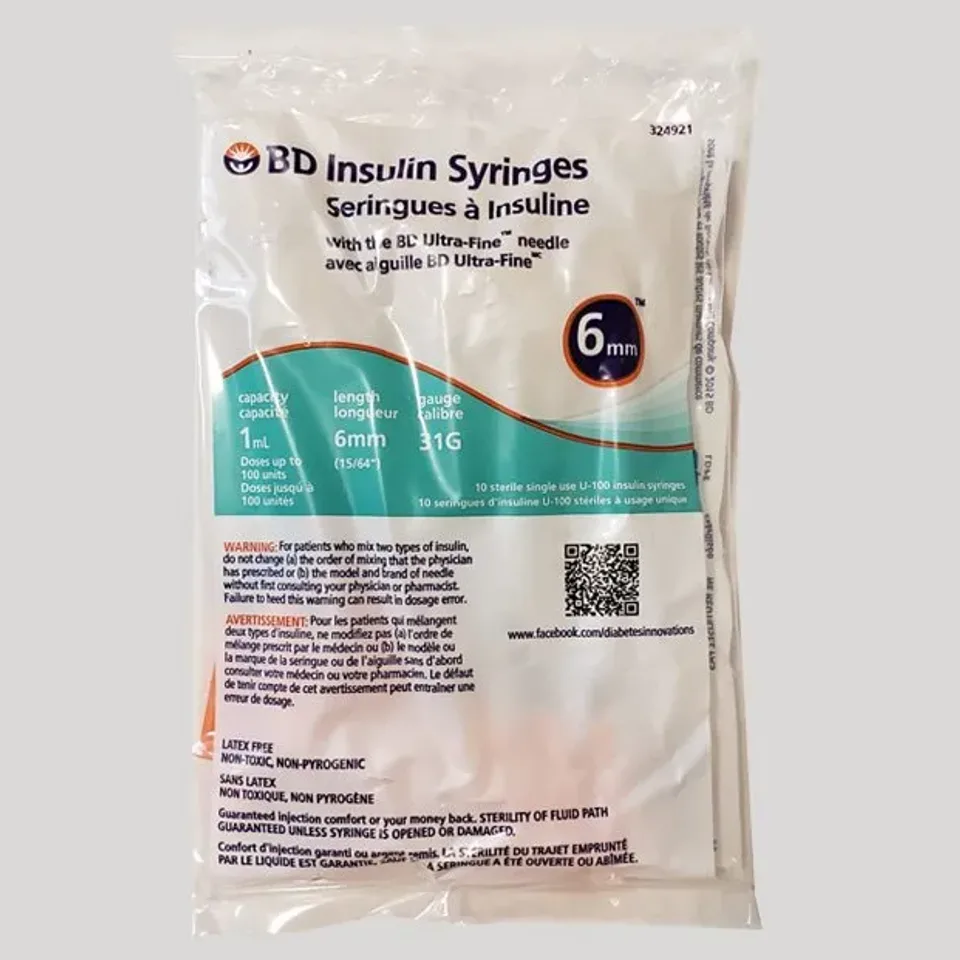
Insulin Syringes (Pack of 10)
$10
In stock
View product
Guide
A peptide amount is written as a mass, in milligrams (mg) or micrograms (mcg), or in units, and the amount in a syringe depends on two numbers: the volume drawn and the concentration of the solution. On a U-100 syringe, each unit mark is 0.01 mL of liquid, not an amount of drug.12 Approved prescription medicines are dosed by the prescriber, following the label.3 Research vials carry no human dose: an unapproved drug shipped for lab research must be labeled "Not for use in humans".4
This page summarizes published sources for information only. It is not medical advice and does not tell anyone to use a product. Questions about your own health belong with a licensed clinician. For questions about an order or a product, contact us.
Most questions about peptide dosage come down to three numbers: the amount of compound in the vial, the volume of liquid it is dissolved in, and the volume drawn from it. This guide explains how each is written and how they connect. It covers measurement only, and it gives no dose, schedule or protocol for any person.
| Unit | What it measures | Conversion |
|---|---|---|
| mg (milligram) | Mass | 1 mg = 1,000 mcg |
| mcg (microgram) | Mass | 1 mcg = 0.001 mg |
| mL (milliliter) or cc | Volume | 1 cc = 1 mL6 |
| Unit mark on a U-100 syringe | Volume | 1 unit = 0.01 mL, so 100 units = 1 mL12 |
| Units of a drug, such as insulin units or IU | An amount of that drug, as its label states | U-100 insulin holds 100 units of insulin per mL17 |
Milligrams and micrograms. A microgram is one thousandth of a milligram, so 0.5 mg is 500 mcg and 2 mg is 2,000 mcg. Converting every figure to the same unit before calculating keeps a factor of 1,000 from slipping into the result.
Milliliters and cc. A cubic centimeter (cc) is the same volume as a milliliter. Vials and syringes may use either abbreviation.6
Two kinds of units. The word covers two different things. A drug can be measured in units: insulin is, and standard U-100 insulin holds 100 units of insulin in each milliliter, the most common strength according to the American Diabetes Association.17 Most insulin syringes are scaled to match, so each unit mark is 0.01 mL.1 For any liquid other than U-100 insulin, those marks still measure volume only. FDA has warned that instructions with some compounded semaglutide give doses in syringe units rather than milligrams or milliliters, and that what those units represent can vary with the product's concentration.2
International units on vials. Some vials are labeled in international units (IU) instead of milligrams. In this catalog that applies to HCG (5000 IU), HGH (10 IU) and HMG (75 IU). An IU counts biological activity, not weight: the Menopur (menotropins) label, for example, states 75 IU of FSH activity and 75 IU of LH activity per vial, measured by bioassays in rats.11 For somatropin (HGH), the WHO International Standard assigns 3.0 IU per mg.12 The sources behind this guide give no such figure for HCG or HMG, so those vials are worked in IU, with concentration written as IU per mL.
Three formulas cover nearly every calculation:
An example with neutral numbers shows why concentration has to be written down. A vial holding 6 mg dissolved in 2 mL gives 3 mg/mL, which is 3,000 mcg/mL, and 0.1 mL of it holds 0.3 mg. Dissolve the same 6 mg in 3 mL and the concentration falls to 2 mg/mL, so the same 0.1 mL holds 0.2 mg. The volume did not change; the amount in it did. A volume or a unit count, on its own, says nothing about the amount.
The reconstitution guide covers the mixing step, including why a powder's peptide content can be lower than its fill weight.
Because U-100 means 100 units in 1 mL, each unit mark is 0.01 mL. FDA's own example is a 5-unit measure on a U-100 syringe, which is 0.05 mL.12 The table below converts volume to units and nothing else; the amount of compound on each line depends on the concentration.2
| Volume | Units on a U-100 syringe |
|---|---|
| 0.01 mL | 1 |
| 0.05 mL | 5 |
| 0.1 mL | 10 |
| 0.25 mL | 25 |
| 0.3 mL | 30 |
| 0.5 mL | 50 |
| 1 mL | 100 |
Barrel size and scale vary. embecta, one maker, sells insulin syringes with 1 mL, 0.5 mL and 0.3 mL barrels, and its 0.3 mL barrel can be had with half-unit marks.5 On a U-100 scale those barrels hold up to 100, 50 and 30 units. MedlinePlus treats each small line on a standard 1 mL insulin syringe as 1 unit,1 but the numbers printed on the barrel in hand are the ones to read. The scale also assumes U-100: embecta's rule is that U-500 insulin always goes with a U-500 syringe.5
The American Diabetes Association lists trouble reading the units on a syringe among the drawbacks of syringes and vials.8 Insulin syringes are on the supplies page, and the units converter turns mL into U-100 units and back.
Under 21 CFR 312.160, an unapproved new drug may be shipped for in vitro tests or laboratory animal research only if it is labeled with a caution ending "Not for use in humans", and the shipper must use due diligence to make sure the buyer regularly runs such tests.4 Testing an unapproved drug in people in the US happens under an Investigational New Drug application, the route by which a study sponsor is exempted from the rule that a drug needs an approved marketing application before it crosses state lines.9
FDA reports warning companies whose unapproved GLP-1 products, falsely labeled "for research purposes", went straight to consumers for human use, complete with dosing instructions.10 For these reasons, this site gives no dose, schedule or protocol for any research vial. Each compound's profile in Peptides A to Z gives the doses reported in published studies, along with species, route and length of treatment, and says where no human dose has been established.
As FDA states the law, a prescription drug may be dispensed only on a licensed practitioner's prescription,3 so for an approved prescription medicine, the dose is the one its prescriber sets, following the label. FDA also notes that approved injectable semaglutide is dosed in milligrams at standard concentrations, and that at the time of its July 2024 alert it came only in prefilled pens.2 Label dose schedules for the GLP-1 medicines are on the GLP-1 dosage page, and the HCG, HGH and HMG profiles give their labels' dosing information.
In July 2024, FDA reported adverse events, some requiring hospital care, that may be linked to overdoses from dosing errors with compounded injectable semaglutide.2 Its findings show how easily the arithmetic goes wrong:
The same traps apply to any measurement in a lab. Each of these checks targets one of them:
$10
In stock
View productNo products match these filters.
For research use only. Not for human or veterinary use. Read the research use policy.
Enter the vial amount, the water added and the amount to measure, and get the concentration and U-100 syringe units. Shows the formula. For reference only.
Enter the peptide amount and the diluent volume and get the concentration per mL and per syringe unit. Shows the formula. For reference only.
Convert between mg and mcg, and between mL and U-100 syringe units. Shows the formula. For reference only.
Each unit line on a U-100 insulin syringe stands for 0.01 mL, so the full 1 mL barrel reads 100 units, 10 units is 0.1 mL and 50 units is 0.5 mL.12 On the same scale, 0.5 mL and 0.3 mL barrels hold up to 50 and 30 units; embecta, one maker, sells both sizes and says U-500 insulin always takes a U-500 syringe.5 The units measure volume only, so the amount of drug they hold depends on the concentration of the liquid.2
No. Each unit mark on a U-100 syringe measures volume: 0.01 mL.2 The milligrams in that volume depend on the concentration. With example numbers, 10 units (0.1 mL) of a 2 mg/mL solution hold 0.2 mg, while the same 10 units of a 4 mg/mL solution hold 0.4 mg. FDA has said confusion among units, milliliters and milligrams may have contributed to dosing errors with compounded semaglutide, in which patients took 5 to 20 times the intended dose.2
There is none. A research vial is not an approved medicine. Federal rules let an unapproved new drug be shipped for test-tube or lab animal research under the caution "Not for use in humans",4 and testing one in people is done under an Investigational New Drug application.9 This site therefore gives no human dose, schedule or protocol. Each compound's profile sets out the published study doses, with species, route and duration. Approved prescription medicines are different: they are dispensed only on a prescription,3 and the prescriber sets the dose from the label.
Multiply by 1,000: 1 mg is 1,000 mcg, 0.5 mg is 500 mcg and 2.5 mg is 2,500 mcg. To go the other way, divide by 1,000. The same arithmetic gives micrograms per syringe unit: because a U-100 unit is 0.01 mL,2 a 3 mg/mL solution holds 0.03 mg, or 30 mcg, in each unit. The units converter does these conversions and shows the formula.
Written by D2C Peptides Editorial Team.
Pending qualified review.
Updated .
D2C Peptides sells peptides for laboratory research. Please confirm both statements to continue.