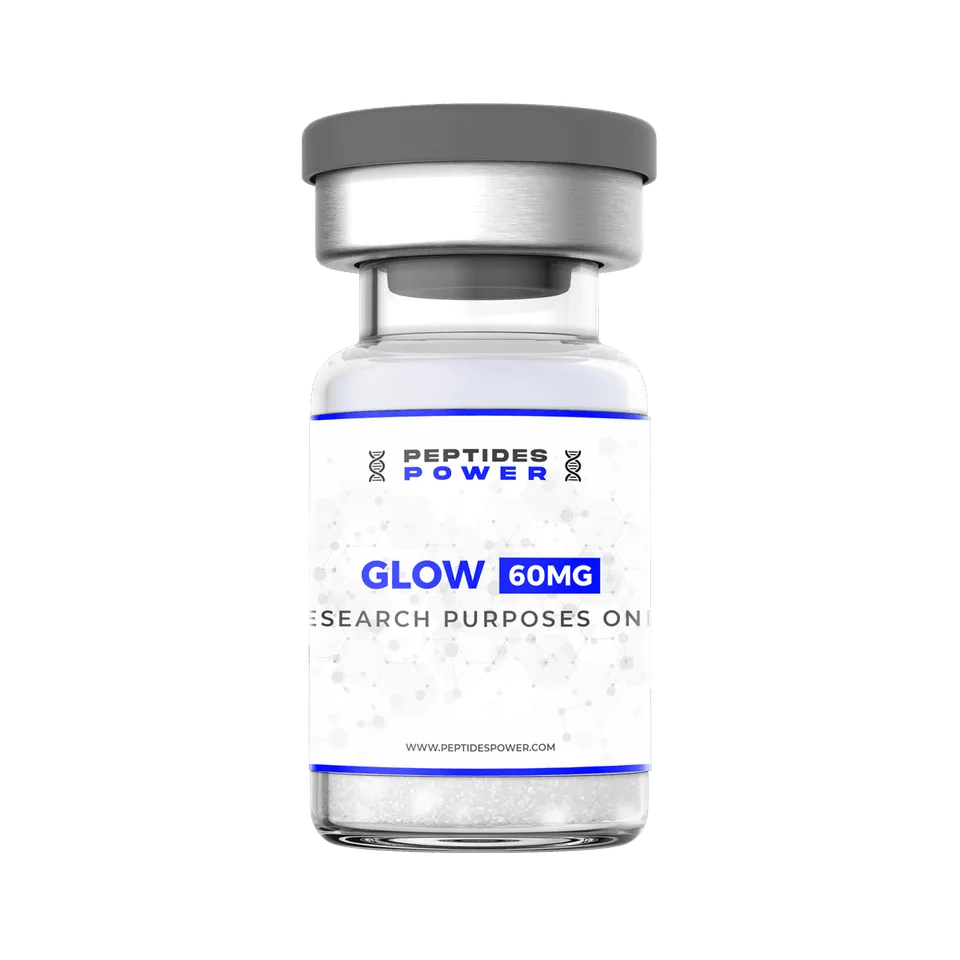
Glow Peptide Stack
$85
In stock
View product
Profile
Glow peptide is a blend of three research peptides, not a single compound: the vial sold here holds 50 mg of GHK-Cu, a copper-bound tripeptide, plus 5 mg each of BPC-157 and TB-500.32 No published study has tested the blend, FDA found no study of TB-500 in people, and none of the ingredients is an approved drug.1234
This page summarizes published sources for information only. It is not medical advice and does not tell anyone to use a product. Questions about your own health belong with a licensed clinician. For questions about an order or a product, contact us.
| Class | Peptide blend: three research peptides freeze-dried in one vial, not a single compound32 |
|---|---|
| Also known as | Glow, Glow blend, Glow stack, GHK-Cu + BPC-157 + TB-500 blend |
| Forms we sell | One 60 mg freeze-dried vial: GHK-Cu 50 mg, BPC-157 5 mg, TB-500 5 mg (10 : 1 : 1 by weight)32 |
| Studies of the blend | None found in PubMed as of October 24, 202651 |
| Regulatory status | Not FDA approved; FDA says neither BPC-157 nor TB-500 is a component of an approved drug32 |
| WADA status | Prohibited: BPC-157 (S0) and TB-500 (S2) on the 2026 List; GHK-Cu not named67 |
| Ingredient | Per vial32 | What it is | PubChem record |
|---|---|---|---|
| GHK-Cu | 50 mg | The tripeptide Gly-His-Lys bound to copper(II)89 | CID 71587328 (prezatide copper), C14H23CuN6O4+, 402.92 g/mol10 |
| BPC-157 | 5 mg | A synthetic 15-amino-acid fragment of a gastric juice protein: GEPPPGKPADDAGLV32911 | CID 9941957, C62H98N16O22, 1419.5 g/mol12 |
| TB-500 | 5 mg | A synthetic, acetylated 7-amino-acid fragment of thymosin beta-4: Ac-LKKTETQ2 | CID 62707662, C38H68N10O14, 889.0 g/mol13 |
The three are mixed at 10 : 1 : 1 by weight, so GHK-Cu makes up five sixths of the powder.32
GHK-Cu. GHK occurs naturally in human plasma, at about 200 ng/mL at age 20 and 80 ng/mL by age 60.9 PubChem holds more than one GHK-Cu record. Prezatide copper has one GHK per copper (402.92 g/mol), while a record titled GHK-Cu has the atoms of two GHK units per copper (744.3 g/mol).10 The supplier does not say which form the vial contains, so its copper content cannot be calculated. Cosmetic ingredient lists name the complex copper tripeptide-1.14
BPC-157. FDA notes that its molecular targets have not been identified and its mechanisms remain poorly understood.3
TB-500. FDA describes TB-500 as amino acids 17 to 23 of the 43-amino-acid protein thymosin beta-4, with an acetyl group added.2 FDA says the two are not the same substance, even though several websites use the names interchangeably.2 The sequence contains LKKTET, the actin-binding region of thymosin beta-4.2
The research vial is listed as Glow Peptide Stack for sale. Ingredient profiles: What is GHK-Cu?, What is BPC-157? and What is TB-500?. For blends in general, see Peptide blends and stacks.
Glow is marketed mainly for skin, but the human skin data come from GHK-Cu applied to the skin: most randomized GHK-Cu trials are small facial cream studies.15 A 2018 review cites the 12-week face and eye cream studies in 71 and 41 women from 2002 dermatology meeting proceedings, not journal papers.9 Evidence for tissue repair with BPC-157 and TB-500 comes mostly from animal models.1629 In a 2026 rat study that combined BPC-157 and TB-500, the pair did no better than either peptide alone.17 Full list with evidence levels: Glow Peptide Stack benefits and uses.
No safety data exist for the blend itself.1 One FDA adverse event report describes skin and gum darkening in a woman injecting a research-labeled BPC-157 and TB-500 product under the skin.3 The reaction returned when she used it again.3 FDA warns that injected peptides such as BPC-157 and TB-500 may trigger immune reactions.23 A 2026 review warns that too much copper-binding peptide in the body could upset copper balance and possibly harm the liver, and notes that controlled human trials of injected GHK-Cu are absent.4 Full list: Glow Peptide Stack side effects.
No human dose is established for Glow or for injected GHK-Cu, BPC-157 or TB-500.118 A 2026 review says dosing, frequency and duration for these peptides remain unknown.18 FDA found no human study of TB-500 at all, so published TB-500 doses come only from animals.2 Doses from single-ingredient studies, other species and other routes are not guidance for people. Full details: Glow Peptide Stack dosage.
Glow is supplied as one freeze-dried powder, so adding diluent reconstitutes the whole 60 mg in one step, and the 10 : 1 : 1 ratio cannot be changed afterward.32 Bacteriostatic Water for Injection, USP contains 0.9% or 1.1% benzyl alcohol as a preservative.19 Its label limits it to diluting or dissolving drugs for injection.19 The label also warns that benzyl alcohol has been linked to toxicity in newborns.19 Giving the water intravenously without a dissolved drug may cause hemolysis, the breakdown of red blood cells.19
Concentration is the powder mass divided by the diluent volume, and all three peptides are diluted by the same volume. The supplier's mixing note uses 3 mL or 5 mL:32
| Diluent added | Whole blend | GHK-Cu | BPC-157 | TB-500 |
|---|---|---|---|---|
| 3 mL | 20 mg/mL | 16.67 mg/mL | 1.67 mg/mL | 1.67 mg/mL |
| 5 mL | 12 mg/mL | 10 mg/mL | 1 mg/mL | 1 mg/mL |
These are concentrations of a lab solution, not doses. Step-by-step lab handling is in How to reconstitute a peptide vial, and the reconstitution calculator does the same arithmetic for other volumes. Diluents and syringes are described in Peptide supplies explained.
No published study has tested the stability or compatibility of the three peptides together.51 The supplier's own figures are 36 months at -20°C and 30 days at 2 to 8°C, with no published stability data behind them.32 FDA notes that peptides can be very sensitive to pH, heat, concentration and impurities, which may lead to clumping and breakdown.2 Single-ingredient data give some bounds:
General storage guidance is in How to store peptides.
United States. FDA's May 2026 reviews state that neither BPC-157 nor TB-500 has a USP or NF monograph or is a component of an FDA-approved drug.32 BPC-157, TB-500 and injectable GHK-Cu were in Category 2 of FDA's interim compounding policy, for substances that may present significant safety risks.21 They left it when the nominations were withdrawn, and FDA's page still lists safety concerns for each.21 In May 2026, FDA said GHK-Cu for routes other than injection would be added back to Category 1, the substances still under evaluation; injectable GHK-Cu is not covered.22
FDA's briefing documents for its July 23 to 24, 2026 advisory committee meeting proposed keeping BPC-157 and TB-500 off the 503A Bulks List.23 That list names the bulk substances compounding pharmacies may use.23 The committee voted 8 to 6, with 1 abstention, to recommend BPC-157, KPV and TB-500 for the list.24 The vote is nonbinding, and a Federal Register search on October 24, 2026 found no proposed rule since the meeting.2425 FDA says a committee meeting before the end of February 2027 will discuss GHK-Cu.26
Research-use labels do not settle legal status. In an August 24, 2026 warning letter, FDA told an online peptide seller that, despite labels saying its products were for laboratory and research use, evidence on its website established that they were intended as drugs for human use.27
Other countries. Health Canada's April 9, 2026 advisory lists BPC-157, GHK-Cu and TB-500 among unauthorized injectable peptide drugs it has seized.28 It says unauthorized drug products are illegal in Canada and that research-use labelling does not make them legal.28 FDA found no approved TB-500 product in Canada, Australia, the United Kingdom or seven other European countries, and none authorized by the European Medicines Agency.2 It found no approved BPC-157 product in any country.3 New Zealand's medicines classification committee proposed in May 2023 that BPC-157 become a prescription medicine.3
Sport. BPC-157 and TB-500 are on WADA's 2026 Prohibited List, and GHK-Cu is not named.67
Published dosing information for Glow Peptide Stack from studies of its ingredients, with its sources, and why it is not advice for you.
What published sources report about Glow Peptide Stack and its uses, with the evidence level of each finding. No promises.
Side effects of Glow Peptide Stack as reported in case reports, small studies of its ingredients and animal research, with links to the full profile.
$85
In stock
View productGlow Peptide Stack for sale: strengths, stock and shipping are on the product page.
For research use only. Not for human or veterinary use. Read the research use policy.
No published study has tested the Glow blend, in people or in animals, so there is no direct evidence that it works.1 Research covers the ingredients one at a time. It includes small skin studies of topical GHK-Cu and three small human studies of BPC-157 rated very low certainty.929 FDA found no human studies of TB-500.2 A 2026 systematic review called the human GHK-Cu literature thin and fragmented.15
No Glow product can be called best on evidence, because no Glow blend has been studied or compared.1 What can be compared is identity. FDA has found multiple salts and derivatives, including different active molecules, sold under the TB-500 name.2 So for any brand, check whether the lot certificate confirms the identity of each of the three ingredients, not only overall purity.
The evidence cannot show that it is. No published study has tested the blend,1 and FDA says the potential safety risks of TB-500 in humans are unknown.2 FDA also says it lacks enough information to know whether BPC-157 would cause harm in humans.21 A 2026 review describes rigorous human safety data for unapproved peptides like these as scarce, with potential for serious harm.16
No study compares KLOW and Glow, and neither blend has been tested.1 KLOW (70 mg) contains Glow's three peptides plus KPV, a tripeptide of lysine, proline and valine.3330 FDA says it has found no human exposure data for KPV by any route.21 Read What is KLOW Peptide Blend? for that blend's profile.
The Wolverine Stack (10 mg (5 mg + 5 mg)) contains only BPC-157 and TB-500, the two minor ingredients in Glow, and no GHK-Cu.32 A 2026 review says TB-500 is frequently combined with BPC-157 in unregulated fitness regimens.4 Of the two products, only Glow contains copper, so the copper concerns on the Glow Peptide Stack side effects page apply to Glow, not to the Wolverine Stack. Profile: What is Wolverine Stack (BPC-157 + TB-500)?
No. Because no FDA-approved drug contains BPC-157 or TB-500, none contains the Glow blend,32 and a 2026 review lists GHK-Cu as an unapproved cosmetic research chemical.4 FDA has still to decide whether compounding pharmacies may use some of these ingredients, as the regulatory section on this page explains.2426
Two of its ingredients are. WADA's 2026 Prohibited List names BPC-157 under S0, non-approved substances, and lists thymosin beta-4 and its derivatives, such as TB-500, under S2.6 GHK-Cu is not named, but S0 covers any pharmacological substance not listed elsewhere that has no current approval by a government health authority for human therapeutic use.7 WADA approved a 2027 List on September 10, 2026, in force from January 1, 2027.31
Written by D2C Peptides Editorial Team.
Pending qualified review.
Updated .
D2C Peptides sells peptides for laboratory research. Please confirm both statements to continue.