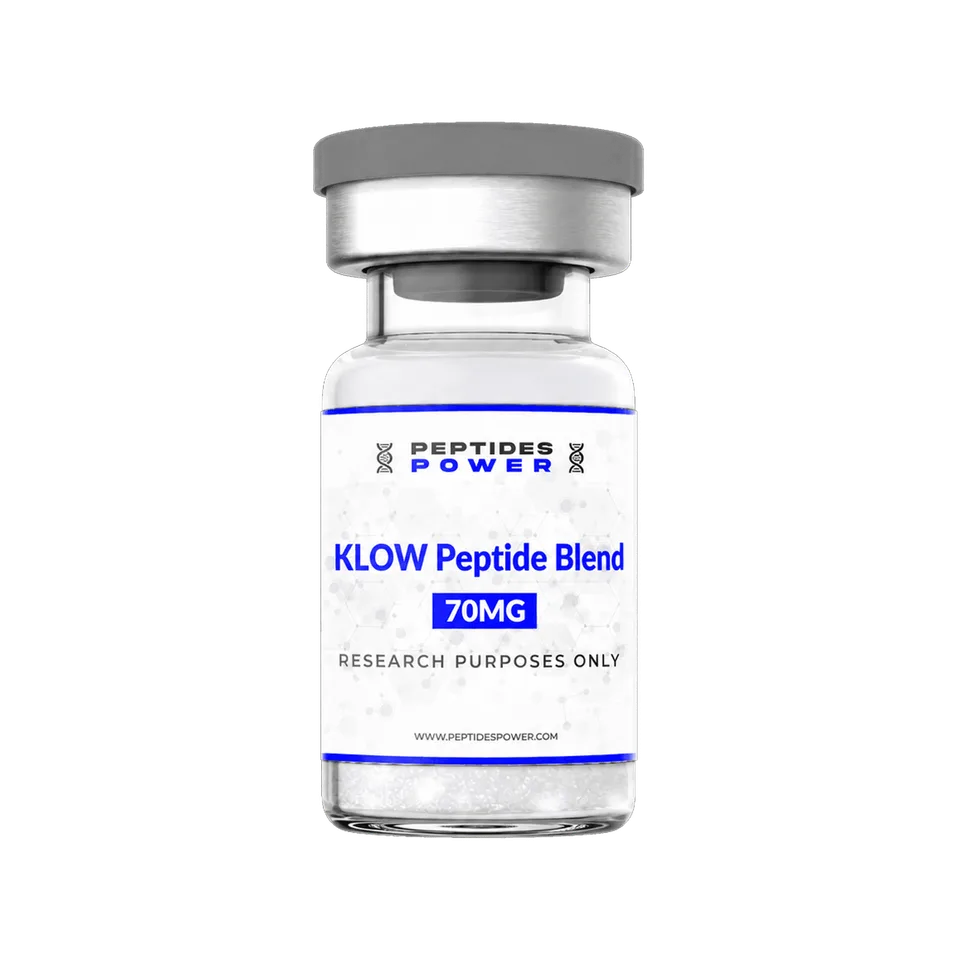
KLOW Peptide Blend
$95
In stock
View product
Profile
KLOW is a research blend of four peptides, BPC-157, TB-500, KPV and GHK-Cu, freeze-dried together in one vial. The amount of each peptide is not disclosed. No published study has tested the mix in animals or people,1 and FDA says BPC-157, TB-500 and KPV are not components of any FDA-approved drug.234
This page summarizes published sources for information only. It is not medical advice and does not tell anyone to use a product. Questions about your own health belong with a licensed clinician. For questions about an order or a product, contact us.
| Class | Peptide blend: four research peptides freeze-dried together in one vial, not a single compound |
|---|---|
| Also known as | KLOW, KLOW blend, Klow peptide, BPC-157 + TB-500 + KPV + GHK-Cu blend |
| Forms we sell | One 70 mg freeze-dried research vial; the split between the four peptides is not stated |
| Studies of the blend | None found in PubMed or ClinicalTrials.gov as of October 24, 2026156 |
| Regulatory status | Not FDA approved; in 2026 FDA staff proposed keeping BPC-157, TB-500 and KPV off the list of substances pharmacies may compound234 |
| WADA status | BPC-157 prohibited under S0 and TB-500 under S2; from 2027 the list names peptides in general under S078 |
KLOW is sold as one premixed powder, not four separate vials, so the four peptides cannot be measured out separately, and the amount of each is not disclosed. What each peptide is, from FDA, PubChem and the research literature:
| Peptide | What it is | Sequence | PubChem record |
|---|---|---|---|
| BPC-157 | A 15-amino-acid partial sequence of body protection compound, a protein isolated from human gastric juice23 | GEPPPGKPADDAGLV24 | CID 9941957: C62H98N16O22, 1419.5 g/mol25 |
| TB-500 | Amino acids 17 to 23 of thymosin beta-4, with an acetyl group added3 | Ac-LKKTETQ3 | CID 62707662: C38H68N10O14, 889.0 g/mol21 |
| KPV | Positions 11 to 13 of the hormone alpha-MSH13 | Lys-Pro-Val24 | CID 125672: C16H30N4O4, 342.43 g/mol25 |
| GHK-Cu | The tripeptide GHK bound to copper; GHK occurs in human plasma, saliva and urine26 | Gly-His-Lys plus copper | CID 71587328 (prezatide copper, 1:1): C14H23CuN6O4+, 402.92 g/mol21 |
BPC-157. Its research is mostly in animals: a 2025 systematic review found that 35 of 36 eligible studies were preclinical.9 FDA says its molecular targets have not been identified and its mechanisms of action remain poorly understood.2 FDA has also found several salts and derivatives sold under the same name.2
TB-500. Its sequence contains LKKTET, the actin-binding region of thymosin beta-4.3 Evidence for TB-500 itself is thin. A 2024 study noted that its biological effects had not been documented, found that it did not speed closure of scratch wounds in cultured fibroblasts, and suggested that earlier reported activity may come from its breakdown product, Ac-LKKTE.273
KPV. In cell studies, nanomolar concentrations blocked NF-kappaB and MAP kinase inflammatory signaling.11 KPV enters intestinal and immune cells through PepT1, a transporter for small peptides.11 FDA says its molecular targets are unknown.43
GHK-Cu. A 2018 review reports that GHK stimulates collagen, elastin and glycosaminoglycan synthesis and supports the work of dermal fibroblasts.28 It is thought to act as a complex with copper.26 Without copper, GHK weighs 340.38 g/mol.21 The listing does not say which copper form or ratio the vial holds.
The vial is listed as KLOW Peptide Blend for sale. Single-peptide profiles: What is BPC-157?, What is TB-500?, What is KPV? and What is GHK-Cu?. How blends differ from single peptides is covered in Peptide blends and stacks.
KLOW has no study of its own, so every reported effect comes from research on its parts.1 Most of that work is in animals: BPC-157 improved healing of muscle, tendon, ligament and bone injuries in preclinical models, and KPV reduced colitis in mice.913 In a 2026 rat study that combined BPC-157 and TB-500, the pair gave no added benefit after tendon repair.12 Full list with evidence levels: KLOW Peptide Blend benefits and uses.
No study has measured side effects of KLOW.1 FDA's adverse event database includes reports in people using BPC-157 of an injection-site reaction, of shortness of breath, and of skin and gum darkening in a woman who injected it with TB-500; her reaction returned when she used the product again.2 FDA says it is unclear whether BPC-157 caused these events.2 FDA says the potential human safety risks of TB-500 and KPV are unknown.34 Full list: KLOW Peptide Blend side effects.
No human dose has been established for KLOW or for any of its four peptides given by injection: a 2026 review states that dosing, frequency and duration of treatment for injectable peptides like these remain unknown,14 and USADA notes that it is unknown whether any dose of BPC-157 is safe.29 Published doses come from studies of single parts, in animals and in a few small BPC-157 studies in people, and they are not guidance for people.302 Full details: KLOW Peptide Blend dosage.
KLOW arrives as one freeze-dried powder, so a diluent added to the vial reaches all four peptides at once. The supplies listed for this vial include bacteriostatic water. A DailyMed label for Bacteriostatic Water for Injection, USP states that it contains 0.9% benzyl alcohol as a preservative, is meant only for diluting or dissolving drugs for injection, is stored at 20 to 25°C, and is not for use in newborns.31
Concentration is the powder mass divided by the diluent volume. For the 70 mg vial, 2 mL of diluent gives 35 mg of total peptide per mL and 3.5 mL gives 20 mg/mL, assuming all of the powder dissolves. Because the split between the four peptides is not disclosed, the concentration of BPC-157, TB-500, KPV or GHK-Cu in that solution cannot be worked out. These are concentrations of a lab solution, not doses. The reconstitution calculator does the same arithmetic for other volumes, and How to reconstitute a peptide vial covers the lab steps.
No published study has tested how the four peptides behave together in one solution.1 Data on the single peptides give some bounds:
General storage guidance is in How to store peptides, and diluents and syringes are described in Peptide supplies explained.
United States. FDA says BPC-157, TB-500 and KPV are not components of any FDA-approved drug.234 All three, plus GHK-Cu for injection, were in category 2 of FDA's compounding policy, the group of nominated substances that may present significant safety risks.34353637 FDA now lists them as previously in category 2, after the nominators withdrew their nominations.34 Since a May 14, 2026 update, GHK-Cu for routes other than injection is back in category 1, the group under evaluation, and FDA plans to consult its advisory committee on it before the end of February 2027.3839
Ahead of a July 2026 advisory committee meeting, FDA staff proposed keeping BPC-157, KPV and TB-500 off the 503A bulks list, the list of bulk substances pharmacies may use to compound.234 They cited poor characterization, missing human safety data and the risk of immune reactions.2341718 Trade press reported that the Pharmacy Compounding Advisory Committee then voted 8 to 6, with one abstention, in favor of allowing all three to be compounded.19 FDA is not bound by that vote, and a change would require formal rulemaking.19 As of October 24, 2026, a Federal Register search found only FDA's April 16, 2026 meeting notice and no proposed rule.40
Research-use labels. In a March 31, 2026 warning letter to a peptide seller, FDA said evidence from the seller's website showed its products were intended as drugs for human use, despite "Research Use Only" labeling.41 That letter concerned retatrutide and tirzepatide, not KLOW's parts.41
Canada. Health Canada's April 9, 2026 advisory lists all four of KLOW's peptides (BPC-157, TB-500, KPV and GHK-Cu) among examples of unauthorized injectable peptide drugs it has seized.42 It says unauthorized drugs are illegal in Canada and that "research use only" labeling does not make them legal.42
Sport. BPC-157 and TB-500 are prohibited under WADA rules, as the questions below explain.78
What published sources report about KLOW Peptide Blend and its uses, with the evidence level of each finding. No promises.
Published dosing information for KLOW Peptide Blend from studies of its four parts, with sources, and why it is not advice for you.
Side effects of KLOW Peptide Blend as reported in studies and FDA reports on its four parts, with links to the full profile. No study has tested the blend.
$95
In stock
View productKLOW Peptide Blend for sale: strengths, stock and shipping are on the product page.
For research use only. Not for human or veterinary use. Read the research use policy.
No study has tested what KLOW does, in animals or in people.1 Its four parts have been studied one or two at a time, mostly in animals: BPC-157 and TB-500 on tendon healing in rats, and KPV on gut inflammation in mice.91011 In a 2026 rat study that combined BPC-157 and TB-500 after tendon repair, the pair did no better than either peptide alone.12 Each finding and its evidence level is on KLOW Peptide Blend benefits and uses.
Both are research blends sold as one freeze-dried vial. GLOW combines GHK-Cu, BPC-157 and TB-500 and states the amount of each. KLOW holds the same three plus KPV, a three-amino-acid fragment of the hormone alpha-MSH,13 and states only the total. No published study has tested the KLOW combination,1 and FDA found no clinical studies or human exposure data for KPV.4 The other blend is profiled at What is Glow Peptide Stack?.
There is no evidence on how fast KLOW acts, or on how it makes a person feel, because it has never been tested in people.1 FDA found no article in which TB-500 was given to humans and no clinical studies of KPV.34 A 2026 review of injectable peptides used in sports medicine states that their dosing, frequency and duration of treatment remain unknown.14 Any timeline offered for KLOW has no study behind it.
The published evidence cannot show that it is. No study has tested KLOW,1 FDA calls the potential human safety risks of TB-500 and KPV unknown,34 and the amount of each peptide in the vial is not disclosed. One 2026 review found rigorous human safety data scarce for unapproved peptides,15 and another found their claimed musculoskeletal benefits unsubstantiated by current human trials.16 Studies that need a known amount of one peptide can start from the single-peptide profiles linked on this page.
No. FDA says BPC-157, TB-500 and KPV are not components of any FDA-approved drug.234 Ahead of a July 2026 advisory committee meeting, FDA staff also proposed keeping all three off the 503A bulks list, which names the bulk substances pharmacies may use to compound, citing poor characterization and missing human safety data.2341718 Trade press reported that the committee voted 8 to 6 the other way, but FDA is not bound by that vote.19
Two of its parts are named on the anti-doping list. BPC-157 is prohibited under WADA's S0 class of non-approved substances, and TB-500 under S2.78 From January 1, 2027, the list names peptides in general under S0, a class prohibited at all times.820 KPV and GHK-Cu are not named in USADA's summary of the 2027 list, but USADA warns that a peptide missing from the list may still be prohibited.20
Not necessarily. FDA describes TB-500 as amino acids 17 to 23 of thymosin beta-4, a 43-amino-acid peptide, with an acetyl group added, and says the two are not the same substance.3 PubChem gives TB-500 a mass of 889.0 g/mol, against 4963 g/mol for thymosin beta-4.2122 The KLOW listing gives no sequence for its TB-500, so which molecule the vial holds is not confirmed.
Written by D2C Peptides Editorial Team.
Pending qualified review.
Updated .
D2C Peptides sells peptides for laboratory research. Please confirm both statements to continue.