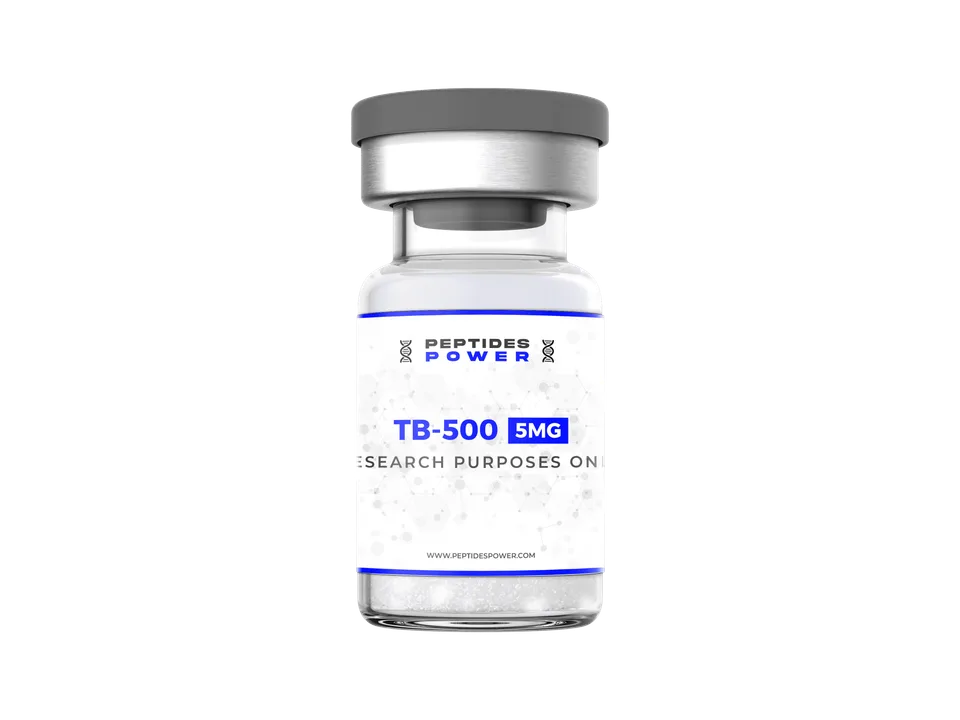
TB-500
$45
In stock
View product
Profile
TB-500 (also written TB500) is a lab-made peptide of seven amino acids, Ac-LKKTETQ.1 It copies positions 17 to 23 of thymosin beta-4, a natural 43-amino-acid protein.1 It is not part of any FDA-approved drug.1 FDA's May 2026 review found no published study in which it was given to people.1
This page summarizes published sources for information only. It is not medical advice and does not tell anyone to use a product. Questions about your own health belong with a licensed clinician. For questions about an order or a product, contact us.
| Class | Synthetic peptide: an N-acetylated heptapeptide (7 amino acids)1 |
|---|---|
| Also known as | TB500, TB 500, Ac-LKKTETQ, thymosin beta-4 fragment (LKKTETQ)23 |
| Not the same as | Thymosin beta-4 (43 amino acids) or thymosin alpha-1 (28 amino acids)14 |
| Forms we sell | 5 mg vial of powder for reconstitution, labeled for research use only |
| US regulatory status | Not FDA-approved; not on FDA's 503A Bulks List or its 503A category lists (updated May 14, 2026)15 |
| WADA status | Prohibited at all times under S2.3 (2026 Prohibited List)6 |
| Human studies | No controlled studies; one uncontrolled 3-patient case series (2026) of a multi-drug mix17 |
TB-500 is a synthetic heptapeptide, a chain of seven amino acids: Ac-Leu-Lys-Lys-Thr-Glu-Thr-Gln-OH, or Ac-LKKTETQ in one-letter code.1 The "Ac" marks an acetyl group on the first amino acid, leucine.1 PubChem lists the free base as C38H68N10O14, molar mass 889.0 g/mol, under compound ID 62707662.8 Its CAS registry number is 885340-08-9.2
"TB-500" is a common name, not an official United States Adopted Name.1 FDA treats the free base and its acetate salt as different active ingredients.1 It notes that several suppliers use the free-base CAS number for the acetate too.1 Products have also appeared under the TB-500 name as other salts, derivatives and even different active molecules.1 A measured mass separates the two TB-500 forms: 889.0 g/mol for the free base, 949.1 g/mol for the acetate.81
Thymosin beta-4, the parent protein, was sequenced in 1981 from calf thymus and has 43 amino acids.9 FDA says TB-500 appears to have first been made from it in 2003.1 A veterinary preparation followed in 2011, marketed to boost performance in horse and greyhound sports.1 Doping-control chemists in 2012 described TB-500 as a synthetic version of an active region of thymosin beta-4.10 That same year, another lab used high-resolution mass spectrometry to confirm that a TB-500 product contained Ac-LKKTETQ.11
The parent protein grips single actin molecules in a 1:1 complex and stops them from joining into filaments.12 FDA says this actin binding appears essential to building actin filaments and maintaining the cell skeleton, which regulates cell shape and movement.1 TB-500 contains LKKTET, the six-amino-acid stretch known as the actin-binding region of thymosin beta-4.1 That the LKKTETQ fragment buffers actin the same way is only a hypothesis.1 FDA says it remains to be determined whether actin binding contributes to the effects reported for this fragment.1
TB-500 is broken down by trimming amino acids one at a time from its tail (C-terminal) end.1 This pattern was seen in treated horses and rats and in lab tests with human serum and human liver and kidney preparations.1 One fragment, Ac-LKKTE, may carry the activity: in a 2024 fibroblast study it alone showed significant wound-healing activity, and TB-500 itself did not.13
Evidence for TB-500 itself comes from animals, cells and one small case series.17 In an exploratory 2026 study of 32 rats (8 per group) after Achilles tendon repair, TB-500 was associated with better tissue scores and stronger tendons at 4 weeks.14 FDA found no human data and concluded there is a lack of evidence to evaluate TB-500 for wound healing.1 Full list: TB-500 benefits and uses. The healing research overview places it beside related compounds.
Three similar names cover three different molecules.
| Peptide | Length | Molar mass | Origin |
|---|---|---|---|
| TB-500 | 7 amino acids1 | 889.0 g/mol8 | Lab-made copy of thymosin beta-4 positions 17 to 231 |
| Thymosin beta-4 (TB4) | 43 amino acids9 | About 4963 g/mol15 | Natural protein first isolated from calf thymus9 |
| Thymosin alpha-1 (thymalfasin) | 28 amino acids4 | 3108.3 g/mol16 | Derived from the precursor protein prothymosin alpha4 |
FDA says TB-500 and thymosin beta-4 are not the same substance, even though several websites use the names interchangeably.1 Small human trials have tested full-length thymosin beta-4, not TB-500: a single-dose IV study in 40 healthy volunteers, eye drops for dry eye, and a topical form for venous ulcers.171819 FDA lists thymosin alpha-1 separately from the TB-500 fragment, with its own safety summary.3 More on that peptide: thymosin alpha-1.
BPC-157 is a 15-amino-acid fragment of a protein first isolated from human gastric juice.20 TB-500 comes from a different parent protein, thymosin beta-4.1 FDA's 2026 briefing documents found five clinical studies that used BPC-157 and none in which TB-500 was given to people.201 FDA staff recommended against adding either to the 503A Bulks List, but the advisory committee voted to recommend both in July 2026.12021 The two also come blended, as in the Wolverine stack, but one rat tendon study found the pair did no better than either peptide alone.14 More: BPC-157.
Side effects of TB-500 in people are unknown, because FDA found no clinical studies or human exposure data by any route.1 FDA's adverse event database held no TB-500 reports through March 26, 2025.1 FDA warns that injected peptides like TB-500 may trigger immune reactions, from antibodies with no symptoms to life-threatening reactions.1 Full list: TB-500 side effects.
No human dose of TB-500 is established, and FDA found no human studies of how the body absorbs or responds to it.1 Published doses come from rats, horses and cell cultures, plus one uncontrolled 3-patient case series.1417 With no clinical studies or human exposure data, the safety of any of these doses in people is unknown.1 Full table: TB-500 dosage.
TB-500 is supplied as a powder and dissolved before lab use.1 Vendor data cited by FDA report that the free base dissolves in water at 50 mg per mL.1 Vendor storage data, also cited by FDA, give the free base powder 1 year at -20°C and a solution 1 month at -20°C.1 No USP or National Formulary standard covers TB-500.1 Lab steps and concentration math: How to reconstitute TB-500. The 5 mg research vial and its specifications are listed under TB-500 for sale.
TB-500 is not FDA-approved.1 There is no USP or National Formulary monograph for TB-500 or its acetate, and neither is part of any approved drug.1 No outsourcing facility has reported compounding drugs containing TB-500 to FDA.1
FDA's safety-risk page lists "Thymosin beta-4, fragment (LKKTETQ), also known as TB-500" among substances once in category 2.3 That category covers bulk substances that may present significant safety risks, and TB-500's nominators later withdrew it.3 FDA's summary there says compounded TB-500 may carry a risk of immune reactions for certain routes.3 It adds that FDA has found no human exposure data.3 As of FDA's May 14, 2026 update, TB-500 sits in none of the three 503A nomination categories.522
On April 16, 2026, FDA announced a Pharmacy Compounding Advisory Committee meeting in the Federal Register (docket FDA-2025-N-6895).23 The notice listed TB-500 free base and TB-500 acetate for discussion, and the committee took them up on July 23, 2026.2425 FDA's briefing document proposed not adding either form to the 503A Bulks List.1 The committee voted 8 to 6, with 1 abstention, in favor of adding both.21 The vote is a nonbinding recommendation: FDA says it will not make a final determination until it has considered the committee's input.1 A physician quoted by Healio said formal rulemaking runs into 2027.21 One dissenting member raised concern that TB-500 is being used in combination with other peptides.21
In a June 12, 2023 warning letter, FDA cited an online seller of injectable and nasal-spray "TB-500".26 Despite "research purpose only" labeling, FDA said evidence from the seller's website showed the products were intended for human use.26 It said they were not generally recognized as safe and effective, which made them new drugs.26
FDA's 2026 review found TB-500 in neither the European nor the Japanese pharmacopeia.1 It found no approved TB-500 products in Canada, Australia, the United Kingdom, Belgium, Ireland, France, Norway, Germany, Spain or Italy.1 It found none authorized for use in the European Union by the European Medicines Agency.1
WADA's 2026 Prohibited List took effect on January 1, 2026.6 It names thymosin beta-4 and its derivatives, such as TB-500, under S2.3: growth factors and growth factor modulators.6 Substances in that class are banned at all times, in and out of competition, and are non-Specified.6 USADA says TB-500 remains prohibited under S2 on the 2027 list, which takes effect January 1, 2027.27 That list also names peptides in general as prohibited under class S0.27 In September 2025, USADA announced a four-year period of ineligibility for a US triathlete who possessed and used BPC-157 and TB-500.28
Published dosing information for TB-500 from studies, with its source, and why it is not advice for you.
What published sources report about TB-500 and its uses, with the evidence level of each finding. No promises.
Side effects of TB-500 as reported in FDA reviews and published studies, with links to the full profile. Reviewed by a qualified reviewer.
How TB-500 is reconstituted, the supplies used, and the calculator, step by step. Sourced and reviewed.
$45
In stock
View productTB-500 for sale: strengths, stock and shipping are on the product page.
For research use only. Not for human or veterinary use. Read the research use policy.
TB-500 has no approved medical use.1 A veterinary preparation appeared in 2011, marketed to boost performance in horse and greyhound sports.1 Today it is marketed online for tissue repair, healing of tendons, muscles and ligaments, reducing inflammation and other uses.1 FDA found no human studies behind any of these uses and concluded there is a lack of evidence to evaluate it for wound healing.1
No. Thymosin beta-4 is a natural protein of 43 amino acids with a molar mass of about 4963 g/mol.115 TB-500 is a lab-made, acetylated piece of it: 7 amino acids and 889.0 g/mol.18 FDA notes that several websites use the names interchangeably, but says they are not the same substance.1 The small human trials of IV infusions, eye drops and a topical form tested thymosin beta-4, not TB-500.171819
No. Thymosin alpha-1 (thymalfasin) is a separate peptide of 28 amino acids, derived from a precursor protein called prothymosin alpha.4 PubChem lists its molar mass as 3108.3 g/mol, against 889.0 g/mol for TB-500.168 TB-500 comes from thymosin beta-4 instead.1 FDA lists the two as separate substances, each with its own safety summary.3 Read more: What is Thymosin Alpha-1?.
They are different molecules from different parent proteins. BPC-157 is a 15-amino-acid fragment of a protein first found in human gastric juice.20 TB-500 is a 7-amino-acid fragment of thymosin beta-4.1 FDA's 2026 reviews found five clinical studies that used BPC-157, and none in which TB-500 was given to people.201 In sport, WADA lists BPC-157 under class S0 and TB-500 under S2.3.6 Read more: What is BPC-157?.
Not in any controlled trial: FDA's May 2026 review found no article in which TB-500 was given to people.1 It also found no human data on how the body handles it.1 A 2026 case series described 3 patients with jaw nerve injury who received TB-500 mixed with other drugs.7 Its authors say the series was uncontrolled and should not be read as evidence that the treatment worked.7
TB-500 is not FDA-approved, and it is not on FDA's 503A Bulks List for pharmacy compounding.15 In a 2023 warning letter, FDA called an online seller's "TB-500" an unapproved new drug, despite its "research purpose only" labels.26 In July 2026 an FDA advisory committee voted 8 to 6, with 1 abstention, to recommend adding it to the compounding list.21 The vote is nonbinding: FDA makes its final determination after considering it.121
Yes. WADA's 2026 Prohibited List names thymosin beta-4 and its derivatives, such as TB-500, under S2.3, a class banned at all times, in and out of competition.6 USADA says TB-500 stays prohibited under S2 on the 2027 list.27 In 2025, USADA gave a four-year period of ineligibility to a US triathlete who possessed and used BPC-157 and TB-500.28
Written by D2C Peptides Editorial Team.
Pending qualified review.
Updated .
D2C Peptides sells peptides for laboratory research. Please confirm both statements to continue.