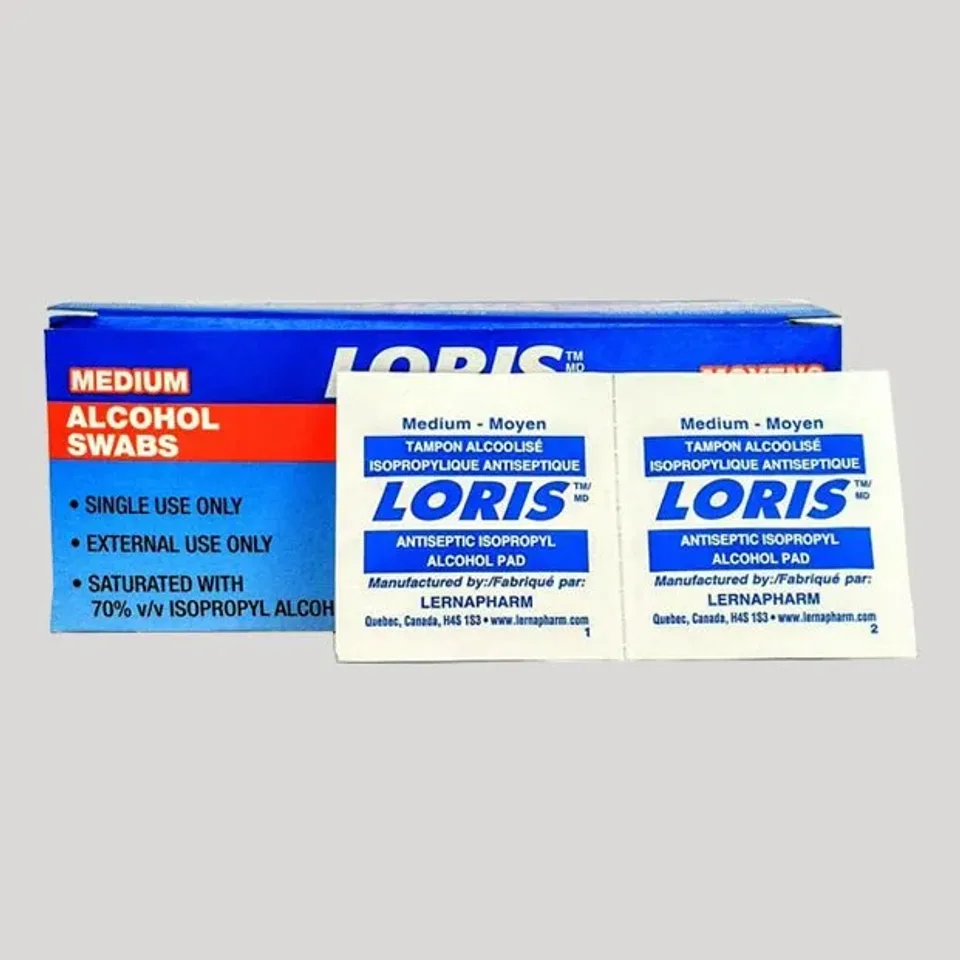
Alcohol Swabs (Pack of 2)
$0.50
In stock
View product
Guide
Peptide safety rests on four checks: a batch certificate with numerical results, sterile handling, correct storage and knowing the side effects sources report. Laboratory tests of peptide products bought online have found wrong amounts, impurities and bacterial endotoxin,12 and FDA warns that injected products get past some of the body's natural defenses against toxins and microbes.3
This page summarizes published sources for information only. It is not medical advice and does not tell anyone to use a product. Questions about your own health belong with a licensed clinician. For questions about an order or a product, contact us.
A certificate of analysis (COA) covers a single batch, so the first check is that its lot number matches the vial. Under FDA's Q7 guidance for making active drug ingredients, a certificate should list every test with its acceptance limit and a numerical result, carry a date and the signature of the quality unit, and give the original manufacturer's name, address and telephone number.11 A sheet that only says "pass", or gives a purity figure with no limit, date, signature or manufacturer, falls short of that.
What to look for, test by test:
Lot matching is explained on the lab results page, and What are research peptides? describes the test methods in more depth.
Independent lab tests explain why the paperwork matters. In a 2024 study, researchers ordered semaglutide from illegal online pharmacies, and all 3 vials that arrived were judged probable substandard and falsified products: endotoxin in every one (2.1645 to 8.9511 EU/mg), 28.56% to 38.69% more drug than labeled, and purity of 7.7% to 14.37% where the labels promised 99%.1 A 2018 Belgian analysis of the 10 falsified peptide drugs seen most often, sourced from three suspected illegal internet pharmacies, found that the amount of drug per unit varied widely, that cysteine-containing peptides were only 5% to 75% pure, and that one sample held lead while several held arsenic at levels reaching ten times the ICH limit for injectable drugs.2
Health Canada's April 2026 warning says unauthorized peptide products may hold too much or too little of the active ingredient, or none at all, unlisted or unknown ingredients, and contaminants such as solvents, heavy metals, particles of fiber, glass or plastic, bacteria, fungi or endotoxins.15
FDA's concern with injectable products is that they enter the body directly, sometimes straight into the bloodstream, skipping some of its main protections against toxins and microbes.3
Opened vials do get contaminated. In a 2013 study at a pulmonary teaching hospital in Iran, 11 of 205 opened single- and multiple-dose vials (5.36%) grew microbes, mostly gram-positive bacteria led by Staphylococcus epidermidis.8 In a hospital study in Ethiopia, sampled in 2021 and published in 2023, 21 of 384 opened injectable medicines (5.5%) grew bacteria. All of the contaminated samples were from multiple-dose vials, and contamination was strongly associated with reuse of a syringe or needle.9
A preservative is not a guarantee. CDC says the preservative in a multiple-dose vial does nothing against viruses and cannot fully stop bacterial contamination.13 CDC's injection safety guidance sets out these practices:1213
Before use, the bacteriostatic water label says to check that the solution is clear and the seal intact, and to inspect a mixed drug for clarity, particles and discoloration.7 The reconstitution guide puts these steps in order, and alcohol swabs are on the supplies page.
A certificate describes a batch when it was tested. Bachem notes that powder which takes up moisture from the air ends up with less peptide in each milligram, and that dissolved peptides may slowly break down even in sterile solution.16 The storage guide gives the temperatures and time limits that peptide makers and approved labels set.
Measuring errors are a safety problem in their own right. FDA has reported people taking 5 to 20 times the intended dose from multiple-dose vials of compounded semaglutide, and said confusion among milliliters, milligrams and syringe units may have contributed.5 Dosing basics explains the units, and the reconstitution calculator and peptide calculator show the arithmetic.
FDA's reviews of substances nominated for pharmacy compounding include these notes on peptides that are also sold for research:17
Side effects for each compound are covered in its profile, listed in Peptides A to Z.
Athletes face a separate risk. Under WADA's 2026 Prohibited List, BPC-157 is banned in and out of competition as a non-approved substance (class S0), and the S2 class names CJC-1295, sermorelin, tesamorelin, AOD-9604 and TB-500 among its examples.19
$0.50
In stock
View productNo products match these filters.
For research use only. Not for human or veterinary use. Read the research use policy.
Enter the vial amount, the water added and the amount to measure, and get the concentration and U-100 syringe units. Shows the formula. For reference only.
Enter the peptide amount and the diluent volume and get the concentration per mL and per syringe unit. Shows the formula. For reference only.
Convert between mg and mcg, and between mL and U-100 syringe units. Shows the formula. For reference only.
For approved GLP-1 medicines, the labels list them, and the GLP-1 side effects page collects them. Compounded and research-labeled versions are not FDA approved, so FDA does not review them for safety, effectiveness or quality before sale.4 By May 31, 2026, FDA had received 990 adverse event reports tied to compounded semaglutide and more than 730 tied to compounded tirzepatide.4 Adverse events reported after overdoses from measuring mistakes with compounded semaglutide included nausea, vomiting, abdominal pain, fainting, dehydration, acute pancreatitis and gallstones.5 FDA calls research-labeled GLP-1 products sold to consumers of unknown quality and possibly harmful.4
Some contamination shows up only in lab tests. Endotoxin is measured with tests such as the LAL test, which FDA has accepted in place of the rabbit pyrogen test for more than 30 years,6 and a 2024 study found it in all 3 semaglutide vials it bought online.1 Visible checks still count: the bacteriostatic water label says not to use it unless the solution is clear and the seal intact, and to inspect a mixed drug for clarity, particles and discoloration.7 Opened vials can also become contaminated: about 5% grew microbes in two hospital studies.89
No. Purity and content are different numbers. Bachem notes that a peptide can test above 95% pure by HPLC while the powder may be only 70 to 90% peptide, the balance being counter-ions and water.10 Labels can also be wrong: in a 2024 study, vials claiming 99% purity measured 7.7% to 14.37%.1 FDA's Q7 guidance expects a batch certificate to report each test as a numerical result against its acceptance limit.11
No. CDC's injection safety checklist says every entry into a vial needs an unused needle and an unused syringe, even for the same patient, after the rubber septum has been wiped with alcohol.12 In an Ethiopian hospital study, all the contaminated samples came from multiple-dose vials, and contamination was strongly associated with reuse of a syringe or needle.9 CDC also notes that a vial's preservative has no effect on viruses.13
Written by D2C Peptides Editorial Team.
Pending qualified review.
Updated .
D2C Peptides sells peptides for laboratory research. Please confirm both statements to continue.