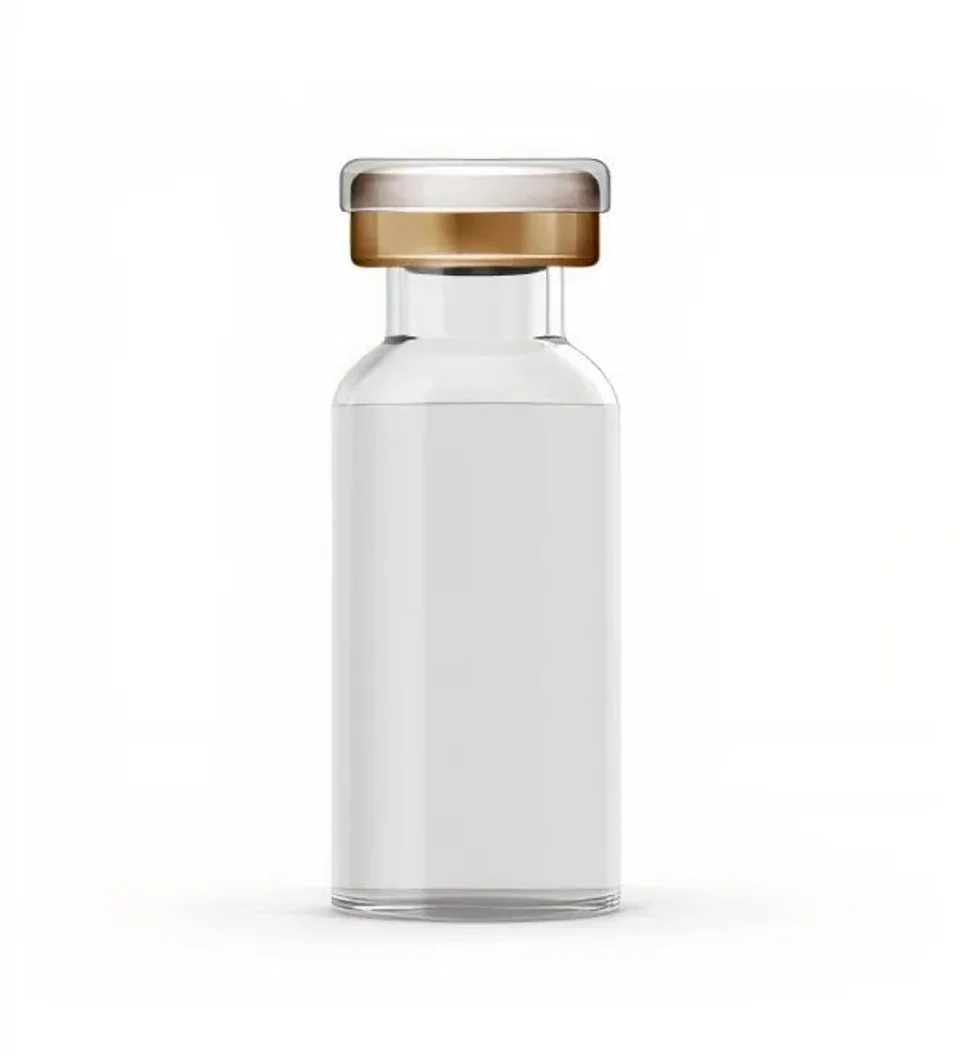
Bacteriostatic Water
$10
In stock
View product
Guide
Freeze-dried peptides keep best cold, dry, dark and tightly closed: peptide makers advise a freezer for long-term storage, and Bachem accepts a refrigerator at 4 °C for short-term use.12 Peptides in solution have a much shorter shelf life, so makers advise against storing them that way,12 and approved products set their own limits once mixed, from immediate use to 60 days.34
This page summarizes published sources for information only. It is not medical advice and does not tell anyone to use a product. Questions about your own health belong with a licensed clinician. For questions about an order or a product, contact us.
| What | Where it is kept | How long |
|---|---|---|
| Freeze-dried peptide, long term | Freezer: below -15 °C (Bachem) or at -20 °C (GenScript), tightly closed, away from bright light12 | Most are stable for several years at -20 °C, depending on the sequence2 |
| Freeze-dried peptide, short term | Refrigerator at 4 °C1 | Short-term use only1 |
| Freeze-dried peptide, in transit | Room temperature, as Bachem typically ships1 | Until arrival; then the storage condition on the label1 |
| Peptide in solution | Not recommended; if unavoidable, single-use aliquots frozen at -20 °C or below -15 °C12 | A few weeks frozen, per Bachem1 |
| Bacteriostatic water, unopened | 20 to 25 °C8 | Until the printed expiration date9 |
| Bacteriostatic water, opened | 20 to 25 °C8 | Discard 28 days after first entry unless the maker states another date9 |
The rest of this guide explains each row, where approved medicines follow different rules, and why FDA is stricter about GLP-1 drugs that arrive warm.
Peptide makers agree on cold for the long term. Bachem's guidance is to keep the powder sealed tight below -15 °C, and colder still, -50 °C or lower, for long-term storage.1 GenScript's figure is -20 °C, out of bright light, where it expects most freeze-dried peptides to last several years, depending on the sequence.2 For short-term use, Bachem considers a refrigerator at 4 °C acceptable.1
Sequence matters. Bachem lists peptides that contain asparagine (Asn), glutamine (Gln), methionine (Met), cysteine (Cys) or tryptophan (Trp) as having limited shelf lives.110
Approved freeze-dried medicines show that no single rule fits every product. The labels split two ways: tesamorelin (EGRIFTA SV and WR) and a Fresenius Kabi hCG product are stored at room temperature, 20 to 25 °C, while ZOMACTON somatropin is refrigerated at 2 to 8 °C.3654 Each of those is a limit set for one product, so for any other vial, the storage condition printed on its label is the guide.
Peptides tend to be hygroscopic, meaning they take up water from the air. Bachem's advice is to open a cold container only after it has warmed to room temperature inside a desiccator, because moisture the powder absorbs dilutes its peptide content and may make it less stable.110 GenScript singles out peptides containing aspartic acid (Asp), glutamic acid (Glu), lysine (Lys), arginine (Arg) or histidine (His) as prone to absorbing moisture, and keeps them in a tightly capped vial inside a desiccator.2
Both makers advise removing only what is needed, quickly, and closing the container tight again,1102 and GenScript returns the rest to a freezer, preferably below -20 °C, under dry conditions.2
Peptides containing Cys, Met or Trp oxidize easily. GenScript advises limiting their exposure to air and keeping vials tightly capped,2 and Bachem mentions oxygen-free water or reducing agents as options when dissolving them.110 Light is the other factor: the EGRIFTA SV, EGRIFTA WR and ZOMACTON labels all keep their vials in the original carton, shielded from light.365
Dissolving a peptide starts a clock. Bachem's position is that peptides should not be stored dissolved, even in sterile, oxygen-free solution, because they may slowly degrade chemically.1 GenScript calls the shelf life of peptides in solution very limited, worst of all for sequences with Cys, Met, Trp, Asp, Gln or an N-terminal Glu, and adds that bacteria can also degrade a peptide in solution.2 The diluent labels agree: a solution is mixed well, used promptly and kept only where the dissolved drug's maker says so.811
Approved products that are mixed before use show how far apart those directions can be:
| Product (label) | Diluent | After mixing | Limit |
|---|---|---|---|
| EGRIFTA SV (tesamorelin) | Sterile water | Not refrigerated or frozen3 | Use right away3 |
| EGRIFTA WR (tesamorelin) | Bacteriostatic water | Room temperature, 20 to 25 °C6 | 7 days6 |
| ZOMACTON 5 mg (somatropin) | Bacteriostatic sodium chloride | Refrigerator5 | 14 days5 |
| ZOMACTON 10 mg (somatropin) | Bacteriostatic water with metacresol | Refrigerator5 | 28 days5 |
| Omnitrope 5.8 mg (somatropin) | Bacteriostatic water, 1.5% benzyl alcohol | Refrigerator, 2 to 8 °C12 | 21 days12 |
| hCG (Fresenius Kabi) | Bacteriostatic water | Refrigerator, 2 to 8 °C4 | Discard after 60 days4 |
The tesamorelin labels say their two formulations differ in reconstitution instructions and storage requirements and are not substitutable,6 so one product's rules do not carry over to another. The sources behind this guide hold no tested limit for any research peptide after mixing, which is why the safest reading of the makers' advice is to dissolve only what the work needs and record the mixing date on the vial.
If a solution must be kept, GenScript recommends a buffer at pH 5 to 6, single-use aliquots held at -20 °C, and no freeze-thaw cycles, with a 0.2 micron filter as a way to strip out possible bacterial contamination.2 Bachem likewise keeps aliquots frozen below -15 °C and does not recommend long-term storage of solutions, especially for peptides containing Asn, Gln, Cys, Met or Trp.110 Aliquots cut both the number of freeze-thaw cycles and the number of times the stock meets air, and GenScript also advises against opening the stock vial repeatedly.2
Approved products take the opposite line for their own mixed solutions: EGRIFTA SV, EGRIFTA WR, ZOMACTON and the Fresenius Kabi hCG vial all say not to freeze after mixing.3654 Where a product has a label, its instruction comes first.
Splitting a solution requires its concentration on record. The reconstitution calculator works the concentration out from the amount and the volume, and the peptide calculator converts a set amount into a volume, so each aliquot can be labeled with what it holds. The reconstitution guide covers the mixing itself.
The bacteriostatic water label stores the vial at 20 to 25 °C and gives no instruction to refrigerate it after opening.8 Once a multiple-dose vial has been opened, meaning its stopper has been pierced, CDC says to write the date on it and throw it out within 28 days, unless its manufacturer gives a different date, and never to use it after the original expiration date.9 The EGRIFTA WR instructions apply the same 28-day limit to their bacteriostatic water.6
Single-dose vials, such as sterile water for injection, are not kept at all: CDC rules out pooling or saving whatever is left in a single-dose vial.9 Bacteriostatic water and the other handling supplies are listed on the supplies page.
Bachem typically sends its freeze-dried peptides out at ambient temperature, with the recommended long-term storage condition noted on the label.1 One approved freeze-dried peptide gives a sense of scale: the EGRIFTA SV label sets 20 to 25 °C and tolerates excursions between 15 and 30 °C, a limit tested for that product alone.3
FDA is stricter about GLP-1 drugs. It says the package inserts of injectable GLP-1 drugs call for refrigeration, reports complaints of compounded GLP-1 drugs arriving warm, and advises patients against using an injectable GLP-1 drug that has arrived warm or without enough refrigeration, since that can affect its quality.7
Shipping details for orders are on the shipping page. On arrival, move each vial to the storage condition printed on its label, and keep it in its box away from light until it is needed.
$10
In stock
View productNo products match these filters.
For research use only. Not for human or veterinary use. Read the research use policy.
Enter the vial amount, the water added and the amount to measure, and get the concentration and U-100 syringe units. Shows the formula. For reference only.
Enter the peptide amount and the diluent volume and get the concentration per mL and per syringe unit. Shows the formula. For reference only.
Convert between mg and mcg, and between mL and U-100 syringe units. Shows the formula. For reference only.
For freeze-dried powder, peptide makers favor the freezer for long-term storage: below -15 °C according to Bachem, or -20 °C away from bright light according to GenScript.12 Bachem accepts a 4 °C refrigerator for short-term use.1 Approved freeze-dried medicines differ by label, from room temperature for tesamorelin to 2 to 8 °C for ZOMACTON somatropin,35 so a vial's own label comes first. Dissolved peptides follow separate, stricter rules.
It depends on the product. Peptide makers describe the shelf life of dissolved peptides as very limited and advise against storing them that way, though Bachem gives frozen solutions a few weeks.12 Approved products set their own limits: immediate use for EGRIFTA SV, 7 days at room temperature for EGRIFTA WR, 14 or 28 days refrigerated for ZOMACTON and 60 days refrigerated for a Fresenius Kabi hCG vial.3654 No tested limit for research peptides appears in the sources behind this guide.
Not necessarily for freeze-dried powder. Bachem typically ships its freeze-dried peptides at ambient temperature, with the long-term storage condition noted on the label,1 and GenScript says peptides keep far longer as dry powder than in solution.2 The sources behind this guide give no transit limits for individual research peptides, so the practical step is to move each vial to its labeled storage condition on arrival. FDA is stricter about GLP-1 drugs: it advises patients against using an injectable GLP-1 drug that has arrived warm or without enough refrigeration.7
Guidance splits. Peptide makers say that if a solution must be stored, it should be split into single-use aliquots and frozen, at -20 °C or below -15 °C, with repeated freeze-thaw cycles avoided.12 Yet every approved label reviewed here (EGRIFTA SV and WR, ZOMACTON, and the Fresenius Kabi hCG product) forbids freezing the mixed solution.3654 Where a product carries a label, its instruction applies.
Written by D2C Peptides Editorial Team.
Pending qualified review.
Updated .
D2C Peptides sells peptides for laboratory research. Please confirm both statements to continue.