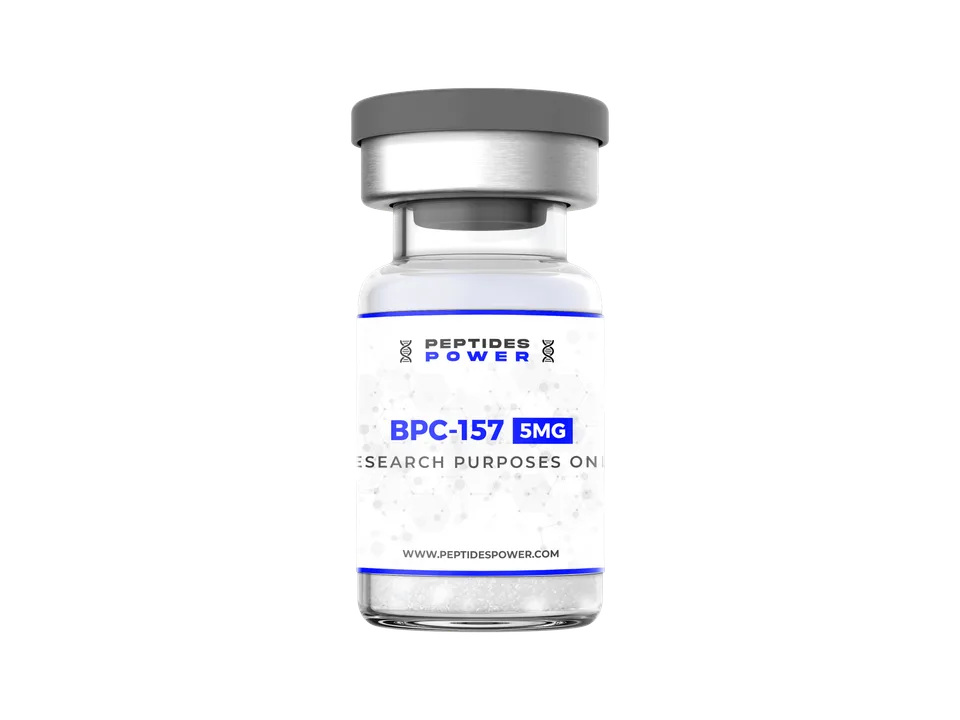
BPC-157
$30
In stock
View product
Profile
BPC-157 is a synthetic peptide of 15 amino acids, described as a partial sequence of a protein isolated from human gastric juice.13 First reported in 1993, it has been studied mostly in rats.23 Human studies are few, small and short, and no BPC-157 medicine is approved in any country.32
This page summarizes published sources for information only. It is not medical advice and does not tell anyone to use a product. Questions about your own health belong with a licensed clinician. For questions about an order or a product, contact us.
| Class | Synthetic peptide of 15 amino acids (a pentadecapeptide)1 |
|---|---|
| Also known as | BPC 157, BPC157, Bepecin, PL-14736, PL-104 |
| Forms we sell | 5 mg vial of freeze-dried powder, for research use only |
| US regulatory status | Not FDA-approved and not part of any approved drug; a July 2026 advisory vote on pharmacy compounding awaits FDA action217 |
| Approved anywhere | No BPC-157 medicine is approved in any country2 |
| WADA status | Prohibited at all times under class S0 (non-approved substances), listed since January 1, 202278 |
| Human studies | Few and small: a 2026 review found three uncontrolled studies (30 people, very low certainty), and FDA lists older enema trials known only from meeting abstracts32 |
BPC-157 is a chain of 15 amino acids: Gly-Glu-Pro-Pro-Pro-Gly-Lys-Pro-Ala-Asp-Asp-Ala-Gly-Leu-Val, or GEPPPGKPADDAGLV in one-letter code.4 PubChem lists the free base as C62H98N16O22, molar mass 1419.5 g/mol, compound ID 9941957.5 Its CAS registry number is 137525-51-0.6 Researchers describe it as a partial sequence of body protection compound, a protein isolated from human gastric juice.1 The literature first reported it in 1993.2
FDA treats BPC-157 free base and its acetate salt as distinct active ingredients, though both contain the same peptide.2 It has also seen several salts and derivatives sold under the one name.2 Researchers will find BPC-157 for sale here as a 5 mg vial of freeze-dried powder.
In endothelial (vessel-lining) cells and in rats with reduced blood flow to a hind leg, BPC-157 raised VEGFR2, a receptor for vessel growth (2017).13 It also switched on the VEGFR2-Akt-eNOS signaling pathway, and treated rats regained blood flow faster.13 In rat tendon cells, it increased outgrowth, survival under stress and migration, likely through the FAK-paxillin pathway (2011).1 FDA cautions that the molecule's targets have not been identified, which makes the reported effects hard to judge.2
BPC-157 resisted breakdown by gastric juice in the lab, but it clears the blood fast.2 In rats and dogs, unchanged BPC-157 had a half-life under 30 minutes.19 It was broken into small fragments and then single amino acids (2022).19
Most of the evidence comes from animal studies, chiefly in rats.326 After the Achilles tendon was cut, rats given BPC-157 had stronger tendons, better walking scores and better tissue repair than rats given saline (2003).18 A tendon cut from the heel bone did not heal back on its own in rats but did with BPC-157 (2006).23 Other rat studies reported better healing of a fully cut quadriceps over 72 days and of a cut knee ligament over 90 days.2425
FDA's review adds gut findings in rats: colon fistulas about 40% smaller from day 3, and NSAID-induced stomach and intestinal lesions more than 75% smaller.2 A 2025 systematic review of orthopaedic research counted 35 preclinical studies among the 36 it included.26
Human data are few and weak: a 2026 systematic review found three studies with 30 people in total, all before-and-after designs with no control group.3 It rated the certainty of evidence very low and said BPC-157 should not be used clinically outside regulated, high-quality trials.3
| Study | Who | What was reported |
|---|---|---|
| Knee pain, 2021 (chart review) | 16 of 17 patients reached at follow-up | 11 of 12 given BPC-157 alone reported significant improvement; no standard measurement tools27 |
| Interstitial cystitis, 2024 (pilot) | 12 women | 10 of 12 reported complete symptom resolution after one procedure; no adverse events28 |
| IV safety, 2025 (pilot) | 2 healthy adults | No change in heart, liver, kidney, thyroid or blood sugar markers20 |
| Ulcerative colitis, 2005 (meeting abstract) | 53 people, randomized | Scores fell 3.2 points with BPC-157 and 1.6 with placebo; no clear difference between groups2 |
FDA concluded there is a lack of evidence that BPC-157 works for ulcerative colitis, a disease with several FDA-approved treatments.2 A University of Arkansas pilot after rotator cuff surgery (target 30 people) was not yet recruiting in October 2026.29 Its record states that BPC-157 has not yet been studied in formal human clinical trials.29
BPC-157 is also sold blended with TB-500 as the Wolverine stack. For other compounds studied in tissue repair, see the healing research overview.
Side effects in people are not well described: FDA notes the human studies were short and small and gave limited safety information.2
General precautions are in peptide safety basics.
No human dose of BPC-157 is established.212 FDA found no published human studies of BPC-157 given under the skin, by mouth, by nasal spray or through the skin.2 USADA notes that it is unknown whether any dose is safe.12 The table lists doses used in published studies; they describe research conditions, not guidance for people.212
| Study | Species | Route | Dose | Length |
|---|---|---|---|---|
| Achilles tendon (2003), quadriceps (2006) | Rats | Intraperitoneal | 10 µg, 10 ng or 10 pg per kg, once daily | Up to 14 and 72 days1824 |
| Knee ligament (2010) | Rats | Intraperitoneal, cream or drinking water | 10 µg or 10 ng per kg; 1.0 µg per g of cream; 0.16 µg per mL of water | 90 days25 |
| Toxicology (2020, FDA summary) | Rats and dogs | Intramuscular | 0.2 to 4.0 mg/kg (rats), 0.1 to 2.0 mg/kg (dogs), daily | 28 days2 |
| Healthy volunteers (abstracts) | 24 people | Rectal enema | Up to 2 mg/kg, once daily | 8 days2 |
| Ulcerative colitis (2005 abstract) | 53 randomized, about 26 given BPC-157 | Rectal enema | 80 mg, once daily | 2 weeks2 |
| Knee pain (2021) | 17 people | Injection into the knee | 2 to 4 mg per injection | 1 or 2 doses2 |
| Interstitial cystitis (2024) | 12 women | Bladder-wall injection | 10 mg in total | One procedure28 |
| IV safety (2025) | 2 adults | Intravenous infusion | 10 mg on day 1, 20 mg on day 2 | 2 days20 |
Background on how study doses are reported is in peptide dosage basics.
No approved BPC-157 product exists, so no official label sets mixing or storage rules.2 FDA describes the free base as a white to off-white freeze-dried powder that dissolves in water at 5 mg/mL, citing supplier data.2 Supplier data cited by FDA report the powder keeps about 3 weeks at room temperature, with long-term storage dry and below -18 °C.2 After mixing, other supplier figures cited by FDA give 2 to 3 weeks at 4 °C and 3 to 4 months at -20 °C.2 FDA adds that pH, heat, concentration and impurities can make such peptides clump or degrade.2
The lab steps are in how to reconstitute a peptide vial. The reconstitution calculator does the concentration math, and how to store peptides covers freezer and refrigerator practice.
BPC-157 is not FDA-approved, is not part of any approved drug and has no USP or National Formulary monograph.2 FDA notes it is marketed in US dietary supplement capsules and tablets.2 The Defense Department's Operation Supplement Safety program says it is not a dietary ingredient and puts it on the DoD Prohibited Dietary Supplement Ingredients List.35
Its compounding status has shifted: FDA moved BPC-157 into category 2, substances with significant safety risks, in September 2023.14 By April 2026, FDA listed it among category 2 substances whose nominators had withdrawn them.9 FDA's safety note stayed posted: possible immune reactions, impurity problems and too little data to know whether it would harm people.9
For its July 23, 2026 advisory committee meeting, FDA evaluated BPC-157 for ulcerative colitis and proposed leaving it off the 503A Bulks List.102 Committee members disagreed, voting 8 to 6 with 1 abstention to add both the free base and the acetate.17 The vote is advisory, and FDA says it will decide only after considering it.2 FDA's meeting page showed no final decision as of October 24, 2026.10
A "research use only" label does not change the law.34 In a warning letter dated June 12, 2023, FDA treated a website's BPC-157 injectables and nasal sprays as unapproved new drugs.34 The site, FDA said, showed they were meant for people even though they carried "research purpose only" labels.34
FDA found no approved BPC-157 product in any country, and BPC-157 is not in the European, Japanese or International Pharmacopeias.2 Health Canada lists it among unauthorized injectable peptide drugs it has seized.32 It says such products are illegal in Canada and that "For Research Use Only" labelling does not make them legal.32 Australia made BPC-157 a prescription-only (Schedule 4) medicine from June 1, 2024, so possessing it without authority is illegal.33 New Zealand's Medicines Classification Committee recommended prescription-medicine status in May 2023, noting very little human data.8
WADA's 2026 Prohibited List names BPC-157 in class S0, non-approved substances, prohibited both in and out of competition.7 WADA first listed it on January 1, 2022.8 USADA's advisory on the 2027 list, in force from January 1, 2027, keeps it prohibited under S0.37 In 2017, a US sports drug-testing laboratory identified BPC-157 in confiscated vials and validated a urine test that detects it at 0.1 ng/mL.36
$30
In stock
View productBPC-157 for sale: strengths, stock and shipping are on the product page.
For research use only. Not for human or veterinary use. Read the research use policy.
BPC-157 has 15 amino acids and is described as part of a gastric juice protein.1 TB-500 is LKKTETQ, a seven-amino-acid fragment of thymosin beta-4, and FDA has found no human exposure data for it.9 WADA bans both at all times, BPC-157 under class S0 and TB-500 under S2.7 In July 2026, FDA's compounding advisory committee reviewed BPC-157 for ulcerative colitis and TB-500 for wound healing.10 Read more: What is TB-500?.
In people, no effect has been established: USADA notes that no human clinical trial shows BPC-157 works for any diagnosis or treatment.12 In rats, it has been reported to improve healing of cut tendons, ligaments and muscle.182524 Cell and rat studies link it to blood-vessel growth signals and to tendon-cell migration.131 FDA says its molecular targets are still unidentified.2
Sermorelin is a growth hormone-releasing hormone (GHRH) analogue that FDA approved as GEREF, including for idiopathic growth hormone deficiency in children with growth failure.11 Its maker discontinued GEREF in 2008, and FDA later found it was not withdrawn for safety or effectiveness reasons.11 No BPC-157 product is approved in any country.2 WADA lists sermorelin under S2 and BPC-157 under S0.7 Read more: What is Sermorelin?.
No. FDA's 2026 review states that neither BPC-157 free base nor its acetate is a component of any FDA-approved drug, and that no BPC-157 product is approved in any country.2 Neither form has a USP or National Formulary monograph.2 FDA also warns that injected or nasal BPC-157 may carry a significant risk of immune reactions.2
In September 2023, FDA placed BPC-157 in category 2, its group of compounding substances with significant safety risks.14 That month it told a pharmacy that drugs compounded with BPC-157 acetate were not eligible for the federal compounding exemptions.15 The nominations were later withdrawn, but a pharmacy still needs a USP monograph, an approved-drug component or a 503A Bulks List entry, and BPC-157 has none.9162 An advisory committee voted in July 2026 to recommend listing it, and FDA had not decided as of October 24, 2026.1710
This is not known for people. The human studies in a 2026 systematic review were three small before-and-after studies without control groups, rated very low certainty, so they cannot show when, or whether, it acts.3 The knee-pain study relied on patient reports without standard measurement tools.27 In the 2003 rat tendon study, differences were measured between days 1 and 14.18 In rats and dogs, unchanged BPC-157 leaves the blood quickly, with a half-life under 30 minutes.19
This is not known for people, because FDA finds too little clinical safety information to characterize BPC-157.2 In a 2-person IV pilot, liver blood tests did not change.20 In rats given liver-damaging challenges (surgery, restraint stress or a toxic chemical), BPC-157 prevented liver cell death (necrosis) and the rise in liver enzymes.2 Yet FDA's reading of 28-day injection studies in rats and dogs noted liver-related signals, including higher ALT, glucose and triglyceride levels.2
Written by D2C Peptides Editorial Team.
Pending qualified review.
Updated .
D2C Peptides sells peptides for laboratory research. Please confirm both statements to continue.