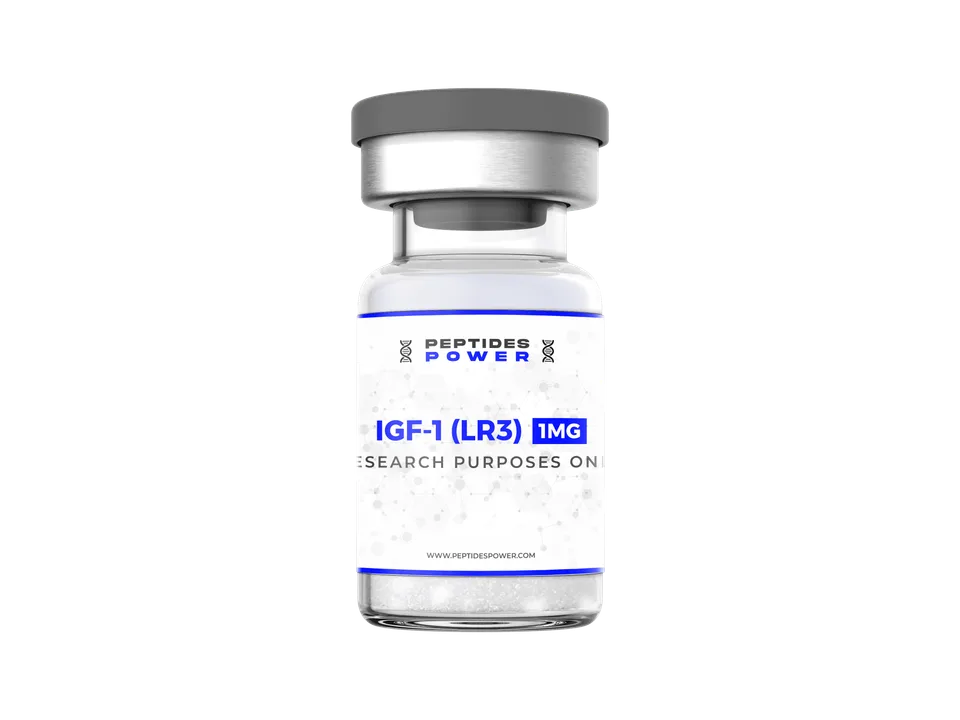
IGF-1
From $35
In stock
Choose strength
Profile
IGF-1 (insulin-like growth factor 1) is a 70-amino-acid hormone that manages the effects of growth hormone.12 IGF-1 LR3 is a lab-made 83-amino-acid analog studied in cells and rats; ClinicalTrials.gov lists no human trial of it.34215 Recombinant human IGF-1 (mecasermin, Increlex) is a prescription drug for growth failure in children with severe primary IGF-1 deficiency.67
This page summarizes published sources for information only. It is not medical advice and does not tell anyone to use a product. Questions about your own health belong with a licensed clinician. For questions about an order or a product, contact us.
| Class | Protein hormone; IGF-1 LR3 is a recombinant analog that FDA's substance registry classes as a protein184 |
|---|---|
| Also known as | Insulin-like growth factor 1, somatomedin C, mecasermin (the drug); the analog: IGF-1 LR3, Long R3 IGF-I, LR3IGF-I, Long [Arg3]-IGF-I931011 |
| Forms we sell | Freeze-dried research vials listed as IGF-1 (0.1 mg, 1 mg); the specification sequence is IGF-1 LR312 |
| Regulatory status | Recombinant human IGF-1 (mecasermin, Increlex) is an FDA-approved prescription drug; FDA stated in 2020 that IGF-1 LR3 is not a component of an FDA-approved drug613 |
| WADA status | Prohibited at all times under class S2.3 (IGF-1 and its analogues)1415 |
Growth hormone binds its receptor in the liver and other tissues and makes them produce and release IGF-1.35 IGF-1 then activates the type 1 IGF-1 receptor, a close relative of the insulin receptor, and that signal drives growth in height.38 It also helps growing tissues take up glucose, fatty acids and amino acids.39 It can lower blood sugar: it curbs glucose output from the liver, increases glucose use in other tissues and holds back insulin release.40
In blood, IGF-1 is carried by six IGF-binding proteins, and more than 80% of it sits in a complex with IGFBP-3 and a third protein, the acid-labile subunit.41 IGF-1 also feeds back on its own trigger: in 6 healthy men, a 48-hour infusion of recombinant IGF-1 cut growth hormone levels by 85%.42 Growth hormone itself is covered in What is HGH?.
IGF-1 LR3 is one of several IGF-1 fusion analogs that a 1992 paper produced in E. coli bacteria and called very useful reagents for studying how IGF-1 acts.4 It puts 13 amino acids in front of human IGF-1, the first 11 of methionyl pig growth hormone and then two more, and swaps arginine for glutamate at position 3, hence the name Long [Arg3]-IGF-I.43103 FDA's substance registry lists its full 83-amino-acid sequence.3
Its defining trait is weak binding to IGF-binding proteins: LR3 binds IGFBP-3, IGFBP-4 and rat plasma binding proteins about 1,000 times more weakly than IGF-1 does.44 It also binds the type 1 IGF receptor about 3 times less well, so its extra potency comes from weaker binding-protein interactions, not from a stronger grip on the receptor.4546 Two cell results fit this: LR3 was 5 to 10 times more potent than IGF-1 in rat L6 muscle cells, which make binding proteins, but less potent in chicken embryo cells that release no detectable binding proteins.3047
Weak binding also shortens its time in the blood. In rats, LR3 was cleared from plasma much faster than IGF-1, a difference the authors traced to its poor binding to plasma binding proteins.48 Vials listed as IGF-1 for sale on this site carry the 83-amino-acid LR3 sequence in their specification.12
In growing female rats dosed for 14 days by implanted pump, IGF-1 raised weight gain, nitrogen retention and food efficiency by 18 to 26% at its top dose, and LR3 matched those effects at about one-sixth of the dose.214933 Muscle protein synthesis and breakdown both rose only slightly, so those muscle measures could not explain the nitrogen gain.26
In male rats given the steroid dexamethasone to induce wasting, LR3 was about 2.5 times more potent than IGF-1 at partly reversing it.5031 The IGF peptides raised gut weight by up to 45%, and the extra carcass weight reflected nitrogen (protein) rather than fat.5122
In diabetic rats, LR3 restored growth with 2.5 to 3 times the potency of IGF-1, and the IGF peptides raised muscle protein synthesis by up to 50%.5253 Insulin-treated rats gained more weight, but the added weight was fat; unlike insulin, the IGF peptides did not reduce sugar loss in the urine.5455
Every human trial below used recombinant human IGF-1 (in one, bound to IGFBP-3), not LR3, so none of them shows how LR3 behaves in people.5
| People studied | Design | What happened |
|---|---|---|
| 76 children with growth hormone insensitivity | Mostly open-label, up to 12 years | Growth rose from 2.8 to 8.0 cm a year in the first year56 |
| 16 healthy postmenopausal women, average age 71 | Randomized, placebo-controlled, 1 year | IGF-1 reached young-adult levels; no change in body composition, bone density, strength, mood or memory5723 |
| 56 recreational athletes | Randomized, placebo-controlled, 28 days of IGF-1 bound to IGFBP-3 | No change in fat or lean mass; maximal oxygen uptake rose5824 |
| 330 adults with ALS | Randomized, placebo-controlled, 2 years | No difference from placebo on any primary or secondary outcome5960 |
| 7 obese adults with type 2 diabetes | Small clinical study, 4 to 52 days | Blood sugar control similar or better in 4 and worse in 3; side effects stopped treatment in all 76162 |
Reviewers add two cautions. No study has shown IGF-1 improving physical performance in healthy people, although well-designed trials have not been done.63 Experience with injected IGF-1 is limited, so most known side effects come from short-term use.64
ClinicalTrials.gov returned no registered study of IGF-1 LR3 in a search run on October 24, 2026, while 37 registered studies list mecasermin.565 So the half-life, effects and safety of LR3 in people are unknown, and the long-term effects of IGF-1 misuse are unknown as well.66 Mechano growth factor (MGF), a separate 24-amino-acid peptide from the E domain of one IGF-1 form, IGF-1Ec, has its own page: What is MGF?6768 Compounds people look up for muscle are compared in peptides and muscle growth.
No human trial of IGF-1 LR3 is registered, so its side effects in people are unknown; what is known comes from recombinant human IGF-1.5 In Increlex trials of 71 children, 42% had low blood sugar at least once, and 4 had seizures or loss of consciousness from it.6970 The label also lists enlarged tonsils, raised pressure inside the skull and allergic reactions.717273 In 7 obese adults with type 2 diabetes, high doses caused swelling, jaw tenderness and a fast heartbeat.25 Full list: IGF-1 side effects.
No human dose of IGF-1 LR3 has been established, because no human trial of it is registered.5 Its published doses come from rats given the peptide by implanted pump.2133 The approved drug Increlex is dosed by body weight, twice daily within 20 minutes of a meal or snack, and the prescriber sets and adjusts the dose.7475 Label schedule and study doses: IGF-1 dosage.
Approved Increlex is not a powder. It comes as a ready-to-use solution of 40 mg mecasermin in 4 mL (10 mg/mL), preserved with benzyl alcohol.76 Its vials are kept refrigerated at 2 to 8 °C (36 to 46 °F), protected from light, never frozen, and used within 30 days of first entry.77
Research vials of IGF-1 LR3 hold a freeze-dried solid that is dissolved before lab use.12 No source reviewed for this page gives mixing or stability data specific to LR3, so general peptide guidance applies:
Bacteriostatic water holds 0.9% or 1.1% benzyl alcohol as a preservative, which allows repeated withdrawals from one vial; its label warns it is not for use in newborns.82 The reconstitution guide walks through sterile technique, the reconstitution calculator does the concentration math, and how to store peptides compares storage options.
Recombinant human IGF-1 is an FDA-approved prescription drug: mecasermin (Increlex) was first approved on August 30, 2005, and its application was deemed a biologics license application (BLA 021839) on March 23, 2020.8384 It is approved to treat growth failure in children 2 years and older with severe primary IGF-1 deficiency, or with a growth hormone gene deletion and neutralizing antibodies to growth hormone.7 The label states it is not a substitute for growth hormone in approved growth hormone uses and is not for secondary IGF-1 deficiency, such as from growth hormone deficiency or malnutrition.36 In the European Union, Increlex has been authorized since 2007 under exceptional circumstances, because the applicant could not provide full efficacy and safety data.8586
In a 2020 warning letter, FDA stated that IGF-1 LR3 is not a component of an FDA-approved human drug.13 IGF-1, IGF-1 LR3 and mecasermin do not appear on FDA's list of bulk substances nominated for 503A pharmacy compounding (updated May 14, 2026).87 In 2025 warning letters to online sellers of peptides and SARMs, FDA said labels such as "research use only" and "not for human consumption" did not stop it from finding that the products were drugs for human use, based on the sellers' own websites. None of those letters named IGF-1 LR3.888990
In sport, IGF-1 (mecasermin) and its analogs sit in class S2.3 of the WADA 2026 Prohibited List, banned both in competition and out of it.1415 USADA's summary of the 2027 List, in force from January 1, 2027, lists IGF-1 and its analogs as prohibited under S2 and names "peptides" in general as prohibited in class S0, non-approved substances.919293
Published dosing information for IGF-1 from labels and studies, with its source, and why it is not advice for you.
Side effects of IGF-1 as reported in labels, trials and published studies, with links to the full profile. Reviewed by a qualified reviewer.
From $35
In stock
Choose strengthIGF-1 for sale: strengths, stock and shipping are on the product page.
For research use only. Not for human or veterinary use. Read the research use policy.
There is no single normal number. IGF-1 is low in childhood, rises to a peak during puberty and falls through adulthood, so a result is read against reference ranges for age and sex.1617 In a child, a low level probably means growth hormone deficiency or insensitivity to growth hormone; a high level may mean gigantism in children or acromegaly in adults.1819 Because growth hormone levels swing through the day while IGF-1 stays steadier, measuring IGF-1 is a reliable way to track growth hormone.20
In rats, IGF-1 and LR3 increased weight gain; in steroid-treated rats, the extra carcass weight reflected nitrogen (protein) rather than fat.2122 In people, IGF-1 did not change body composition in a 1-year trial of 16 older women, or fat and lean mass in a 28-day trial of 56 athletes given IGF-1 bound to IGFBP-3.2324 In 7 obese adults with type 2 diabetes given high doses, it caused mild weight gain along with swelling of the face and hands.25
That has not been shown in people. In growing rats, IGF-1 and LR3 raised weight gain and nitrogen retention, yet muscle protein synthesis rose only slightly.2126 No human trial of LR3 is registered.5 Trials of recombinant IGF-1 in adults found no gain in lean mass or strength, and a 2026 review calls direct evidence that IGF-1 builds muscle in healthy people limited.232427
No. IGF-1 is a protein hormone, a single chain of 70 amino acids (IGF-1 LR3 has 83), not a steroid.13 The WADA Prohibited List keeps them in separate classes: anabolic androgenic steroids sit in class S1, while IGF-1 and its analogs sit in class S2.3, growth factors. Both classes are on the list of substances banned in sport.2814
It is a chain of 83 amino acids, so it is often called a peptide, but FDA's substance registry classes it as a protein.38 FDA's 2020 rule defining biological products counts any amino acid chain longer than 40 amino acids as a protein, a definition that covers both native IGF-1 (70 amino acids) and LR3 (83).291
No benefit has been shown in people, because no human trial of LR3 is registered.5 A 1992 paper described LR3 and related analogs as very useful reagents for studying how IGF-1 acts.4 In rat muscle cells it was 5 to 10 times more potent than IGF-1, and in rats it was 2.5 to 6 times more potent for growth measures.303132 Those are lab findings, not demonstrated health benefits.
They have not been compared in people.5 In one 14-day rat study, LR3 matched the growth effect of a high IGF-1 dose at about one-sixth of the amount, while infused human growth hormone did not stimulate growth.3334 Growth hormone works partly by raising IGF-1, and the Increlex label states that Increlex is not a substitute for growth hormone in approved growth hormone uses.3536
No study reviewed for this page measured testosterone after IGF-1 LR3, in people or in animals. Published LR3 research looked at growth, nitrogen balance and protein turnover in cells and rats, and no human LR3 trial is registered.21375 Claims that it raises testosterone have no published support in these sources.
Written by D2C Peptides Editorial Team.
Pending qualified review.
Updated .
D2C Peptides sells peptides for laboratory research. Please confirm both statements to continue.