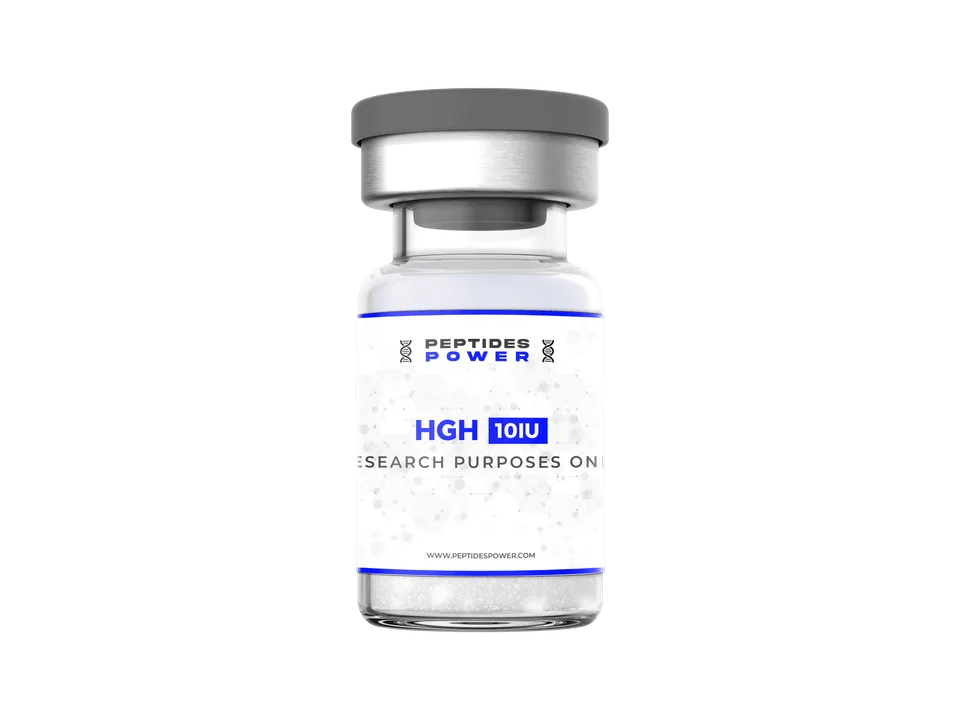
HGH
$35
In stock
View product
Profile
HGH (human growth hormone), called somatropin as a drug, is a protein of 191 amino acids that the pituitary gland releases in pulses.123 It drives growth in children and shapes body composition in adults, partly through IGF-1.13 In the US it is a prescription drug for growth hormone deficiency and a few other conditions, not for anti-aging.145
This page summarizes published sources for information only. It is not medical advice and does not tell anyone to use a product. Questions about your own health belong with a licensed clinician. For questions about an order or a product, contact us.
| Class | Protein hormone of 191 amino acids that activates the growth hormone receptor; drug versions are recombinant somatropin16 |
|---|---|
| Also known as | Somatropin, somatotropin, human growth hormone (hGH); US brands include Genotropin, Humatrope, Norditropin, Omnitrope, Saizen, Serostim and Zomacton674 |
| Forms we sell | 10 IU research vial (freeze-dried powder); prescription somatropin brands are not sold here |
| Regulatory status | Prescription biologic in the US, first approved in 1987; distributing it for any human use other than HHS-authorized, physician-ordered treatment is a federal crime under 21 U.S.C. 333(e)189 |
| WADA status | Prohibited at all times, with its analogues and fragments (2026 list, S2.2.3)10 |
For people with a diagnosed deficiency or another labeled condition, somatropin has been a prescription treatment since its first US approval in 1987, and a 2011 Endocrine Society guideline judges its risks low in deficient adults.115 For healthy adults, the evidence comes mostly from small trials, and reviewers describe small changes in body composition with more adverse events.5
Growth hormone-releasing hormone from the hypothalamus makes pituitary somatotroph cells build growth hormone and release it in pulses, and ghrelin from the stomach also switches production on.32 In 149 healthy men aged 16 to 83, growth hormone secretion was linked to slow wave (deep) sleep independent of age, and fell by about 372 micrograms per decade from early adulthood to midlife as deep sleep declined.16 Release peaks in puberty and reaches a low point near age 55.2
Its targets include chondrocytes (cartilage), osteoblasts (bone), myocytes (muscle), hepatocytes (liver) and adipocytes (fat), and IGF-1 made in the liver and other tissues carries part of the signal.3 In deficient patients, the label describes three metabolic effects: the body retains more nitrogen, a sign of protein building; stored fat is mobilized into the blood as fatty acids; and large doses can impair glucose tolerance.1
After an injection under the skin, about 80% of a Genotropin dose reaches the circulation.1 Its half-life is about 3.0 hours that way in adults with deficiency, against 0.4 hours when given into a vein in healthy adults.1 Standard somatropin is given daily, while the long-acting analogue lonapegsomatropin is usually injected once a week.817
| Study | Who | Length | Main result |
|---|---|---|---|
| Genotropin label, 6 randomized trials | 172 adults with diagnosed deficiency | 6 months and longer | Lean mass up; fat mass and waist size down; effects held past 6 months1 |
| Rudman, NEJM 1990 | 21 men aged 61 to 81 with low IGF-1 (12 treated) | 6 months | Lean mass up 8.8%, fat tissue down 14.4%, lumbar spine density up 1.6%18 |
| Blackman, JAMA 2002 | 131 adults aged 65 to 88 | 26 weeks | Lean mass up 3.1 kg in men and 1.0 kg in women; men's strength not significantly higher13 |
| Liu 2007 review | 220 healthy older adults given GH (mean age 69) | Mean 27 weeks | Fat down 2.1 kg, lean mass up 2.1 kg, weight unchanged5 |
| Liu 2008 review | 303 young, physically fit adults given GH (mean age 27) | Mean 20 days | Lean mass up 2.1 kg; strength and exercise capacity did not seem to improve19 |
| Meinhardt 2010 | 96 recreational athletes | 8 weeks | Sprint capacity up 3.9%, not maintained 6 weeks after stopping; the lean gain came from extracellular water20 |
| Cochrane 2014 | 701 people with burns (13 trials) | Varied | Adult burn wounds healed about 9 days sooner; more high blood sugar in adults21 |
Read together, the trials in healthy people show about 2 kg more lean mass, partly water, without a clear gain in strength.51920 The 2008 reviewers concluded that claims of better physical performance are not supported by the scientific literature.19
The goal pages map these searches: Peptides and muscle growth, Peptides and weight loss, Peptides and sleep and Peptides and healing and recovery.
Sermorelin and Tesamorelin are GHRH analogues: they ask the pituitary for more of its own growth hormone instead of supplying it.113 Tesamorelin, the 44-amino-acid GHRH sequence plus a hexenoyl group, is FDA approved only to reduce excess abdominal fat in adults with HIV and lipodystrophy, and its label calls it weight neutral.3 WADA groups Ipamorelin, ibutamoren and macimorelin as secretagogues and lists GHRP-2 and GHRP-6 as GH-releasing peptides.10
HGH Fragment 176-191 and AOD-9604 are short pieces from the C-terminal end of HGH, and WADA bans both as growth hormone fragments.2310 In obese mice, long-term treatment with HGH or AOD9604 caused weight loss.23 The HGH research vial is listed at HGH for sale; it is not a licensed somatropin product.
The Genotropin label's adverse event table covers adults with diagnosed deficiency during the first 6 months of placebo-controlled treatment.1 Most events were mild to moderate signs of fluid retention.1 Every row below was significantly more common than on placebo except headache and fatigue.1
| Reaction | Genotropin | Placebo |
|---|---|---|
| Swelling, peripheral | 17.5% | 5.1%1 |
| Joint pain (arthralgia) | 17.3% | 4.2%1 |
| Pain in the arms or legs | 14.7% | 5.9%1 |
| Edema, peripheral | 10.8% | 2.6%1 |
| Headache | 9.9% | 7.7%1 |
| Tingling (paresthesia) | 9.6% | 1.9%1 |
| Stiffness in the arms or legs | 7.9% | 1.6%1 |
| Fatigue | 5.8% | 3.8%1 |
| Muscle pain (myalgia) | 4.9% | 1.6%1 |
Injection-site reactions, rashes and lipoatrophy (loss of fat under the skin where injections are repeated) are also common.1 Label warnings and trials add more:
A prescriber sets every somatropin dose for a diagnosed condition and adjusts it by clinical response, side effects and age- and sex-adjusted IGF-I levels.1 The label schedules are written in mg:
| Labeled use | Label dosing |
|---|---|
| Children with growth hormone deficiency (Genotropin) | Generally 0.16 to 0.24 mg/kg per week1 |
| Prader-Willi syndrome (Genotropin) | Generally 0.24 mg/kg per week1 |
| Turner syndrome (Genotropin) | Generally 0.33 mg/kg per week1 |
| Idiopathic short stature (Genotropin) | Up to 0.47 mg/kg per week1 |
| Adult deficiency, fixed start (Genotropin) | About 0.2 mg a day (0.15 to 0.30), raised every 1 to 2 months by about 0.1 to 0.2 mg a day1 |
| Adult deficiency, weight-based (Genotropin) | Up to 0.04 mg/kg per week at the start, at most 0.08 mg/kg per week1 |
| HIV wasting (Serostim) | 0.1 mg/kg once daily at bedtime, up to 6 mg8 |
Older patients start lower and increase in smaller steps.1 Trials in healthy people used research doses: initial daily doses averaging 14 micrograms per kg in older adults, an average of 36 micrograms per kg a day in young, fit adults, and 2 mg a day for 8 weeks in recreational athletes.51920 No dose is approved for anti-aging, bodybuilding or fat loss, and these study figures are not guidance for any person.54
US labels write somatropin doses in mg.1 The international unit (IU) is a historical unit; the WHO International Standard converts at 3.0 IU per mg of somatropin.24
Mixing and storage rules come from the licensed products' labels:
These limits belong to licensed products, and no stability study of research-labeled vials was found. Lab steps and the math are in How to reconstitute a peptide vial, the Reconstitution calculator and How to store peptides.
Somatropin was first approved in the US in 1987, and MedlinePlus lists 11 US brands, one of them (Nutropin) no longer on the market.14 It is prescription only. Since March 23, 2020, approved somatropin products have been regulated as biologics, which FDA says are not eligible for the 503A and 503B compounding exemptions.12627
Labeled uses vary by brand: growth failure in children (deficiency, Prader-Willi syndrome, small for gestational age, Turner syndrome and idiopathic short stature), adult deficiency, HIV-associated wasting and short bowel syndrome.184
Under 21 U.S.C. 333(e), knowingly distributing HGH, or possessing it with intent to distribute, for any human use other than HHS-authorized, physician-ordered treatment of a disease or recognized medical condition is punishable by up to 5 years in prison, or 10 years when someone under 18 is involved.9 The law covers somatrem, somatropin and analogues of either; convictions count as Controlled Substances Act felonies for forfeiture, and DEA may investigate.9 DailyMed lists the somatropin product Serostim with "DEA Schedule: None".8
FDA has not approved somatropin for anti-aging, and the 2007 review states that distributing it for that purpose is illegal in the US.5
WADA's 2026 Prohibited List, in force from January 1, 2026, bans growth hormone, its analogues (lonapegsomatropin, somapacitan, somatrogon) and fragments (AOD-9604, hGH 176-191) at all times under S2.2.3.10 It also bans GHRH analogues, secretagogues and GH-releasing peptides, along with IGF-1 and its analogues.10 In the European Union, Omnitrope is a prescription-only biosimilar of Genotropin, authorized EU-wide on April 12, 2006.28
$35
In stock
View productHGH for sale: strengths, stock and shipping are on the product page.
For research use only. Not for human or veterinary use. Read the research use policy.
No. Sermorelin is a synthetic 29-amino-acid analogue of growth hormone-releasing hormone (GHRH), the shortest synthetic peptide with the full biological activity of GHRH.11 It prompts the anterior pituitary to secrete its own growth hormone, while HGH (somatropin) is the 191-amino-acid hormone itself.111 In the studies reviewed in 1999, transient facial flushing and injection-site pain were the most commonly reported side effects.11 More: What is Sermorelin?
These sources do not settle it. A 1999 review noted that sermorelin at its recommended dosage had not been compared directly with somatropin.11 In children with growth hormone deficiency, though, sermorelin given as a continuous infusion or in 3 divided doses raised growth rate less than once-daily somatropin at 30 micrograms per kg.11 Somatropin holds FDA approvals for several growth and deficiency conditions.1 WADA bans both at all times, growth hormone under S2.2.3 and GHRH analogues under S2.2.4.10
They are different molecules, and no human study in these sources tests one against the other. IGF-1 LR3 is IGF-1 with an N-terminal extension and arginine at position 3, and it binds poorly to IGF-binding proteins; in dexamethasone-treated rats it was about 2.5 times as potent as natural IGF-1.12 HGH works partly by raising IGF-1, which the liver makes in response to it.23 WADA bans IGF-1 and its analogues at all times, as it does growth hormone.10 More: What is IGF-1?
It is the hormone made by the growth-stimulating somatotroph cells of the pituitary gland, at the base of the brain.2 In children it stimulates linear growth, and in adults who lack it, treatment lowers fat mass and raises lean body mass.1 Drug versions, called somatropin, are made with recombinant DNA, Genotropin in E. coli bacteria and Serostim in a mouse cell line, and both have the same 191-amino-acid sequence as pituitary growth hormone.18
In a 26-week randomized trial of healthy adults aged 65 to 88, joint pain was more common in men given GH (41% vs 0%), and carpal tunnel symptoms in men given GH plus testosterone (32% vs 0%).13 Diabetes or glucose intolerance developed in 18 GH-treated men versus 7 not given GH.13 A 2007 review of healthy older adults also found more swelling and breast enlargement (gynecomastia).5 Labels add raised pressure inside the skull, serious allergic reactions and second tumors in some childhood cancer survivors.1
No compound has been shown to be best. WADA lists three kinds of growth hormone releasing factors: GHRH analogues such as sermorelin, tesamorelin and CJC-1295; secretagogues such as ipamorelin, ibutamoren (MK-677) and macimorelin; and GH-releasing peptides such as GHRP-2 and GHRP-6.10 Tesamorelin and macimorelin each have one narrow FDA-approved use: tesamorelin for excess abdominal fat in adults with HIV and lipodystrophy, and macimorelin for diagnosing adult growth hormone deficiency.314 WADA bans all of them at all times.10
Written by D2C Peptides Editorial Team.
Pending qualified review.
Updated .
D2C Peptides sells peptides for laboratory research. Please confirm both statements to continue.