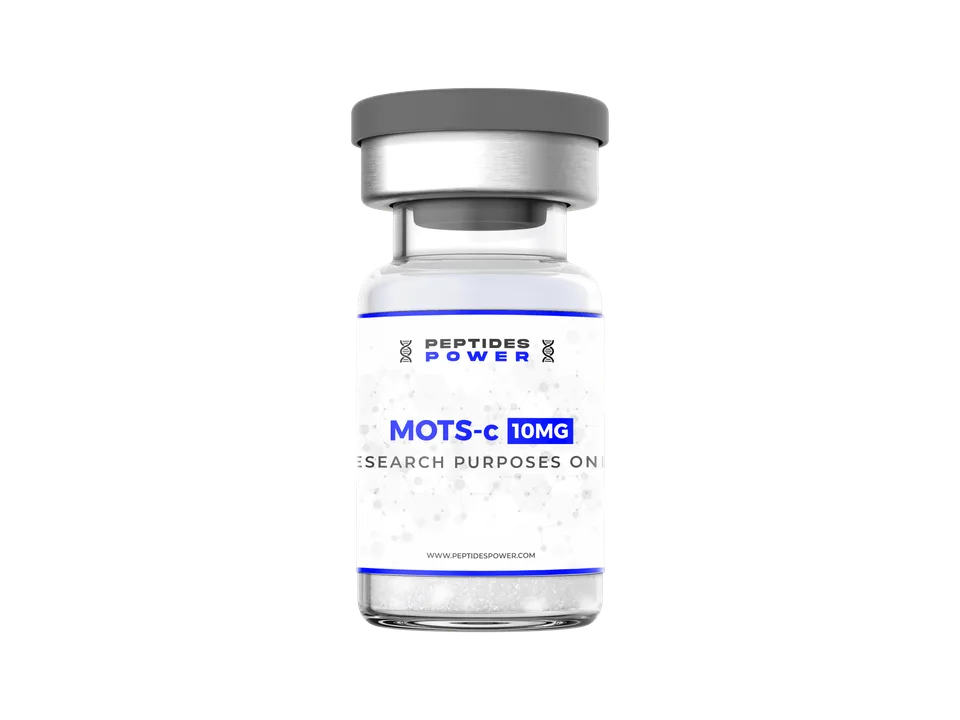
MOTS-c
$55
In stock
View product
Profile
MOTS-c is a 16-amino-acid peptide coded by a short stretch of mitochondrial DNA, in the 12S rRNA gene.1 Scientists first described it in 2015 and have studied it mostly in mice, rats and cells for effects on metabolism and insulin sensitivity.1 It is not an FDA-approved drug, and FDA found no clinical studies of it in people.1
This page summarizes published sources for information only. It is not medical advice and does not tell anyone to use a product. Questions about your own health belong with a licensed clinician. For questions about an order or a product, contact us.
| Class | Mitochondrial-derived peptide, 16 amino acids long1 |
|---|---|
| Also known as | Mitochondrial open reading frame of the 12S rRNA-c; also written MOTS c or MOTSc2 |
| First described | 2015, by Lee and colleagues1 |
| Forms we sell | One 10 mg vial of freeze-dried powder, sold for research use only |
| Regulatory status (US) | Not FDA-approved; a July 2026 advisory vote to allow compounding is not binding13 |
| WADA status | Prohibited at all times under section 4.4.1 (AMPK activators) and named explicitly2 |
| Human trials | None completed; a phase 2a trial in adults with prediabetes began in 202624 |
MOTS-c is short for mitochondrial open-reading-frame of the twelve S rRNA type-c.15 A 51-base-pair stretch of the mitochondrial 12S rRNA gene codes for it, and the peptide is 16 amino acids long (MRWQEMGYIFYPRKLR).67 Lee and colleagues reported it in 2015 as a regulator of insulin sensitivity and metabolic balance.5 Its formula is C101H152N28O22S2, with a molar mass of 2174.6 g/mol.8
It belongs to the mitochondrial-derived peptides.1 A related peptide, humanin, was found in 2001 and comes from the 16S rRNA gene instead.6 The body makes MOTS-c itself, and it can be measured in human and rodent blood.5 Research products are synthetic copies.1 FDA treats the free base and the acetate salt as two different ingredients, so the salt form on a label matters.1
The mechanism work so far comes from cells grown in the lab and from mice.5910 In the 2015 work, skeletal muscle appeared to be the main target in mice.5 In a human kidney cell line, MOTS-c slowed the folate cycle and the purine production linked to it, which switched on AMPK, an enzyme that senses cell energy.51 That slowdown can make AICAR, a known AMPK activator, build up inside cells.1
Later studies added detail. Under glucose restriction, MOTS-c moved into the cell nucleus and helped regulate many genes, including antioxidant-response genes, in a 2018 cell study.9 A 2024 study reported that it binds and activates an enzyme called CK2 in cell-free tests.10 In mice, its protection against muscle wasting weakened when CK2 was suppressed.10
Big gaps remain. FDA reviewers wrote in May 2026 that its molecular targets are unknown, so it is hard to predict which organs it affects; their review does not cite the 2024 CK2 study.1 FDA found no pharmacokinetic studies in animals or people.1 In human blood in a test tube, MOTS-c broke down quickly into shorter pieces, and whether injected MOTS-c can reach active levels in people over time has not been determined.1
| Research area | Evidence type | Main finding |
|---|---|---|
| Body weight | Mice | Less weight gain on a high-fat diet; no change on a normal diet15 |
| Insulin and blood sugar | Mice; human observational | Better insulin sensitivity in mice; lower blood MOTS-c on average in type 2 diabetes111 |
| Exercise and aging | Mice; human observational | Better treadmill performance in mice; the body's own MOTS-c rose with exercise in one small study112 |
| Bone and blood vessels | Rat cells; rats | More bone-forming cells in a dish; less vessel calcification in rats1 |
| Treatment in people | No completed trials2 | A phase 2a trial in prediabetes started in 2026, with no results yet4 |
Human evidence is thin: FDA found no clinical studies or human exposure data by any route.1 Blood levels are also hard to compare, because a mass spectrometry test could not confirm levels measured with ELISA.13 A 2023 review noted that no effective way of using MOTS-c in the clinic has been developed.14 In short, the treatment studies show effects in rodents, not in people.1 Full list with evidence levels: MOTS-c benefits and uses.
CB4211 is a modified analog of MOTS-c developed by the company CohBar.15 Unlike MOTS-c, it has been through a human trial, a phase 1a/1b study with 88 participants.16 No results are posted on ClinicalTrials.gov.16
No completed clinical trial has reported MOTS-c side effects, and FDA found no human safety data and no toxicity studies.21 USADA's summary of side effects reported by people who claim to have bought it online includes a fast heart rate or palpitations, injection site irritation, insomnia, immune reactions and fever.2 One concern FDA names is that injected MOTS-c could trigger an immune response because of aggregates or impurities.1 Full list: MOTS-c side effects.
No human dose of MOTS-c has been established.1 Published doses come from rodent studies that injected 0.5 to 15 mg/kg into the abdominal cavity (intraperitoneal).5121 FDA found that those studies did not assess how effects change with dose.1 A phase 2a trial registered in 2026 gives a fixed daily dose under the skin for 12 weeks, but the registry does not state the amount.4 Full details: MOTS-c dosage.
The MOTS-c for sale on this site is a 10 mg vial of freeze-dried powder; diluent is sold separately. FDA's 2026 review, citing supplier data, says the dry free base is stable at -20°C when desiccated, protected from light and tightly closed.1 Once reconstituted, the solution is recommended to be kept at +4°C for 2 to 7 days, or below -18°C for later use.1
Two cautions come from the same review. Water solubility is reported (6.25 mg/mL for the acetate salt), yet no data show that MOTS-c dissolves completely in a finished solution.1 Peptides can also clump or degrade when pH, temperature, concentration, impurities or other ingredients change.1
Concentration is plain division, and it is lab arithmetic, not a dose. For example, 10 mg in 2 mL of diluent gives 5 mg/mL. The reconstitution guide covers the lab steps, the reconstitution calculator does the math, and how to store peptides covers cold storage.
MOTS-c is not an FDA-approved drug.1 No USP or National Formulary monograph exists for it or its acetate salt, and neither is part of an approved drug.1 USADA adds that it is not approved for use in humans or in compounded medications.2
Its compounding status moved several times in 2026:
Other points from the record:
Published dosing information for MOTS-c from published studies, with its source, and why it is not advice for you.
What published sources report about MOTS-c and its uses, with the evidence level of each finding. No promises.
Side effects of MOTS-c as reported in published studies, with links to the full profile. Reviewed by a qualified reviewer.
$55
In stock
View productMOTS-c for sale: strengths, stock and shipping are on the product page.
For research use only. Not for human or veterinary use. Read the research use policy.
It is an injection of synthetic MOTS-c, a lab-made copy of the natural peptide.1 FDA found injectable MOTS-c marketed online for uses such as mitochondrial energy, liver fat metabolism, metabolic balance and glucose control.1 Its 2026 review also found no human studies of MOTS-c by any route,1 and FDA is concerned that injected MOTS-c could trigger immune reactions because of aggregates and impurities.1 No FDA-approved drug contains it.1
Research on MOTS-c has focused mostly on metabolism.15 FDA's 2026 review lists the uses it was nominated for: insulin resistance, obesity, osteoporosis, vascular calcification, muscle and fat metabolism, and longevity.1 The studies behind those uses were done in cells and rodents, not people.15 MOTS-c has no approved therapeutic use,2 is not part of any FDA-approved drug, and FDA found no clinical studies of it in people.1
AICAR (acadesine) is not a peptide. It is a purine nucleoside analogue that activates AMPK, the cell's energy sensor.23 MOTS-c is a 16-amino-acid peptide coded by mitochondrial DNA.5 In cell studies, MOTS-c slows the folate cycle and purine production, which makes AICAR build up inside cells and activates AMPK indirectly.51 MOTS-c is also named explicitly on the WADA Prohibited List, under activators of AMPK.2
They are different kinds of molecules. NAD+ is the oxidized form of nicotinamide adenine dinucleotide, found in all living cells, where it carries electrons from one metabolic reaction to another.24 MOTS-c is a 16-amino-acid peptide coded by mitochondrial DNA that regulated insulin sensitivity and metabolism in cell and mouse studies.5 None of the sources reviewed for this page compared the two directly. For NAD+ itself, see What is NAD+?
The published evidence does not show that MOTS-c is safe or effective in people.1 Reported benefits come from rodent and cell studies,1 and FDA says the safety risks of MOTS-c in humans are unknown.1 USADA notes that no human clinical trial has been completed and that there are no data on long-term use.2 It is also prohibited in sport at all times.2 A placebo-controlled phase 2a trial in adults with prediabetes started in 2026 and has no results yet.4
Written by D2C Peptides Editorial Team.
Pending qualified review.
Updated .
D2C Peptides sells peptides for laboratory research. Please confirm both statements to continue.