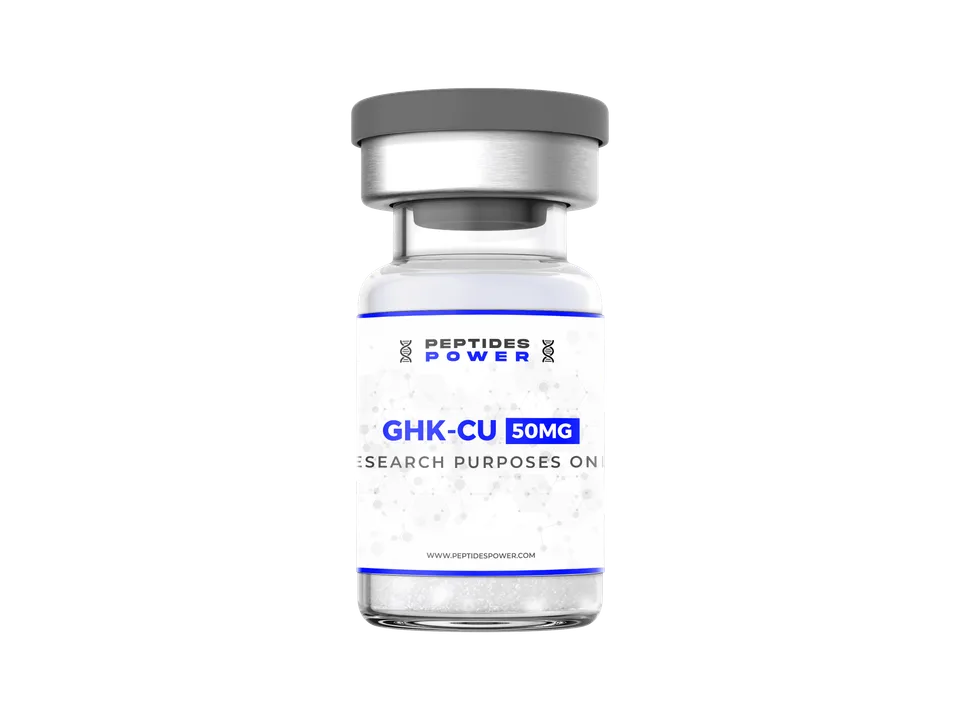
GHK-Cu
$45
In stock
View product
Profile
GHK-Cu is GHK, a three-amino-acid peptide (glycine, histidine, lysine) found in human plasma, bound to a copper ion.12 Skin and hair cosmetics use it under the name copper tripeptide-1.34 It is not an FDA-approved drug.5 Nearly all human data come from products applied to the skin, and FDA calls human data on injectable GHK-Cu limited.67
This page summarizes published sources for information only. It is not medical advice and does not tell anyone to use a product. Questions about your own health belong with a licensed clinician. For questions about an order or a product, contact us.
| Class | Metallopeptide: the copper(II) complex of the tripeptide GHK (Gly-His-Lys)41 |
|---|---|
| Also known as | Copper tripeptide-1 (cosmetic INCI name), prezatide copper, copper peptide38 |
| Forms we sell | 50 mg research vial (blue freeze-dried solid)9 |
| Regulatory status | Not an FDA-approved drug; non-injectable GHK-Cu is in FDA compounding Category 1 (May 2026), injectable is not5107 |
| WADA status | Not named on the 2026 Prohibited List; the list does not say whether class S0 covers it11 |
GHK is a tripeptide of glycine, L-histidine and L-lysine, which ChEBI classes as a metabolite, a chelator and a vulnerary (wound-healing agent).1 It occurs naturally in human plasma, saliva and urine, and its discoverer's group reports plasma levels of about 200 ng/mL at age 20, falling to 80 ng/mL by age 60.2 Loren Pickart isolated GHK-Cu in 1973 as an activity in human albumin.2
A 1980 paper in Nature reported that the tripeptide readily binds copper(II) and helped cultured liver cancer cells take up the metal.29 PubChem lists the 1:1 complex at 401.91 to 402.92 g/mol, against 340.38 g/mol for copper-free GHK.183031 Studies of plain GHK, such as a 2012 analysis of lung gene signatures, are not direct evidence for GHK-Cu.32 Researchers who need the compound itself can find GHK-Cu for sale as a 50 mg research vial.
Every human trial in the sources reviewed applied GHK-Cu to the skin, and most enrolled few people.635
| Study | People | Product | Reported result |
|---|---|---|---|
| Diabetic foot ulcers, 1994: multicenter, randomized, evaluator-blinded, placebo-controlled27 | Adults with diabetic neuropathic ulcers; number not given in the abstract | Gel daily after debridement, with standard wound care27 | Median plantar-ulcer closure 98.5% against 60.8% with the inactive gel; infections 7% against 34% in ulcers treated right after debridement27 |
| Laser resurfacing, 2006: randomized | 13 patients completed | Skin care products | No objective difference from skin care without GHK-Cu in redness, wrinkles or skin quality; higher patient satisfaction28 |
| Eyebrows, 2026: randomized, double-blind, split-face poster | 18 healthy adults20 | 2% serum on one brow, placebo on the other23 | Hair count rose on the treated side, with no significant change on the placebo side23 |
| Facial skin, 12 weeks: 2002 meeting abstract36 | 71 women with photoaging | Facial cream | Denser, thicker skin; fewer fine lines; shallower wrinkles36 |
| Eye area, 12 weeks: 2002 meeting abstract | 41 women with photodamage | Eye cream | Better than placebo and a vitamin K cream45 |
| Small skin wounds: phase 2, registered | Healthy adults aged 18 to 55; 60 planned | 0.1% gel against vehicle37 | Recruiting; no results posted as of October 202637 |
A 2026 systematic review counted Loren Pickart or Anna Margolina of Skin Biology Inc. as authors on about 35% of the primary GHK-Cu literature in its window, and noted that Pickart held commercial interests in the field for decades. It calls the group's work scientifically substantive, but says this concentration of authorship limits the independence of the evidence.6 The cream results above are known from meeting abstracts summarized by that group.36
In lab diffusion cells, copper from a 0.68% copper tripeptide solution crossed dermatomed human skin at 136.2 micrograms per square centimeter over 48 hours, and about 97 micrograms per square centimeter stayed in the tissue.38 A 2026 review cautions that finding copper on the far side cannot show that the intact GHK-Cu complex crossed.20
Two blends on this site combine GHK-Cu with other peptides: the Glow Peptide Stack and the KLOW Peptide Blend. WADA's 2026 list names BPC-157 in class S0 and TB-500 among thymosin beta-4 derivatives in class S2, but not GHK-Cu.1139 See the BPC-157 profile and the TB-500 profile.
Goal pages: skin and hair, healing and recovery and muscle, where the GHK-Cu data come from mice only.16
Human safety data on GHK-Cu are limited.720
General points on weighing safety claims are in Peptide safety basics.
No human dose of GHK-Cu has been established, for injection or on the skin.1320 The human studies below tested topical products, and every injected amount comes from mice or rats. None of these figures is guidance for people.
| Study | Species and route | Amount and schedule |
|---|---|---|
| Small skin wounds, phase 2 registration (recruiting) | Healthy adults aged 18 to 55; on the skin | 0.1% w/w gel, a thin film of about 0.5 g once daily for 14 days37 |
| Eyebrows, 2026 | 18 adults; on the skin | 2% serum twice daily for 12 weeks23 |
| Diabetic foot ulcers, 1994 | Adults with diabetes; on the ulcer | A metered dose of gel daily after debridement; strength not given in the abstract27 |
| Acute lung injury, 2016 | Mice; into the abdomen (intraperitoneal) | 1 or 10 µg per gram of body weight every 24 hours for 3 days before the injury14 |
| Lung fibrosis, 2020 | Mice; intraperitoneal | 0.2, 2 or 20 µg per gram per day, on alternate days15 |
| Smoke-induced muscle loss, 2023 | Mice; intraperitoneal | 0.2 or 2 mg/kg once a week for 7 weeks42 |
| ACL graft, 2015 | Rats; into the knee joint | 0.3 or 3 mg/mL once a week for 4 weeks, starting 2 weeks after surgery17 |
One microgram per gram of body weight equals 1 mg/kg, so the mouse studies span 0.2 to 20 mg/kg per dose (our arithmetic). Peptide dosage basics explains how study doses are read.
The supplier ships GHK-Cu as a blue freeze-dried solid and gives a shelf life of 36 months at -20 °C or 30 days at 2 to 8 °C.9 These are its own figures, not independent stability data.9
No source reviewed gives a shelf life for a mixed GHK-Cu vial or a GHK-Cu-specific reconstitution method. The general lab steps are in the reconstitution guide, the reconstitution calculator does the concentration math, and How to store peptides covers sealed and mixed vials.
GHK-Cu is not an approved drug.5 In an April 2020 warning letter, FDA listed GHK-Cu among the bulk substances a compounding pharmacy used, and said such drugs did not qualify for the section 503A exemptions because they have no USP or NF monograph and are not a component of an FDA-approved human drug.5
FDA removed GHK-Cu from compounding Category 1 on April 22, 2026 after its nominators withdrew, and on May 5 one nominator said it had meant to withdraw only the injectable route.10 FDA's list updated May 14, 2026 puts non-injectable GHK-Cu back in Category 1, the substances under evaluation for the 503A bulks list.10 For Category 1, FDA says it does not intend to act against compounders who meet the conditions in its guidance.22 Injectable GHK-Cu stays on FDA's list of withdrawn nominations previously in Category 2.7
FDA intends to consult its Pharmacy Compounding Advisory Committee on GHK-Cu before the end of February 2027.1044 As of October 24, 2026, no meeting date is posted.1044
Health Canada's April 2026 advisory lists GHK-Cu among unauthorized injectable peptide drugs it has seized. It says marketing such products as for research use only and not for human consumption does not make them legal.46
A 2026 review notes that in the European Union, a finished product with copper tripeptide may be sold as a cosmetic only when its purpose and claims fit the cosmetic definition and it meets Regulation (EC) No 1223/2009.20
GHK-Cu is not named on the WADA 2026 Prohibited List.11 Class S0 bans at all times any pharmacological substance not covered elsewhere on the list and with no current government approval for human therapeutic use, and the list does not say whether GHK-Cu falls under it.11
The supplier states that its products are for research purposes only, not for human consumption, and not evaluated by FDA.9 Vials sold here carry the label: For research use only. Not for human or veterinary use.
$45
In stock
View productGHK-Cu for sale: strengths, stock and shipping are on the product page.
For research use only. Not for human or veterinary use. Read the research use policy.
No GHK-Cu product has passed FDA review as a drug, so no brand can point to an approval for use in people.5 For research vials, compare the test documents instead. The certificate posted by this store's supplier for lot 2025-02-13 reports 99.90% purity by HPLC-UV-MS, with no sterility, endotoxin or content-per-vial results.12 Lab documents for products sold here are on the lab results page.
No benefit of injected GHK-Cu has been shown in people: the sources reviewed hold no published human trial of it, and a ClinicalTrials.gov search for GHK in October 2026 found none registered.35 A 2026 orthopaedic review found no clinical data supporting it for musculoskeletal conditions.13 The injection results come from rodents: less lung injury and lung scarring in mice, less smoke-related muscle loss in mice, and knee-graft healing in rats that faded once treatment stopped.1415164217
It carries copper: each molecule of the 1:1 complex holds one copper atom, about 16% of its 401.91 g/mol mass (our arithmetic).1819 Formal absorption studies of the intact complex have not been reported, so how much copper reaches the body is unknown.20 Adults need 900 mcg of copper a day and large amounts are poisonous, but a 2026 review says dietary limits do not convert into limits for injected products.2120
No. In a 2020 warning letter, FDA stated that GHK-Cu has no USP or NF monograph and is not a component of any FDA-approved human drug.5 Non-injectable GHK-Cu sits in Category 1 of FDA's compounding list (updated May 14, 2026), which means it is still under evaluation; that is an enforcement policy for pharmacies, not an approval.1022
The direct evidence is one small trial. In a 2026 randomized, double-blind study published as a conference poster, 18 healthy adults used a 2% GHK-Cu serum on one eyebrow and a placebo on the other for 12 weeks, and hair count and diameter rose on the treated side.2320 Two other hair studies used different molecules: a 2007 follicle study tested AHK-Cu, and a 2016 trial in 45 people with male pattern hair loss used GHK combined with 5-aminolevulinic acid.2425
It depends on the product, its use and the country. As copper tripeptide-1 it is a cosmetic ingredient, and US cosmetic ingredients other than color additives need no FDA approval, though intended use decides whether a product is legally a cosmetic or a drug.326 FDA does not intend to act against pharmacies compounding non-injectable GHK-Cu under its Category 1 conditions; injectable GHK-Cu is outside that policy.22107 Health Canada lists GHK-Cu among unauthorized injectable peptide drugs it has seized, and says research-use labels do not make such products legal.46
It depends on the use and the route, and the trials are small. On the skin, a gel improved closure of diabetic plantar ulcers in a 1994 randomized trial, while a 2006 laser-resurfacing study found no objective difference from skin care without GHK-Cu, only higher patient satisfaction.2728 A 2026 systematic review calls the human evidence thin, and another 2026 review calls GHK-Cu promising but unproven.620
No daily amount has been established for people, by injection or on the skin, and a 2026 review of injectable peptides including GHK-Cu says dosing, frequency and duration remain unknown.13 Human studies tested topical products on their own schedules, and every injected dose in the studies reviewed was given to mice or rats.14154217
Written by D2C Peptides Editorial Team.
Pending qualified review.
Updated .
D2C Peptides sells peptides for laboratory research. Please confirm both statements to continue.