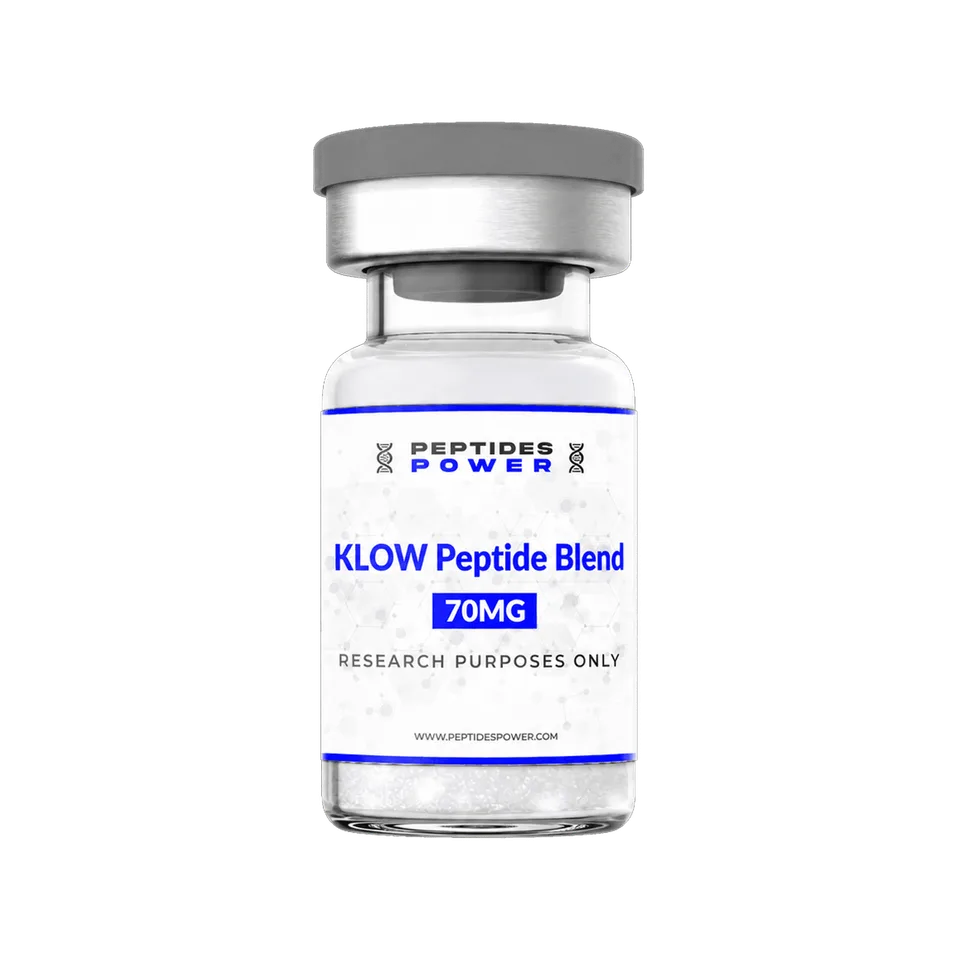
Staging preview: health content pending qualified review

Side effects

KLOW Peptide Blend side effects

No study has measured side effects of KLOW, so its safety in people is unknown.1 Reports exist only for its parts: headache and flatulence after BPC-157 enemas, a few FDA adverse event reports and animal safety signals.2 FDA calls the human safety risks of TB-500 and KPV unknown.34

This page summarizes published sources for information only. It is not medical advice and does not tell anyone to use a product. Questions about your own health belong with a licensed clinician. For questions about an order or a product, contact us.

What is known about the blend itself

No study has measured side effects of KLOW, in animals or in people.1 The closest records are two complaint reports about "blended TB-500 and BPC-157", two of its four parts, which FDA found during its 2026 review; the reports did not include safety assessments.3 Trade press reported that at FDA's July 2026 advisory meeting, one committee member raised concern that TB-500 is being used in combination with other peptides.5

FDA's adverse event database held no reports for TB-500 through March 26, 2025,3 and none for KPV through December 3, 2025.4 FDA notes that reporting to this database is voluntary, so the absence of reports does not show that no harm occurred.4

Reported in people

Mild or no events in small studies

  • BPC-157 enemas. Headache and flatulence were the adverse events reported most often in healthy volunteers given BPC-157 as an enema; the meeting abstracts give no rates.2
  • Other small BPC-157 studies. No serious adverse events appear to have been reported, but FDA notes these studies were short and small and gave limited safety information.2 The 12-woman bladder study reported no adverse events,6 and a 2-person IV pilot reported no adverse effects.7
  • Thymosin beta-4, not TB-500. In a placebo-controlled trial of IV full-length thymosin beta-4 in 40 healthy volunteers, adverse events were infrequent and mild or moderate.8

Single reports to FDA, cause not established

FDA's review lists these reports from its adverse event database and says it is unclear whether BPC-157 caused them.2

  • Injection site. A woman using BPC-157 injections had 9 days of redness and swelling around the injection site, but she was also injecting compounded thymosin.9
  • Breathing. A 28-year-old man developed shortness of breath, which led to an emergency room visit, after injecting BPC-157 acetate under the skin.10
  • Skin and gums. A 40-year-old woman injecting a research-labeled product with BPC-157 and TB-500 under the skin twice daily developed diffuse skin darkening and darker gums, and the same reaction returned when she used it again two weeks later.2 It involved two of KLOW's four parts.

Seen in animal studies

  • Clotting and liver. In 28-day studies with daily injections into muscle, BPC-157 was linked to signals FDA judged clinically relevant: altered clotting tests (aPTT shorter in rats, longer in dogs) and liver-related changes (higher ALT, glucose and triglycerides).2
  • Other toxicity. A 2020 preclinical safety study found mild irritation in a local tolerance test and lower creatinine in dogs at 2 mg/kg, but not at lower doses.13 Otherwise BPC-157 was well tolerated in its tests in mice, rats, rabbits and dogs, with no genetic or embryo-fetal toxicity.13
  • Pregnancy. In rats, BPC-157 injected into muscle at up to 4 mg/kg/day on gestation days 6 to 15 caused no fetal malformations.11 FDA found no study covering a complete reproductive cycle.11
  • Gaps. FDA found no carcinogenicity studies of BPC-157 or TB-500, and no developmental or reproductive studies of TB-500.23 For KPV, FDA found no animal toxicity studies of any kind.4

Risks FDA and reviewers describe

These risks are named in reviews and warnings. How often they occur is unknown.

  • Immune reactions. FDA says injected BPC-157, TB-500 and GHK-Cu may provoke immune reactions, a risk raised by peptide clumping (aggregation) and impurities.2314 FDA adds that, in general, injection under the skin is linked to more immune reactions than injection into a muscle or vein.3
  • Copper. A 2026 review calls copper a recognized contact sensitizer in susceptible people15 and says repeated injection of GHK-Cu should be evaluated for copper build-up in the liver and, at high exposures, the nervous system.16 In large amounts, copper is poisonous.17 KLOW does not disclose how much GHK-Cu it holds.
  • Product quality. FDA found BPC-157, TB-500 and KPV sold as multiple salts and derivatives under the same common names, and certificates of analysis that lacked tests for impurities, bacterial endotoxins or aggregates.234
  • Unregulated supply. A 2026 review warns that unapproved peptides such as BPC-157 and TB-500 lack established human safety profiles and carry risks including contamination, manufacturing impurities, inaccurate dosing, abnormal blood vessel growth and cancer development.18 FDA says injectable products can pose risks of serious harm because they bypass some of the body's key defenses against toxins and microorganisms.19
  • Class warnings. Health Canada lists risks of unauthorized injectable peptide drugs, including liver or kidney damage, blood clots and the growth of cancerous tumors.20 Its April 2026 advisory names all four of KLOW's peptides among examples of products it has seized.20 These warnings cover the group, not effects measured for KLOW's parts.

Warnings

  • No safe dose is known. USADA says it is unknown whether any dose of BPC-157 is safe,21 and FDA calls the human safety risks of TB-500 and KPV unknown.34
  • Long-term use. FDA found no repeat-dose toxicity study of BPC-157 longer than 28 days.12
  • Pregnancy. Animal reproductive testing is incomplete for BPC-157 and absent for TB-500 and KPV,234 and FDA found no human exposure data at all for TB-500 or KPV.34
  • Athletes. BPC-157 is prohibited under WADA class S0 and TB-500 under S2,2223 and from January 1, 2027 the list names peptides in general under S0.23

Back to the full profile: What is KLOW Peptide Blend?. Study findings are in KLOW Peptide Blend benefits and uses, and amounts used in research in KLOW Peptide Blend dosage. Single-peptide safety pages: TB-500 side effects and KPV side effects. The three-peptide blend is covered in Glow Peptide Stack side effects, and general precautions in Peptide safety basics. Vial specifications and storage are on the KLOW Peptide Blend for sale page.

More on KLOW Peptide Blend

  • KLOW Peptide Blend benefits and uses

    What published sources report about KLOW Peptide Blend and its uses, with the evidence level of each finding. No promises.

  • KLOW Peptide Blend dosage

    Published dosing information for KLOW Peptide Blend from studies of its four parts, with sources, and why it is not advice for you.

KLOW Peptide Blend in the store

KLOW Peptide Blend for sale: strengths, stock and shipping are on the product page.

For research use only. Not for human or veterinary use. Read the research use policy.

Frequently asked questions

What are the side effects of KLOW?

None have been measured for the blend, because no study has tested it.1 For its parts, BPC-157 enema studies most often reported headache and flatulence, and FDA lists single reports of injection-site redness, shortness of breath, and skin and gum darkening in people injecting BPC-157 products, without establishing the cause.2 Animal studies of BPC-157 showed clotting and liver signals.2 FDA also warns that injected peptides like these may trigger immune reactions.3

Is KLOW safe?

Its safety is unknown. No study has tested KLOW,1 USADA says it is unknown whether any dose of BPC-157 is safe,21 and FDA concluded that the potential human safety risks of TB-500 and KPV are unknown because there are no human data.34 FDA also found several salts and derivatives, including different active substances, sold under each of these names, so a label alone may not show which molecule a product holds.234

Can KLOW cause an allergic or immune reaction?

It is possible, but nobody has measured how often. FDA says injected BPC-157, TB-500 and GHK-Cu may provoke immune reactions, ranging from antibodies with no symptoms to life-threatening reactions, and that clumping and impurities can raise the risk.2314 Copper, which GHK-Cu carries, is a recognized contact allergen in susceptible people, and a 2026 review recommends metal-allergy screening for injectable copper-peptide products.15

Does KLOW affect the liver or blood clotting?

No study has looked at KLOW,1 but there are open questions about two of its parts. In 28-day studies, BPC-157 injected into muscle changed clotting test results in rats and dogs and raised liver-related markers such as ALT.2 A 2026 review says repeated injection of GHK-Cu should be evaluated for copper build-up in the liver.16 Whether these signals apply to people, or to the four peptides mixed together, has not been tested.

Written by D2C Peptides Editorial Team.

Pending qualified review.

Updated .

Sources

  1. PubMed search: (BPC-157 OR "BPC 157") AND KPV AND GHK. National Library of Medicine (PubMed E-utilities), 2026.
  2. FDA Briefing Document: BPC-157-Related Bulk Drug Substances (BPC-157 (free base) and BPC-157 acetate), PCAC Meeting July 23-24, 2026. U.S. Food and Drug Administration, 2026.
  3. FDA Briefing Document, Pharmacy Compounding Advisory Committee, July 23-24, 2026: TB-500-Related Bulk Drug Substances (TB-500 (Free Base) and TB-500 acetate). U.S. Food and Drug Administration, 2026.
  4. FDA Evaluation of KPV-Related Bulk Drug Substances (KPV (Free Base) and KPV acetate) for Inclusion on the 503A Bulk Drug Substances List, FDA briefing document for the July 23-24, 2026 PCAC meeting (memo dated 5/12/2026). U.S. Food and Drug Administration, 2026.
  5. FDA committee recommends looser restrictions for several peptides. Healio, 2026.
  6. Effect of BPC-157 on Symptoms in Patients with Interstitial Cystitis: A Pilot Study (Lee E et al.): design and safety. Alternative Therapies in Health and Medicine, 2024.
  7. Safety of Intravenous Infusion of BPC157 in Humans: A Pilot Study (Lee E, Burgess K). Alternative Therapies in Health and Medicine, 2025.
  8. A randomized, placebo-controlled, single and multiple dose study of intravenous thymosin beta4 in healthy volunteers (Ruff D et al.). Annals of the New York Academy of Sciences, 2010.
  9. FDA presentations, Pharmacy Compounding Advisory Committee, July 23, 2026: BPC-157 FAERS report (injection site). U.S. Food and Drug Administration, 2026.
  10. Same source as 9: BPC-157 FAERS report (shortness of breath).
  11. Same source as 9: BPC-157 reproductive toxicity.
  12. Same source as 9: BPC-157 nonclinical safety.
  13. Preclinical safety evaluation of body protective compound-157, a potential drug for treating various wounds (Xu C, et al.; PMID 32334036). Regulatory Toxicology and Pharmacology (PubMed abstract via NCBI E-utilities), 2020.
  14. Certain Bulk Drug Substances for Use in Compounding that May Present Significant Safety Risks (GHK-Cu entry). U.S. Food and Drug Administration, 2026.
  15. Mateescu DM, et al. GHK-Cu as a Bioactive Metallopeptide and Drug-Delivery Cargo (sensitization). Pharmaceutics, 2026.
  16. Same source as 15: et al. GHK-Cu as a Bioactive Metallopeptide and Drug-Delivery Cargo (copper accumulation).
  17. Copper in diet. MedlinePlus, U.S. National Library of Medicine, 2025.
  18. Dangers of Injectable Peptides and Other Unregulated "Biohacking" Drugs (Moiz A et al.). Missouri Medicine, 2026.
  19. Warning Letter to Wholesale Peptide (MARCS-CMS 729447), June 17, 2026. U.S. Food and Drug Administration, 2026.
  20. Think twice before injecting peptides bought online: unauthorized products can seriously harm you (public advisory, 2026-04-09). Health Canada (Recalls and safety alerts), 2026.
  21. BPC-157: What Athletes Should Know About the Prohibited Experimental Peptide (health risks). U.S. Anti-Doping Agency (USADA).
  22. Same source as 21: What Athletes Should Know About the Prohibited Experimental Peptide (status).
  23. Athlete Advisory: What’s New on the 2027 WADA Prohibited List? (named peptides). U.S. Anti-Doping Agency (USADA), 2026.
