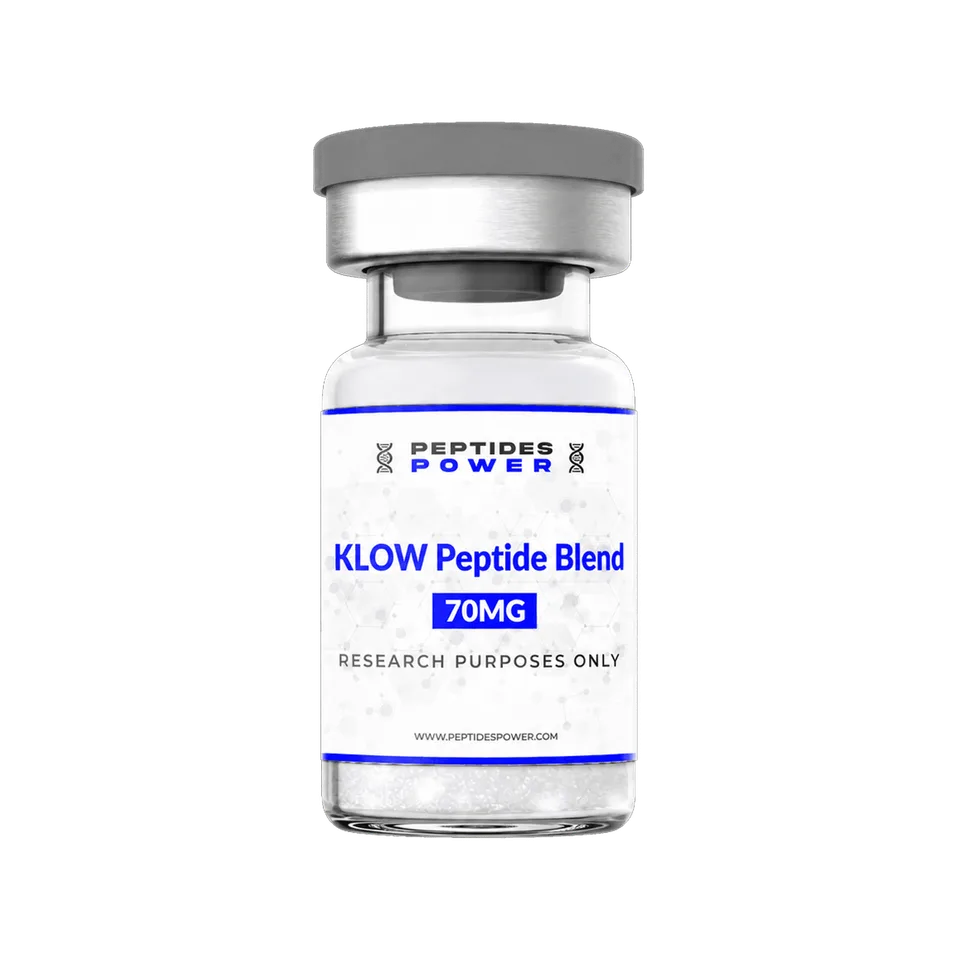
KLOW Peptide Blend
$95
In stock
View product
Benefits and uses
No study has tested KLOW, so no benefit of the blend itself is documented.1 Reported benefits come from research on its four parts, mostly in rats and mice.718 The clearest positive human result is a randomized, placebo-controlled trial of a GHK-copper gel on diabetic ulcers.21 In rats, adding BPC-157 to TB-500 gave no extra benefit.4
This page summarizes published sources for information only. It is not medical advice and does not tell anyone to use a product. Questions about your own health belong with a licensed clinician. For questions about an order or a product, contact us.
KLOW has never been studied as a blend, so what sources report comes from research on its four peptides, one or two at a time.1 The table gives each peptide's strongest reported finding and the kind of study behind it. None of these results came from a KLOW vial.
| Peptide | Strongest reported finding | Evidence level |
|---|---|---|
| BPC-157 | Better healing of muscle, tendon, ligament and bone injuries7 | Animal: 35 of 36 studies in a 2025 review were preclinical7 |
| TB-500 | Repaired rat Achilles tendons bore significantly more load before failing than controls5 | Animal: one study of 32 rats5 |
| KPV | Less chemically induced colitis in mice given KPV by mouth18 | Animal: FDA found no human data20 |
| GHK-Cu | Median 98.5% ulcer closure with a gel, against 60.8% with plain gel21 | Human: randomized, placebo-controlled trial of a gel on the skin21 |
In rats with a cut Achilles tendon, daily BPC-157 improved load to failure, stiffness and Achilles function scores, while saline-treated rats healed poorly (2003).6 A 2025 systematic review found 36 eligible studies, 35 of them preclinical.7 In those animal models, BPC-157 improved functional, structural and biomechanical outcomes after muscle, tendon, ligament and bone injuries.7
Most of the human data are small and uncontrolled. In a retrospective chart review, 14 of 16 patients reported knee-pain relief after BPC-157 was injected into the knee, alone or with thymosin beta-4 (reported as TB4).8 A 2026 review said significant methodological flaws and a lack of controls limit that report.9 In a pilot study without a control group, 10 of 12 women with interstitial cystitis reported complete symptom resolution after one BPC-157 treatment.10 A randomized trial in 53 adults with ulcerative colitis is known only from a 2005 meeting abstract, and FDA concluded the evidence does not support effectiveness.11 Profile: What is BPC-157?
TB-500 is an acetylated copy of amino acids 17 to 23 of human thymosin beta-4.14 Evidence for TB-500 itself is thin. FDA's 2026 review found no information on TB-500 given to patients.13 In a 2024 lab study, it did not speed wound closure in cultured fibroblasts, and the authors suggest that wound-healing activity reported earlier may come from its breakdown product, Ac-LKKTE.12 Its main positive result is the 2026 rat study described above.5
Most other positive results belong to full-length thymosin beta-4, not TB-500. In rats, thymosin beta-4 increased re-epithelialization (regrowth of the skin's surface layer) of full-thickness wounds by 42% at day 4 and by up to 61% at day 7, compared with saline.15 In people, thymosin beta-4 eye drops met key efficacy objectives in a 9-person phase 2 trial for severe dry eye,16 and a review reports that in two phase 2 trials of stasis and pressure ulcers it sped healing by almost a month in the patients whose ulcers healed.17 Full list: TB-500 benefits and uses
KPV is alpha-MSH(11-13), a three-amino-acid piece of the hormone alpha-MSH.19 Given by mouth, it reduced the incidence of chemically induced (DSS and TNBS) colitis in mice in a 2008 study.18 A second 2008 team found significant anti-inflammatory effects in two mouse colitis models, effects at least partly independent of the MC1R melanocortin receptor.19 FDA found no data, such as clinical studies, on KPV use in humans.20 Full list: KPV benefits and uses
In a multicenter, randomized, evaluator-blinded, placebo-controlled trial (1994), people with diabetic neuropathic ulcers were treated daily with a GHK-copper gel.21 Median area closure of plantar ulcers was 98.5%, against 60.8% with the plain gel.21 In ulcers treated right after debridement, infections were less common with the active gel: 7% against 34%.22 A 2015 review reports that GHK in cosmetic products tightened loose skin, improved elasticity, density and firmness and reduced fine lines and wrinkles, and that GHK induced systemic wound healing in rats, mice and pigs.23 A 2026 review found no clinical data supporting GHK-Cu for musculoskeletal conditions.24 Profile: What is GHK-Cu?
No study has tested whether the four peptides act together, in any species.1 A 2026 rat study tested two of the four together, BPC-157 and TB-500.4 In 32 rats after Achilles tendon repair, giving both for 4 weeks brought no added benefit over either peptide alone.45
Two more gaps separate these findings from a KLOW vial. The amount of each peptide in the blend is not disclosed, so it cannot be matched to the amounts used in studies, which are listed in KLOW Peptide Blend dosage. And the human results above for GHK-Cu and thymosin beta-4 include a gel on ulcers and eye drops, not a freeze-dried mix of four peptides.2116
KLOW is searched alongside several goals. What the sources above support for each:
The full profile is What is KLOW Peptide Blend?, and reported harms are in KLOW Peptide Blend side effects. How mixed vials differ from single peptides is covered in Peptide blends and stacks. The vial is listed as KLOW Peptide Blend for sale under the store's research use policy.
Published dosing information for KLOW Peptide Blend from studies of its four parts, with sources, and why it is not advice for you.
Side effects of KLOW Peptide Blend as reported in studies and FDA reports on its four parts, with links to the full profile. No study has tested the blend.
$95
In stock
View productKLOW Peptide Blend for sale: strengths, stock and shipping are on the product page.
For research use only. Not for human or veterinary use. Read the research use policy.
No published source describes how KLOW makes a person feel, because it has never been studied in people.1 The closest human reports, on knee pain and bladder symptoms after BPC-157 treatment, measured narrow outcomes and had no control group.810 Without one, a reported change cannot be separated from expectation or natural recovery. A 2026 review said the lack of controls limits how far the knee report can be trusted.9
No published evidence ranks one above the other: no study has tested KLOW or compared it with GLOW.1 Both contain BPC-157, TB-500 and GHK-Cu. KLOW adds KPV, whose effects are known only from cell and animal studies, and FDA found no data on KPV use in humans.1820 GLOW lists the amount of each peptide, while KLOW lists only the total, so the two cannot be compared milligram for milligram. The other blend's evidence is in Glow Peptide Stack benefits and uses.
No. Searches of PubMed and ClinicalTrials.gov in October 2026 found no published study and no registered trial of KLOW.123 The closest human data come from a 2021 knee-pain chart review in which 4 of 16 patients received BPC-157 together with thymosin beta-4.8 That review had no control group and included neither KPV nor GHK-Cu, so it says nothing about the four-peptide mix.
That has not been tested in KLOW.1 The anti-inflammatory data on its parts come from cells and animals. In cell studies, nanomolar amounts of KPV blocked NF-kappaB and MAP kinase inflammatory signaling, and KPV given by mouth reduced chemically induced colitis in mice.18 A 2025 review summarized that BPC-157 lowered inflammatory cytokines in preclinical studies.30 Neither effect has been shown in people: FDA found no data on KPV use in humans,20 and the BPC-157 cytokine findings are preclinical.30
Written by D2C Peptides Editorial Team.
Pending qualified review.
Updated .
D2C Peptides sells peptides for laboratory research. Please confirm both statements to continue.