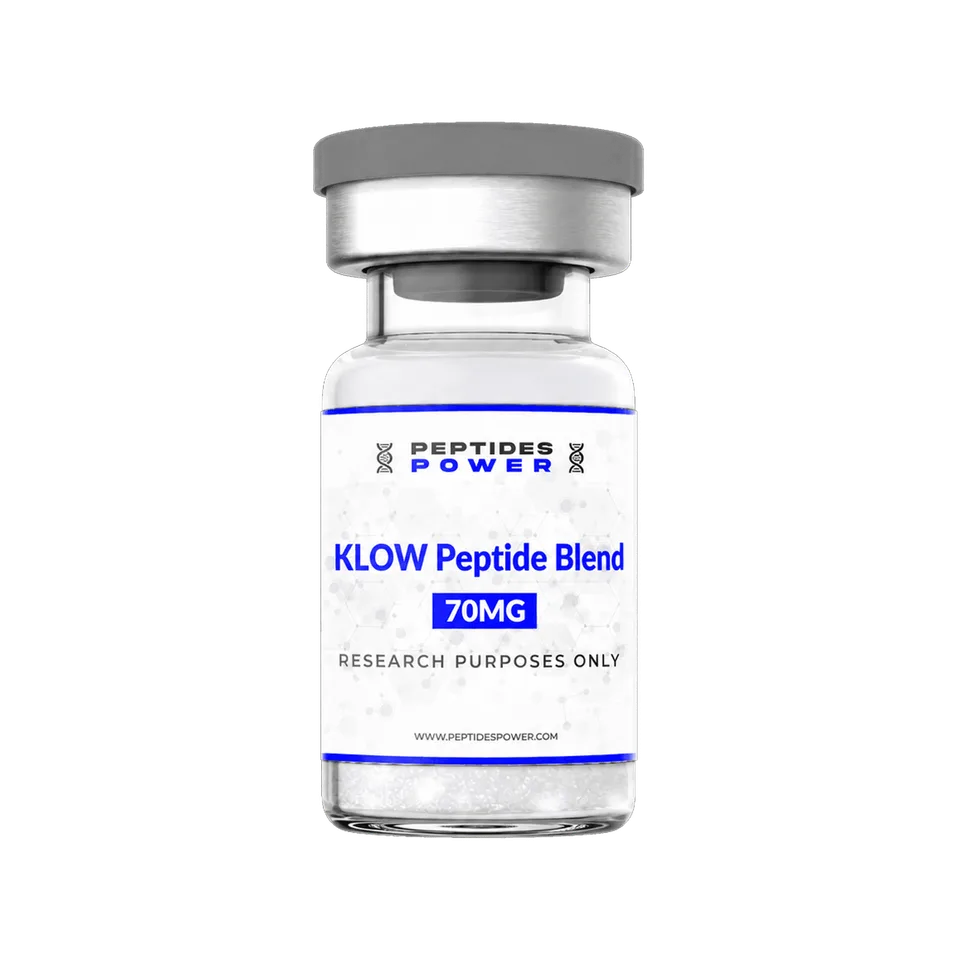
KLOW Peptide Blend
$95
In stock
View product
Dosage information
No human dose of KLOW has been established, and no published study has given the blend to animals or people.12 The amounts on this page come from studies of its single parts: animal studies, small BPC-157 studies in people, and trials of thymosin beta-4 and a GHK-copper gel. They record what researchers used, not guidance for anyone.
This page summarizes published sources for information only. It is not medical advice and does not tell anyone to use a product. Questions about your own health belong with a licensed clinician. For questions about an order or a product, contact us.
No human dose of KLOW has been worked out: no published study has given the blend to animals or people,1 so there is no tested amount, schedule or length of use. The gap extends to its parts: a 2026 review of injectable peptides used in sports medicine states that their indications, dosing, frequency and duration of treatment remain unknown.2 USADA adds that, because BPC-157 has had little study in people, it is unknown whether any dose is safe.3
FDA's 2026 reviews show how thin the human record is. FDA found no study that gave BPC-157 to people under the skin, by mouth, by nasal spray or through the skin,4 no article in which TB-500 was given to people,5 and no data, such as clinical studies, on KPV use in humans.6
These are the amounts researchers used for KLOW's single parts, with species, route and length. They describe the studies, not a dose for anyone, and this page does not convert animal amounts into human ones.
| Peptide | Study | Subjects | Route | Amount and schedule |
|---|---|---|---|---|
| BPC-157 | Achilles tendon (2003) | Rats with a cut tendon | Into the abdominal cavity (intraperitoneal) | 10 µg/kg, 10 ng/kg or 10 pg/kg once daily from 30 minutes after surgery, assessed on days 1, 4, 7, 10 and 147 |
| BPC-157 and TB-500 | Achilles tendon repair (2026) | 32 male rats | Intraperitoneal | BPC-157 10 µg/kg/day and TB-500 60 µg/kg/day, alone or together, for 4 weeks89 |
| BPC-157 | Enema studies (meeting abstracts) | 24 healthy volunteers | Rectal enema | Up to 2 mg/kg once daily for 8 days10 |
| BPC-157 | Ulcerative colitis trial (2005 abstract) | 53 people, BPC-157 or placebo | Rectal enema | 80 mg once daily for 2 weeks11 |
| BPC-157 | Knee pain chart review (2021) | 17 people, as counted by FDA | Into the knee joint | 2 to 4 mg, 1 or 2 doses10 |
| BPC-157 | Interstitial cystitis pilot (2024) | 12 women aged 39 to 76 | Injections around the bladder | 10 mg in total, in one procedure12 |
| BPC-157 | IV safety pilot (2025) | 2 healthy adults | IV infusion | 10 mg on day 1, then 20 mg on day 213 |
| TB-500 | Blood-level study (2012) | Thoroughbred geldings | Under the skin | One 10 mg dose5 |
| Thymosin beta-4, not TB-500 | Phase 1 trial (2010) | 40 healthy volunteers in 4 groups of 10 | IV | 42, 140, 420 or 1,260 mg once, then daily for 14 days14 |
| Thymosin beta-4, not TB-500 | Phase 2 dry eye trial (2015) | 9 people with severe dry eye | Eye drops | 0.1% drops 6 times daily for 28 days15 |
| KPV | Colitis study (2008) | Mice, 10 per group | In drinking water | 100 µM for 8 days16 |
| GHK-Cu | Muscle-loss study (2023) | Mice exposed to cigarette smoke | Intraperitoneal | 0.2 or 2 mg/kg once a week for 7 weeks17 |
| GHK-Cu | Diabetic ulcer trial (1994) | People with diabetic neuropathic ulcers | Gel on the skin | A metered amount daily; gel strength not given in the abstract18 |
Data on how quickly KLOW's parts leave the body come from single doses in animals. After one IV dose, BPC-157's half-life was 5.3 minutes in dogs and 15.2 minutes in rats.19 In horses given 10 mg of TB-500 under the skin, blood levels peaked 1 to 2 hours after dosing and could no longer be measured 6 to 10 hours after dosing.5 FDA found no human pharmacokinetic studies of TB-5005 and no human data for KPV.6 Single-dose animal figures like these do not set a schedule for people.
Dissolving the powder in a measured volume of diluent gives a total peptide concentration in mg per mL. That number describes a lab solution, not a dose, and for KLOW it cannot be split into the concentration of each peptide. The reconstitution calculator and the peptide calculator do this arithmetic, and general background is in Peptide dosage basics.
Start with the full profile, What is KLOW Peptide Blend?. What the studies above found is summarized in KLOW Peptide Blend benefits and uses, and reported harms in KLOW Peptide Blend side effects. Single-peptide pages: TB-500 dosage, KPV dosage and What is BPC-157?. The related three-peptide blend is covered in Glow Peptide Stack dosage.
What published sources report about KLOW Peptide Blend and its uses, with the evidence level of each finding. No promises.
Side effects of KLOW Peptide Blend as reported in studies and FDA reports on its four parts, with links to the full profile. No study has tested the blend.
$95
In stock
View productKLOW Peptide Blend for sale: strengths, stock and shipping are on the product page.
For research use only. Not for human or veterinary use. Read the research use policy.
No length of use has been tested. No study has given KLOW to anyone,1 and a 2026 review states that the duration of treatment for injectable peptides like its parts remains unknown.2 The studies in the table ran from a single dose up to 7 weekly doses in mice, 4 weeks of daily doses in rats and 28 days of daily eye drops in people.517815 FDA found no repeat-dose toxicity study of BPC-157 longer than 28 days.20
No. No schedule has been established for KLOW or for any of its parts in people.12 A 2026 review states that the frequency of treatment for injectable peptides like these remains unknown,2 and FDA found no human pharmacokinetic studies of TB-500.5 The animal data on how fast the parts clear come from single doses, such as a BPC-157 half-life of minutes in rats and dogs,19 and they do not define a schedule for people.
Any monthly figure would assume a dose and schedule, and none has been established for KLOW in people.23 The vial also does not disclose how its total divides between BPC-157, TB-500, KPV and GHK-Cu, so it cannot be split into known amounts of any one peptide. The product page, KLOW Peptide Blend for sale, lists the vial for laboratory research under the research use policy.
No dose for people can be read from these studies. The rat amounts were injected into the abdominal cavity, per kilogram of body weight, after one surgical injury, and they covered one or two peptides, not four.78 No human trial has confirmed any of them, and a 2026 review states that dosing for these injectable peptides remains unknown.2 KLOW's split between its four peptides is also not disclosed, so even a known single-peptide amount could not be located in the vial.
Written by D2C Peptides Editorial Team.
Pending qualified review.
Updated .
D2C Peptides sells peptides for laboratory research. Please confirm both statements to continue.