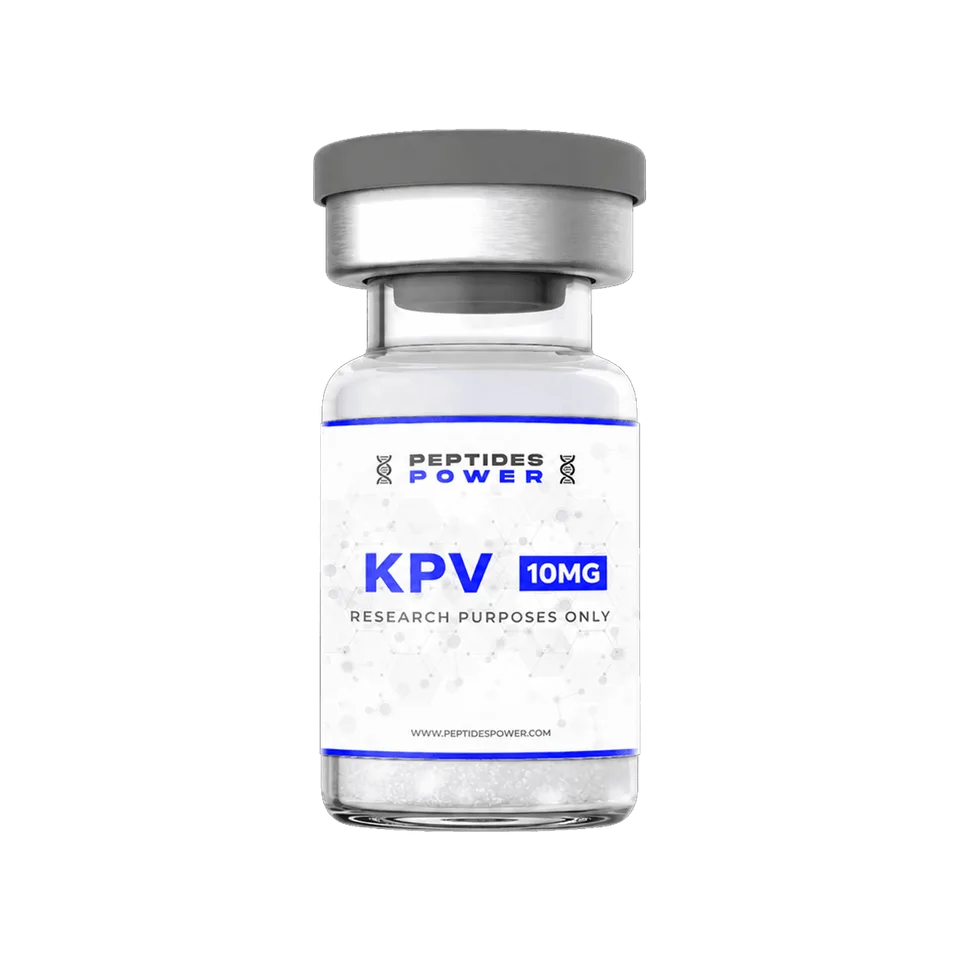
KPV
$60
In stock
View product
Profile
KPV is a tripeptide (lysine, proline, valine) that matches the last three amino acids of alpha-MSH, a natural hormone.12 In cell and animal studies, most often mouse colitis models, it reduced inflammation without alpha-MSH's skin-darkening effect.345 It is not an approved drug, and FDA's 2026 review found no studies in people.6
This page summarizes published sources for information only. It is not medical advice and does not tell anyone to use a product. Questions about your own health belong with a licensed clinician. For questions about an order or a product, contact us.
| Class | Tripeptide (Lys-Pro-Val) matching positions 11 to 13 of alpha-MSH, a melanocortin hormone716 |
|---|---|
| Also known as | alpha-MSH (11-13), Msh (11-13), ACTH-(11-13), lysyl-prolyl-valine; made as free base or KPV acetate26 |
| Forms we sell | 10 mg research vial (white freeze-dried powder)8 |
| Regulatory status | Not FDA approved and not on the 503A bulks list as of October 25, 2026; an FDA advisory committee voted in July 2026 to recommend adding it639910 |
| WADA status | Not named on the 2026 Prohibited List; USADA says the 2027 list names peptides in general under class S03811 |
KPV is a chain of three amino acids, lysine, proline and valine, that matches positions 11 to 13 of alpha-MSH.1 Alpha-MSH is a 13-amino-acid hormone (sequence SYSMEHFRWGKPV) derived from a larger precursor protein, proopiomelanocortin.15 Researchers describe KPV as naturally occurring, and FDA's 2026 review reports that it can be made by solid-phase peptide synthesis.166
PubChem lists KPV free base as CID 125672, with the formula C16H30N4O4 and a molar mass of 342.43 g/mol.7 FDA's substance registry gave it the identifier UNII 7V6LGD8S5R in a record created August 11, 2026.22 FDA notes that KPV is a common name with no official US adopted name, and that it has seen several salts and derivatives sold under that name, so a vial labeled KPV may not hold the substance a researcher expects.6 Researchers who need the compound itself can find KPV for sale as a 10 mg research vial.
The most studied area is mouse colitis, where KPV given in drinking water or in colon-targeted nanoparticles reduced inflammation and sped recovery.3425 Other studies report effects on chemotherapy mouth sores in rats, brain injury in mice, and human skin cells and bacteria in the lab.12141326 FDA concluded that these nonclinical studies suggest anti-inflammatory and wound-healing properties in cell and rodent models.6 Full list: KPV benefits and uses.
FDA's review dated May 12, 2026 found no human study of KPV: its searches of PubMed, Embase, ClinicalTrials.gov and FDA's adverse event databases turned up no clinical studies, human pharmacokinetic data, case reports or human exposure data by any route.6 A ClinicalTrials.gov search on October 24, 2026 returned no registered KPV studies.27 A 2019 review proposed KPV and related peptides as promising future candidates for treating skin wounds and ulcers; that is a proposal, not a trial result.19
| Molecule | What it is | How it differs from KPV |
|---|---|---|
| Alpha-MSH | The 13-amino-acid parent hormone; KPV is its last three amino acids1 | Acts through MC1, MC3, MC4 and MC5 receptors and darkens skin through MC1; a 2010 review of lab and animal research says KPV keeps almost all of its anti-inflammatory capacity628 |
| KdPT (Lys-D-Pro-Thr) | A KPV derivative matching amino acids 193 to 195 of IL-1 beta5 | A different molecule, also reported to be anti-inflammatory without a pigment effect19 |
| (CKPV)2 | Two linked copies of a modified KPV, Ac-Cys-Lys-Pro-Val-NH229 | Reduced Candida vaginal infection in rats, and its effects on macrophages depended on the MC1 receptor29 |
| N-acetylated KPV | A slightly modified KPV; FDA classes the 1989 mouse ear-swelling study as testing this form306 | FDA placed studies of N-acetylated KPV and of the KPV dimer outside its evaluation of KPV itself6 |
The supplier lists KPV as one of four peptides, with BPC-157, TB-500 and GHK-Cu, in the KLOW Peptide Blend.31 All three appear on FDA's list of substances previously in compounding category 2 whose nominations were withdrawn.34 On July 23, 2026, FDA's compounding advisory committee voted to recommend all three for the 503A bulks list; RAPS reported an 8 to 6 vote, with 1 abstention, for BPC-157 and KPV.35910 See the BPC-157 profile, the TB-500 profile and the GHK-Cu profile.
No side effects of KPV in people are documented: FDA found no study of it in people, and its adverse event database held no KPV reports through December 3, 2025.6 FDA warns that peptides such as KPV can trigger immune responses ranging from antibodies with no symptoms to life-threatening reactions, and it found no animal toxicity studies (acute, repeat-dose, genetic, reproductive or cancer).6 Health Canada's list of risks for unauthorized injectable peptides, such as liver or kidney damage and blood clots, describes the class, not effects measured for KPV.15 Full list: KPV side effects.
No human dose of KPV is established: FDA found no clinical studies and no human pharmacokinetic data by any route, so there is no tested dose, schedule or length of use for people.6 Published amounts come from mice, such as KPV dissolved in drinking water for 8 days during induced colitis, or a single abdominal injection after a brain injury.2314 They describe experiments and are not guidance for people. Full list: KPV dosage.
The supplier describes the vial contents as a white freeze-dried solid, says the powder must be mixed with bacteriostatic water, and does not include the water.832 Its storage figures are 36 months at -20 °C or 30 days at 2 to 8 °C, with mixed solutions kept at 2 to 8 °C; these are supplier statements, not independent stability data.8
The lab steps are in the reconstitution guide, the reconstitution calculator handles concentration math, and How to store peptides covers sealed and mixed vials.
KPV is not an approved drug: FDA's review dated May 12, 2026 found that it has no USP or NF monograph and is not a component of any FDA-approved drug.6 As of October 25, 2026, it is not among the substances on the 503A bulks list in federal regulations (21 CFR 216.23).39
KPV used to sit in FDA's compounding category 2, the nominated bulk substances FDA says may present significant safety risks.34 Its nomination was withdrawn: FDA's list, current as of April 22, 2026, files KPV under substances nominated but withdrawn and states that FDA has found no human exposure data for KPV by any route.34
FDA staff recommended against adding KPV, as free base or acetate, to the 503A bulks list.6 They said it is not well characterized, its extent of use in compounding is unknown, and there is no information on its use in humans to judge safety or effectiveness.6 On July 23, 2026, FDA's Pharmacy Compounding Advisory Committee, which FDA had asked to vote separately on the two forms, recommended adding KPV; RAPS reported the tally as 8 to 6, with 1 abstention, in a vote it described as covering BPC-157 and KPV.18910 FDA's meeting page had posted no minutes or vote results as of October 25, 2026, and FDA says its advisory committees make non-binding recommendations.35 NCPA reported that pharmacies may not compound KPV until final rulemaking is in place.10
FDA said that outsourcing facilities (503B) had not reported compounding any drug product containing KPV from January 2017 to June 2025.6 In a June 2026 warning letter to an online peptide seller, about other peptides, FDA stated that despite research-use-only and not-for-human-consumption labels, evidence from the seller's labeling and website established that its products were intended as drugs for human use.36
FDA's 2026 review found no KPV monograph in the European Pharmacopoeia or the Japanese Pharmacopoeia, and no KPV product authorized by the European Medicines Agency.6 Health Canada's advisory of April 9, 2026 lists KPV among unauthorized injectable peptide drugs it has seized, and says research-use-only labeling does not make such products legal or exempt from regulatory requirements.15
KPV is not named on the WADA 2026 Prohibited List, whose class S0 bans at all times any pharmacological substance not covered elsewhere on the list and with no current government approval for human therapeutic use.38 USADA's guide to the 2027 list, in force from January 1, 2027, does not name KPV individually either.11 It says many peptides not approved for human use fall under class S0, non-approved substances, or other classes, and that the 2027 list names peptides in general under S0.11 A 2026 review of peptide use in sport lists KPV among peptides promoted to athletes and bodybuilders.37
The supplier states that its products are for research purposes only and are not intended for human consumption.8 Vials sold here carry the label: For research use only. Not for human or veterinary use.
Published dosing information for KPV from animal and cell studies, with its sources, and why it is not advice for you.
What published sources report about KPV and its uses, with the evidence level of each finding. No promises.
Side effects of KPV as reported in FDA's 2026 review and published studies, with links to the full profile. No study has tested KPV in people.
$60
In stock
View productKPV for sale: strengths, stock and shipping are on the product page.
For research use only. Not for human or veterinary use. Read the research use policy.
In research, KPV has been studied mainly for gut inflammation in mouse colitis models, with smaller lines of work on wounds, skin cells, brain injury and microbes in cells and animals.341213141 None of these uses has been tested in people.6 FDA concluded in 2026 that there is a lack of evidence to evaluate how well KPV works for wound healing or inflammatory conditions.6 Each area and its evidence level is set out in KPV benefits and uses.
No group of people is known to be able to use KPV safely, because FDA found no study of it in people.6 FDA also found no animal toxicity, reproductive or cancer studies, so the risks for anyone, pregnant women included, are unknown.6 Health Canada tells consumers not to use unauthorized injectable peptides such as KPV.15 Athletes also face anti-doping rules on unapproved peptides.11
There is no FDA-approved KPV medicine to prescribe.6 As of October 25, 2026, KPV is also not on FDA's 503A bulks list, the list of bulk substances pharmacies may use to compound drugs.39 On July 23, 2026, FDA's advisory committee voted to recommend adding it, against FDA staff advice; RAPS reported an 8 to 6 tally, with 1 abstention, for BPC-157 and KPV.9 NCPA reported that the vote is not binding and that pharmacies may not compound KPV until final rulemaking is in place.10
No KPV pill is approved.6 Mouse studies gave KPV by mouth, in drinking water or in colon-targeted nanoparticles, and cell studies show uptake through the gut transporter PepT1, but no oral product has been tested in people.3166 FDA notes that websites promote compounded KPV as oral, injectable, topical and nasal spray products.6 The form sold on this site is a freeze-dried powder in a vial.8
No. FDA's review dated May 12, 2026 states that KPV, as free base or acetate, is not a component of any FDA-approved drug and has no USP or NF monograph.6 A search of FDA's Drugs@FDA data on October 24, 2026 found no approved product with KPV as an active ingredient.17 The same FDA review found no KPV product authorized by the European Medicines Agency.6
Not exactly. FDA evaluates KPV free base and KPV acetate as separate bulk drug substances that share one active moiety, and it asked its advisory committee to vote on each form separately.618 The acetate is heavier, 402.5 against 342.43 g/mol, so 10 mg of KPV acetate carries about 8.5 mg of KPV itself (our arithmetic).67 The two forms also dissolve very differently in water, which matters for lab mixing.6
No tanning effect has been reported, though KPV has not been tested in people: reviews report that it lacks the pigment-inducing activity of alpha-MSH, which darkens skin mainly through MC1 receptors on pigment cells, and KPV did not compete for MC1 receptor binding in lab tests.195620 In a 2003 mouse study, Melanotan II raised cyclic AMP in macrophages and KPV did not, though both reduced white-cell build-up in peritonitis.21 See What is Melanotan 2?.
Written by D2C Peptides Editorial Team.
Pending qualified review.
Updated .
D2C Peptides sells peptides for laboratory research. Please confirm both statements to continue.