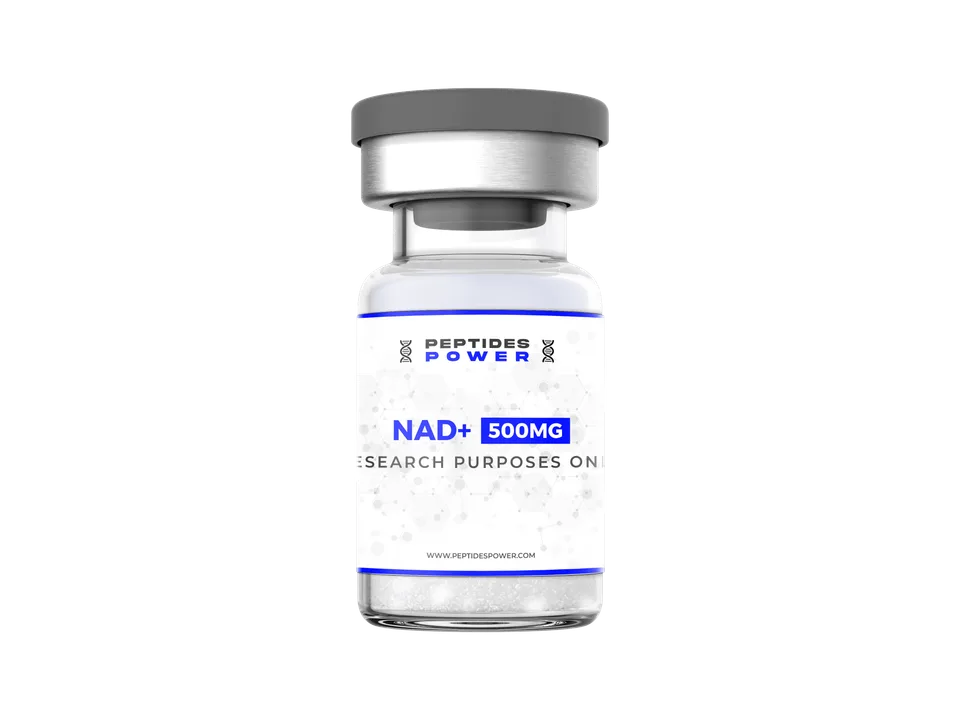
NAD+
$75
In stock
View product
Profile
NAD+ (nicotinamide adenine dinucleotide) is a coenzyme in human cells that carries electrons in energy metabolism and is needed by enzymes such as sirtuins and PARPs.12 It is not a peptide.1 NAD+ injections are not FDA-approved, and human data on the effects of IV NAD+ remain limited.34
This page summarizes published sources for information only. It is not medical advice and does not tell anyone to use a product. Questions about your own health belong with a licensed clinician. For questions about an order or a product, contact us.
| Class | Coenzyme; a dinucleotide of a nicotinamide nucleotide and an adenine nucleotide, not a peptide1 |
|---|---|
| Also known as | Nicotinamide adenine dinucleotide, nadide, beta-NAD, coenzyme I, codehydrogenase I, cozymase I, diphosphopyridine nucleotide (DPN)5 |
| Forms we sell | One vial of freeze-dried NAD+ (500 mg) sold for laboratory research; no diluent included |
| Regulatory status (US) | Not FDA-approved; in 503A Category 1 (under evaluation) on FDA's May 14, 2026 list36 |
| WADA status | The 2026 Prohibited List bans IV infusions or injections over 100 mL per 12 hours outside hospital treatment, surgery or clinical diagnostic investigations, whatever they contain7 |
NAD+ is short for nicotinamide adenine dinucleotide. PubChem files it under the name nadide (CID 5892, CAS 53-84-9) and lists synonyms that include coenzyme I and diphosphopyridine nucleotide.20215 Its structure is two nucleotides, one carrying nicotinamide and one carrying adenine, joined by a pyrophosphate link.1 Because it contains no amino acids, it is not a peptide and has no peptide sequence.1
Inside cells, NAD+ accepts electrons and becomes NADH, then hands them on again.1 This redox cycle makes it central to energy metabolism.2 Enzymes that do not move electrons need it too, including sirtuins and PARPs (poly(ADP-ribose) polymerases).2 NAD+ also donates ADP-ribose groups.1 These roles come from laboratory and animal research. They do not by themselves show that extra NAD+ from outside the body improves health.22
Cells make NAD+ by three routes. The de novo route starts from the amino acid tryptophan and runs through the kynurenine pathway. The Preiss-Handler route starts from nicotinic acid in the diet. The salvage route recycles nicotinamide back into NAD+, and the precursors NR and NMN feed into it.2 Nicotinamide riboside (NR) is described as an NAD+ precursor vitamin.23
NAD+ carries an overall negative charge, so it cannot pass through cell membranes on its own.24 Lower NAD+ levels go along with older age in rodents and people, including in skin samples from 49 people aged from newborn to 77. That is a correlation; it does not show that low NAD+ causes aging.225
Human evidence on NAD+ injections comes from a few small studies. A 2019 pilot gave 8 healthy men one 750 mg IV infusion over 6 hours. There were no adverse events, and plasma NAD+ did not rise for at least the first 2 hours; it was 398% above baseline only at the 6 hour mark.24 A 2026 review of clinic records found that all 6 clients given 500 mg by IV on 4 consecutive days reported moderate to severe symptoms during infusion.4 A 2026 preprint, not yet peer reviewed, tested 100 mg given three ways (IV push, intramuscular, subcutaneous) in groups of 4 to 6 adults.26 These were blood-level and tolerability studies. The authors of the 2026 clinic review state that human data on the efficacy and health effects of IV NAD+ remain limited.4
No controlled human trial in these sources shows that NAD+ injections improve energy, memory or aging.4 Most human data on raising NAD+ come from oral precursors. Oral NR raised NAD+ levels or metabolism in trials of 6 and 8 weeks.2314 Even so, a 2023 review found it has shown few clinically relevant effects.27 Each goal, with its evidence level, is covered in NAD+ benefits and uses.
| Compound | What it is | Human data in these sources | US status |
|---|---|---|---|
| NAD+ | The coenzyme itself1 | IV and injection pilots with 4 to 8 people per NAD+ group24426 | Not FDA-approved; 503A Category 136 |
| NADH | The reduced form of the same coenzyme1 | FDA noted nonclinical data suggesting it is unstable in acid and likely degraded before absorption by mouth16 | 503A Category 16 |
| Nicotinamide riboside (NR) | An oral NAD+ precursor and vitamin B3 form2313 | Raised NAD+ in 6 and 8 week trials; few clinically relevant effects overall231427 | GRAS notice 635 for foods (2016); 503B Category 1 as the chloride133 |
| Nicotinamide mononucleotide (NMN) | An oral precursor, converted to NR outside cells before uptake2 | Raised blood NAD over 60 days; raised muscle insulin sensitivity in a 10 week trial159 | Not reviewed in these sources |
In a 2026 review of clinic records, every one of the 6 clients who received 500 mg of NAD+ by IV reported moderate to severe symptoms during the drip. They included abdominal cramping, diarrhea, nausea, vomiting, a raised heart rate and chest pressure, and they ended when the drip stopped.4 A slower 6 hour infusion of 750 mg caused no adverse events in 8 men.24 FDA has also received adverse event reports of severe chills, shaking, vomiting and fatigue after NAD+ injectable drugs, which it says are consistent with excessive endotoxin levels.28 Full list: NAD+ side effects.
There is no established or approved human dose for NAD+ injection in the US.3 FDA also found too little clinical data to judge NAD's safety in compounded products.16 The studies on record used 750 mg in one 6 hour IV infusion, 500 mg by IV on each of 4 days, or 100 mg per injection.24426 These amounts describe research, not doses for people. Full details: NAD+ dosage.
According to FDA, NAD breaks down substantially at room temperature and with light, moisture or alkaline pH.16 The vial sold here contains freeze-dried NAD+ that must be dissolved before lab work; one registered study prepared 100 mg in 2 mL of bacteriostatic water.29 Steps, supplies and concentration math: How to reconstitute NAD+. The research vial and its matching supplies are listed under NAD+ for sale.
NAD+ is not an FDA-approved drug. On FDA's 503B list, ingredients of approved drugs carry two asterisks, and beta-nicotinamide adenine dinucleotide has none.3 Compounded drugs, including compounded NAD+, are not FDA-approved.12
In an October 2024 notice, FDA said compounders were using food-grade NAD+ from repackagers to make IV products.28 In the GenoGenix case, an unopened vial from a lot linked to three emergency room referrals contained 3,360 EU/mL of bacterial endotoxins.19 The related recall of NAD+ for Injection was classified Class I on October 21, 2025.31 As of October 2026, FDA's enforcement database lists 14 recalls of NAD or NADH products classified from 2017 to 2025, most for lack of sterility assurance.32
A "research use only" label does not settle a product's status either. In February 2025, FDA sent a warning letter to a different online peptide seller about semaglutide and tirzepatide. It said such labels did not change its finding that the products were drugs intended for human use, based on the website.33
A 2026 trial protocol from Beijing Children's Hospital describes injectable Coenzyme I (NAD+) as a marketed product in China (approval number H41024721). It is supplied in 5 mg vials, and its package insert lists coronary heart disease and myocarditis.34 For athletes, the WADA list in force from January 1, 2026 caps IV infusions or injections at 100 mL per 12 hours. The cap applies whatever the drip contains; hospital treatment, surgery and clinical diagnostic investigations are exempt.7
What published sources report about NAD+ and its uses, with the evidence level of each finding. No promises.
Side effects of NAD+ as reported in clinical trials and published studies, with links to the full profile. Reviewed by a qualified reviewer.
How NAD+ is reconstituted, the supplies used, and the calculator, step by step. Sourced and reviewed.
Published dosing information for NAD+ from clinical trials and published studies, with its source, and why it is not advice for you.
$75
In stock
View productNAD+ for sale: strengths, stock and shipping are on the product page.
For research use only. Not for human or veterinary use. Read the research use policy.
No. Ozempic (semaglutide) is an FDA-approved GLP-1 receptor agonist used with diet and exercise to improve blood sugar control in adults with type 2 diabetes.8 NAD+ is a coenzyme, not a GLP-1 drug, and has no FDA approval.13 Oral NAD+ precursor trials did not show weight loss: ten weeks of NMN left body weight and fat unchanged in 25 women with prediabetes,9 and twelve weeks of NR had no effect on body composition in 40 obese men.10 More on the brand: What is Ozempic?
Not as an approved product in the US. NAD is in FDA's 503A Category 1.6 FDA does not intend to act against licensed pharmacies or physicians compounding with Category 1 substances when its conditions are met.11 Compounding under section 503A needs a valid patient-specific prescription, and compounded drugs are not FDA-approved.12 Even so, the authors of a 2026 clinic study note that IV NAD+ has become widely available in commercial clinics.4
No, but the two are linked. Cells turn vitamin precursors such as nicotinic acid and nicotinamide riboside into NAD+, recycle nicotinamide into it, and can also build it from the amino acid tryptophan.2 A dietary lack of niacin causes the disease pellagra, with low NAD+ levels.2 In 2016, FDA had no questions about nicotinamide riboside chloride as a source of vitamin B3 in foods.13 NAD+ itself is the finished coenzyme.
The oral trials reviewed here tested NAD+ precursors rather than NAD+ itself: nicotinamide riboside (NR) and nicotinamide mononucleotide (NMN). In an 8-week trial of 140 adults, oral NR raised whole-blood NAD+ in step with the amount taken.14 Oral NMN raised blood NAD over 60 days in 80 adults.15 FDA noted that nonclinical data suggest NADH, the reduced form, is unstable in acid and likely broken down before absorption when swallowed.16
MOTS-c is a 16 amino acid peptide encoded in mitochondrial DNA.17 In mice, it prevented insulin resistance linked to age and to a high-fat diet.17 NAD+ is not a peptide at all. It is a dinucleotide coenzyme that carries electrons in energy metabolism and supports enzymes such as sirtuins.12 For the peptide's own evidence, see What is MOTS-c?
No. 5-Amino-1MQ (5-amino-1-methylquinolinium) is, as its name shows, an amine-substituted methylquinolinium. Compounds of that type block the enzyme NNMT, and a potent one was tested in mice with diet-induced obesity.18 NAD+ is a coenzyme. FDA's January 2026 warning letter to the outsourcing facility GenoGenix named the two as separate substances, neither on the 503B bulks list.19
Written by D2C Peptides Editorial Team.
Pending qualified review.
Updated .
D2C Peptides sells peptides for laboratory research. Please confirm both statements to continue.