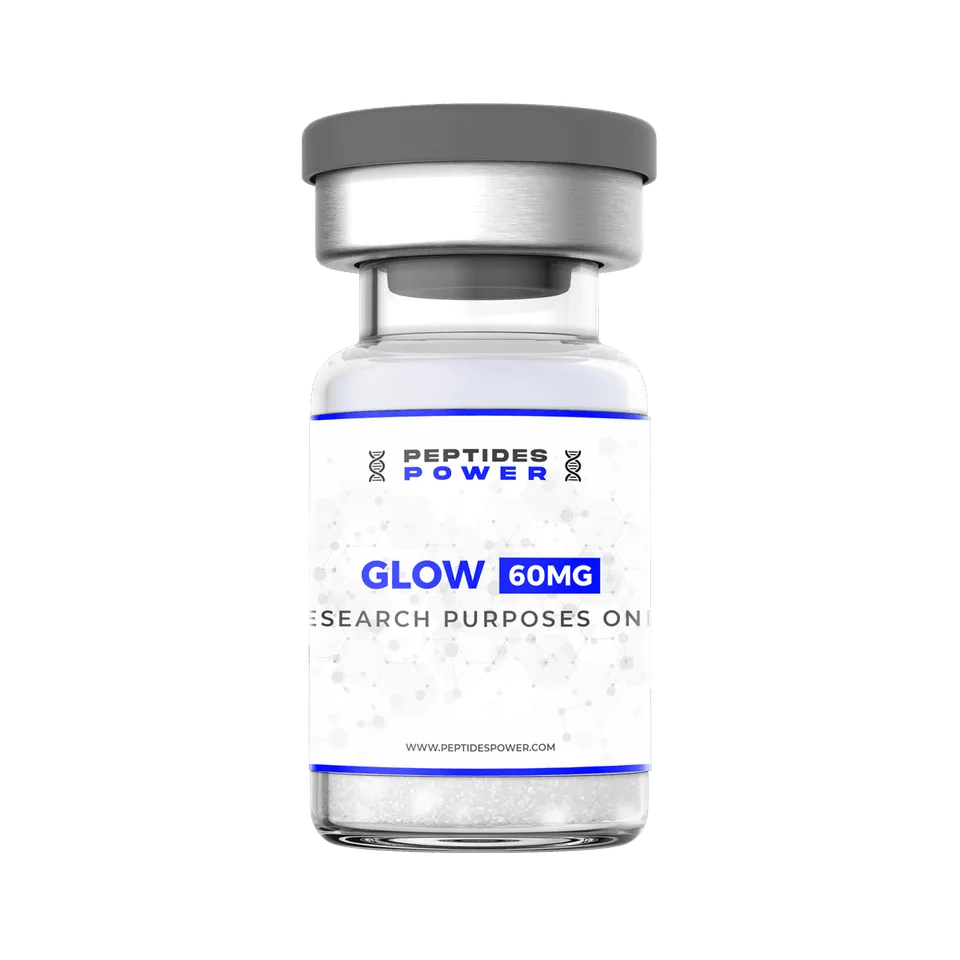
Glow Peptide Stack
$85
In stock
View product
Benefits and uses
Glow peptide benefits are inferred from studies of its single ingredients, because no published study has tested the blend.1 The human data are mostly small topical GHK-Cu skin studies, and the BPC-157 and TB-500 evidence comes mainly from animals.23 Each finding below carries its evidence level, from cell studies to randomized trials.
This page summarizes published sources for information only. It is not medical advice and does not tell anyone to use a product. Questions about your own health belong with a licensed clinician. For questions about an order or a product, contact us.
Glow is promoted mainly for skin, but no published study has tested the blend, so every claimed benefit is borrowed from research on one ingredient at a time.1 That research spans very different levels of evidence:
| Claimed benefit | Ingredient studied | Strongest evidence found | Evidence level |
|---|---|---|---|
| Firmer, smoother skin | GHK-Cu on the skin | 12-week creams in 71 and 41 women4 | Human, conference abstracts |
| Wound healing | GHK-Cu on the skin | Gel on diabetic foot ulcers, 19945 | Human, randomized and placebo-controlled |
| Hair growth | GHK-Cu on the skin | Eyebrow serum in 18 adults, 20266 | Human, small, conference poster |
| Tendon and ligament repair | TB-500, BPC-157, GHK-Cu | Rat tendon and ligament studies78 | Animal |
| Knee pain | BPC-157 by injection | Chart review of 16 patients9 | Human, uncontrolled |
| Muscle repair | GHK-Cu, BPC-157 | Mouse study; one human trial registered1011 | Animal |
| Collagen production | GHK-Cu | Fibroblast cultures12 | Cell study |
Two cautions apply across the GHK-Cu literature. First, about 35% of the primary research counted in a 2026 systematic review includes Loren Pickart or Anna Margolina of Skin Biology Inc. as an author.2 Pickart first isolated the peptide and held commercial interests in the field for decades.2 The review calls this group's work scientifically substantive but says the concentration of authorship limits the independence of the evidence.2 Second, the 71- and 41-woman cream studies are known only from 2002 dermatology meeting proceedings cited in the pair's 2018 review.4
In the lab, GHK-Cu raised collagen output by cultured fibroblasts and increased connective tissue in rat wound chambers.1215 A 2026 systematic review of 64 records still judged the human literature thin and fragmented.2
No published study has tested Glow on hair.1 A lab study of human hair follicles kept in culture used AHK-Cu, a different copper peptide, not GHK-Cu; AHK-Cu lengthened the follicles.16 In 18 adults, a 2% GHK-Cu serum applied to one eyebrow twice daily for 12 weeks increased hair count. The placebo side showed no significant change, and the study was published as a conference poster.176 A GHK complex with 5-aminolevulinic acid, not GHK-Cu, raised hair counts in 45 men with pattern hair loss over 6 months. Counts rose by 52.6 and 71.5 at two strengths, versus 9.6 with placebo.18
A 2026 orthopaedic review found no clinical data supporting GHK-Cu for musculoskeletal conditions.22
It is unknown whether the three peptides do anything together, because no published study has tested the blend.1 FDA found no human studies of TB-500, and most human GHK-Cu trials used creams on the skin.202
Related reading: What is Glow Peptide Stack?, Glow Peptide Stack side effects and Glow Peptide Stack dosage. Goal overviews: Peptides and skin and hair and Peptides and healing and recovery. Ingredient profiles: What is GHK-Cu?, What is BPC-157? and What is TB-500?. The research vial: Glow Peptide Stack for sale.
Published dosing information for Glow Peptide Stack from studies of its ingredients, with its sources, and why it is not advice for you.
Side effects of Glow Peptide Stack as reported in case reports, small studies of its ingredients and animal research, with links to the full profile.
$85
In stock
View productGlow Peptide Stack for sale: strengths, stock and shipping are on the product page.
For research use only. Not for human or veterinary use. Read the research use policy.
There are no published results for the blend itself.1 Reported results come from single-ingredient research. Examples are a 12-week GHK-Cu face cream study in 71 women, reported at a 2002 dermatology meeting, and rat studies of BPC-157 and TB-500.47 FDA found no published study in which TB-500 was given to humans.20
Unknown. No study has measured how quickly the blend acts.1 The GHK-Cu face and eye cream studies judged skin after 12 weeks, and the rat tendon study measured strength after 4 weeks.47 Neither tested the blend or injected GHK-Cu, and those time points were study designs, not measures of how fast anything works.
It is the same named ingredient, used a different way. Most randomized GHK-Cu trials are small studies of facial creams, where the complex is listed as copper tripeptide-1.224 In a lab test on human skin samples, copper from a 0.68% copper tripeptide solution crossed the skin over 48 hours.25 No controlled human trial of injected GHK-Cu exists.26
Written by D2C Peptides Editorial Team.
Pending qualified review.
Updated .
D2C Peptides sells peptides for laboratory research. Please confirm both statements to continue.