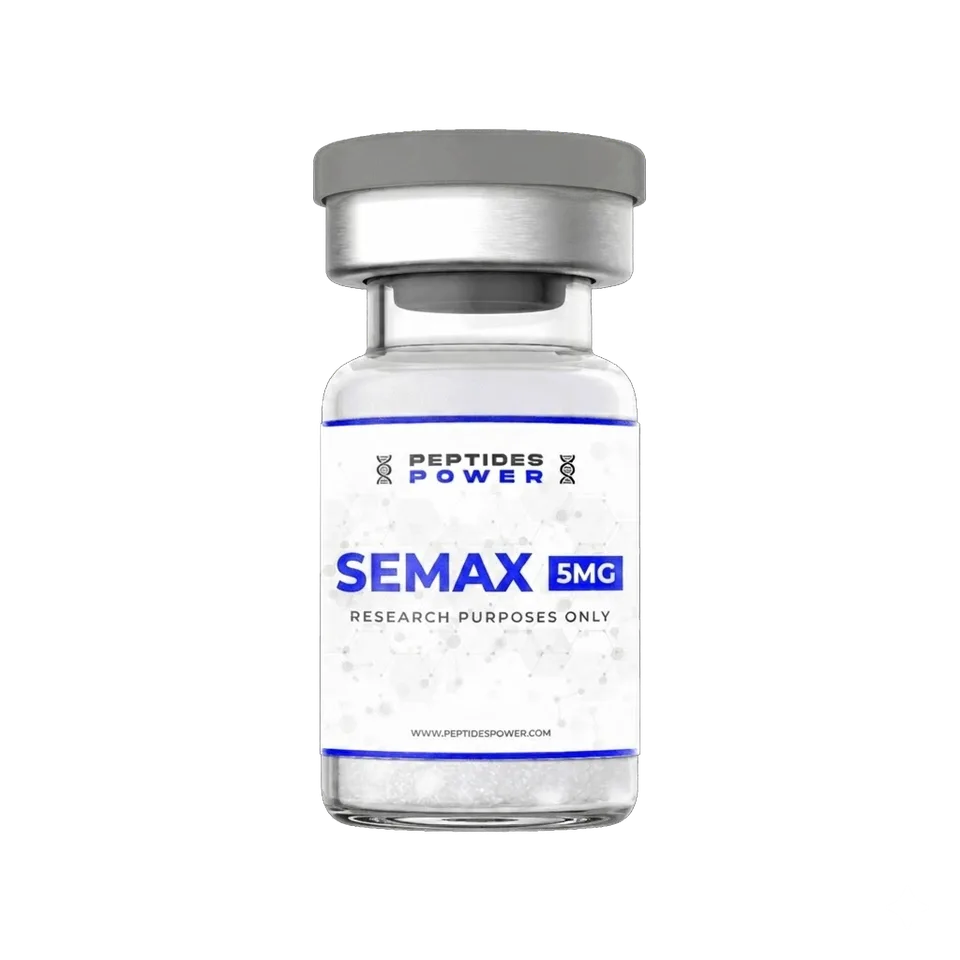
Semax
$35
In stock
View product
Profile
Semax is a short synthetic peptide (7 amino acids: Met-Glu-His-Phe-Pro-Gly-Pro) built from part of the hormone ACTH and designed as an analog of the ACTH(4-10) fragment.1237 In Russia it is a listed vital and essential drug, used for neurological conditions.4 It is not FDA-approved, and a 2026 review notes its Russian record lacks independent Western validation.56
This page summarizes published sources for information only. It is not medical advice and does not tell anyone to use a product. Questions about your own health belong with a licensed clinician. For questions about an order or a product, contact us.
| Class | Heptapeptide (7 amino acids) designed as an analog of the ACTH(4-10) fragment of the hormone ACTH137 |
|---|---|
| Also known as | ACTH(4-7)PGP, "ACTH (4-7), Pro-Gly-Pro-" (PubChem record title)81 |
| Forms we sell | 5 mg research vial (freeze-dried powder) |
| Regulatory status | Not FDA-approved; on Russia's List of Vital and Essential Drugs; listed by FDA among withdrawn category 2 compounding nominations549 |
| WADA status | Not named on WADA's 2026 Prohibited List; reviews disagree on whether it is prohibited (a 2025 review: unclear, citing its resemblance to the class S2 substance tetracosactide)521053 |
Semax is a 7-amino-acid peptide with the sequence Met-Glu-His-Phe-Pro-Gly-Pro, or MEHFPGP in one-letter code.2 Its first four amino acids repeat the ACTH sequence at positions 4 to 7, and the Pro-Gly-Pro tripeptide on the end completes a molecule designed as an analog of the natural ACTH(4-10) fragment.13 PubChem lists the formula C37H51N9O10S and a molar mass of 813.9 g/mol.1 Despite that origin, a 2007 paper describes Semax as completely devoid of hormonal activity.12
Semax is a Russian drug.33 Its developers looked back on about 15 years of design and study work in a 1997 review, and scientists at the Institute of Molecular Genetics of the Russian Academy of Sciences make the peptide for their studies.2324 Russian researchers report many years of use in neurological practice for acute and chronic disorders, including stroke.824
The mechanism research comes from animals and lab samples:
The human studies below come mostly from Russian groups, and most enrolled patients with stroke or other brain disorders.
| Study | People | Design | What was reported |
|---|---|---|---|
| Acute ischemic stroke, 1997 | 30 given Semax, 80 controls | Comparison with conventionally treated patients; randomization and blinding not described30 | Some influence on the rate of neurological recovery30 |
| Acute ischemic stroke, 1999 | Not given in the abstract | Retrospective comparison31 | Immune and biochemical markers shifted toward anti-inflammatory reactions31 |
| Brain damage after oxygen loss, 1999 | 73 | No control group described32 | Effective in patients with memory disorders32 |
| Optic nerve disease, 2000 | Not given in the abstract | 3 groups, one of them a control group33 | Better intensity and speed of visual recovery when added to standard therapy33 |
| Cerebrovascular insufficiency, 2005 | 187 | No control group described34 | Significant clinical improvement and stabilized disease progression34 |
| Motor neuron disease, 2007 | 27 | Open-label, sequential groups15 | No effect on chronic partial denervation (EMG) or clinical scores; better overall quality-of-life score35 |
| Stroke rehabilitation, 2018 | 110 | Semax and no-Semax subgroups; randomization not described16 | Higher blood BDNF; Semax and high BDNF levels sped improvement and raised the final Barthel (daily-living) score21 |
| Healthy adults, 2018 | 14 given Semax, 10 placebo | Placebo-controlled, single nasal dose22 | Greater volume of the front (medial frontal) subcomponent of the default mode network on resting fMRI22 |
| Healthy adults, 2020 | 52 | Semax, Selank or placebo19 | Changes in brain connectivity on fMRI19 |
None of the patient studies above is described in its abstract as randomized, blinded and placebo-controlled, and the two healthy-volunteer studies measured brain networks, not memory or focus.303132333415162219 The developers' 1997 review also stated that Semax significantly improves memory and attention in healthy men working under extreme conditions, but the data behind that claim were not available for review.23
Researchers who need the compound for lab work can buy Semax as a freeze-dried research vial. The goal page Peptides and focus and memory maps other compounds studied for thinking and memory, and What is Selank? covers a related peptide.
Human side-effect data are thin.6 In 187 patients with cerebrovascular insufficiency, investigators reported a minor percentage of side effects and good tolerance, without naming the effects.34 In 73 patients with brain damage after oxygen loss, some showed bursts of abnormal electrical activity on EEG (paroxysmal activity) after Semax was given, and the authors advised monitoring brain activity during the first dose.39 The developers' 1997 review stated that Semax produced no negative side effects or complications in any case.23
A 2026 review cautions that the lack of serious adverse events in the Russian literature is encouraging but not enough for firm safety conclusions.6 FDA says compounded Semax may provoke an unwanted immune response (immunogenicity) for some routes, because of potential aggregation (clumping) and peptide-related impurities.18
A 2007 paper notes that, in animal studies, Semax can augment the effects of psychostimulants on dopamine release, as in the rodent amphetamine results above.1213 A 2026 review warns that an online product labeled as a given peptide may hold the wrong dose, a degraded compound or impurities, and it names Semax among peptides whose online presence may run ahead of their human evidence and safety data.40 Health Canada warns that unauthorized injectable peptides, including the Semax products named in its 2025 advisory, may cause infection and allergic reactions.41
No human dose of Semax is established in the US: FDA has approved no Semax product, and it has no, or limited, safety information for the routes proposed for compounded Semax.518 The doses below come from small Russian human studies or from animal studies. They are research context, not guidance for people.
| Study | People | Route and dose | Schedule |
|---|---|---|---|
| Acute ischemic stroke, 1997 | 30 patients | Route not stated; 12 mg a day for moderate strokes and 18 mg a day for severe strokes, the doses the authors found most effective14 | Courses of 5 and 10 days14 |
| Motor neuron disease, 2007 | 27 patients | Nasal, 1% solution, 12 mg a day15 | Two 10-day courses with a 2-week break15 |
| Stroke rehabilitation, 2018 | Semax subgroups of 110 adults | Route not stated; 6 mg (6,000 micrograms) a day16 | Two 10-day courses 20 days apart16 |
| Healthy adults, 2018 | 14 given Semax | Nasal, 1% solution; amount not given in the abstract22 | Single dose22 |
The developers' 1997 review reported effects lasting 20 to 24 hours after nasal doses of 0.015 to 0.050 mg/kg in animals and people, even though a rat study found the peptide itself is broken down rapidly by enzymes.4228
Animal studies used these doses:
Animal doses are not human doses, and none of these studies was designed to set one.
The human studies that give a strength used a 1% solution given into the nose, and no published steps for dissolving Semax powder were found.1522 What applies to a freeze-dried vial is general guidance from peptide makers.
Bachem notes that freeze-dried peptides can ship at room temperature and can be kept in a refrigerator at 4 °C for short-term use, while longer storage calls for a tightly closed container below -15 °C, colder being better.43 GenScript recommends -20 °C away from bright light.44
Semax's sequence calls for care on two counts. It contains methionine, which GenScript flags as prone to oxidation, and Bachem notes that peptides containing methionine have limited shelf lives and need special care against oxidation once dissolved.2444345 It also contains glutamic acid and histidine, which GenScript lists among the amino acids that make a peptide absorb moisture from the air.44 Bachem advises warming a cold peptide to room temperature in a desiccator before opening it.45
Once dissolved, peptides keep far less well.44 Bachem advises against storing peptides in solution, even sterile and oxygen-free solution, because they may slowly degrade; frozen solutions may keep for a few weeks, and long-term storage of solutions is not recommended, especially for peptides containing methionine.4345 How to reconstitute a peptide vial sets out the bench steps, the reconstitution calculator converts a chosen diluent volume into a concentration, and How to store peptides explains cold storage.
United States: FDA has not approved Semax.549 On FDA's list of bulk substances that may present significant safety risks in compounding, Semax (heptapeptide) sits in the table of former category 2 nominations that their nominators withdrew, with the immunogenicity warning described above.918 An April 1, 2020 FDA warning letter to Tailor Made Compounding named Semax among the bulk substances in drugs that did not qualify for the compounding exemptions: none of those substances had a USP or NF monograph, was part of an FDA-approved drug or appeared on the 503A bulks list.46 A November 10, 2021 letter to another compounding business noted that Semax had not then been nominated for the list.47
FDA's Pharmacy Compounding Advisory Committee met on July 24, 2026 to discuss Semax (free base and acetate) for cerebral ischemia, migraine and trigeminal neuralgia.48 News and legal reports say the committee narrowly voted to recommend Semax for the 503A bulks list, although FDA's career scientists had recommended against it.4950 The vote is advisory and non-binding: FDA decides whether to accept it, and adding a substance to the bulks list requires notice-and-comment rulemaking.50 FDA's meeting page showed no minutes or vote results when checked on October 25, 2026.48
Russia: Semax is on the Russian List of Vital and Essential Drugs for Medical Application and is used to treat neurological disorders and stress conditions.4
Canada and seized products: Health Canada's 2025 advisory covered peptides seized from, or sold by, the company Canada Peptide, Semax among them, and it notes that injectable peptides are prescription drugs in Canada.41 A 2020 study of seized pharmaceutical preparations found Semax and Selank, and reported that such peptides were freely available online as powder for injection or in nasal sprays.51
Sport: WADA's 2026 Prohibited List does not name Semax.52 A 2025 review rated its status unclear, presuming it may meet WADA's criteria because it resembles tetracosactide, a class S2 substance, while a 2026 review states that WADA prohibits it.1053
$35
In stock
View productSemax for sale: strengths, stock and shipping are on the product page.
For research use only. Not for human or veterinary use. Read the research use policy.
The evidence is limited.11 In 2026, a Russian expert council on add-on drug treatment for ADHD in children and adolescents placed Semax in Group B, drugs with a limited evidence base, and advised such drugs only within a multidisciplinary approach.11 The 2007 paper that proposed Semax for ADHD offered a hypothesis, not trial data.12 In rodents, Semax strongly amplified the dopamine release caused by D-amphetamine, and no data on combining Semax with stimulant medicines in people were found.13
No human dose or schedule is established in the US, and Semax is not FDA-approved.5 In published Russian patient studies, Semax was given daily in courses of 5 to 10 days, and two studies repeated the course after a break of 2 weeks or 20 days.141516 Those were study regimens, not guidance for people. The Dosage information section lists each regimen and its route.
Semax is not approved by FDA, and a search of ClinicalTrials.gov, the trial registry run by the US National Library of Medicine, found no Semax study in October 2026.54917 Its clinical research comes mostly from Russia, and a 2026 review says that decades of Russian use have not been independently validated or followed by systematic safety surveillance under Western regulatory frameworks.6 FDA says it has no, or limited, safety information for the routes proposed for compounded Semax.18
Neither one has been shown to outperform the other.19 The only human comparison found, a 2020 brain-scan study of 52 healthy adults, measured brain connectivity rather than symptoms, and its authors describe Selank as anxiolytic and Semax as nootropic.19 The two share only a Pro-Gly-Pro end: Semax is Met-Glu-His-Phe-Pro-Gly-Pro and Selank is Thr-Lys-Pro-Arg-Pro-Gly-Pro.7 In lab tests on human serum, Semax's IC50 against enkephalin-degrading enzymes was half Selank's (10 vs 20 micromolar).7 See What is Selank?.
In rats it does. A single dose raised BDNF (brain-derived neurotrophic factor) protein in the hippocampus up to 1.4-fold, and nasal doses raised BDNF in the basal forebrain 3 hours later.320 In a Russian study of 110 stroke patients, Semax raised blood BDNF whatever the timing of rehabilitation.21 The two controlled studies in healthy adults measured brain networks on scans, and neither abstract reports a memory or focus result.2219
Written by D2C Peptides Editorial Team.
Pending qualified review.
Updated .
D2C Peptides sells peptides for laboratory research. Please confirm both statements to continue.