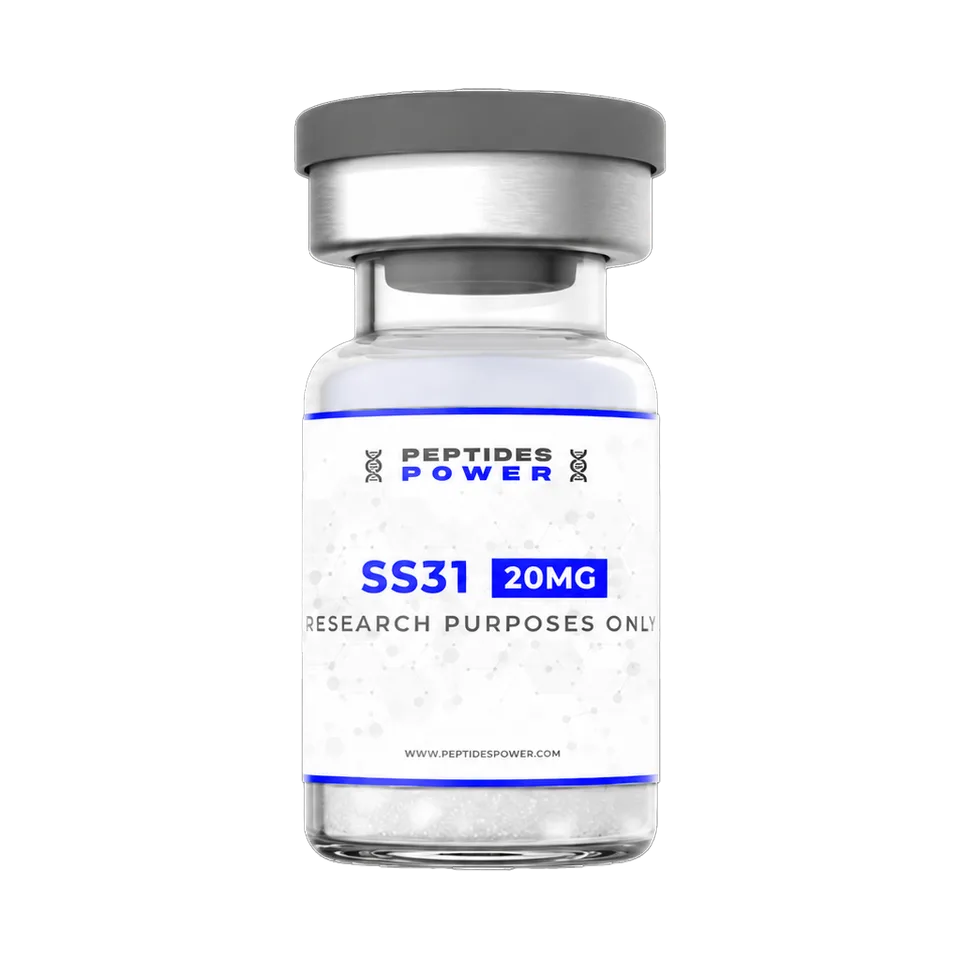
SS-31
$85
In stock
View product
Profile
SS-31 is the research name for elamipretide, a lab-made peptide of four amino acids that binds cardiolipin, a lipid in the inner membrane of mitochondria.51 In September 2025, FDA granted accelerated approval to an elamipretide injection, Forzinity, for Barth syndrome in patients weighing at least 30 kg.2 Research-grade SS-31 has no FDA approval.36
This page summarizes published sources for information only. It is not medical advice and does not tell anyone to use a product. Questions about your own health belong with a licensed clinician. For questions about an order or a product, contact us.
| Class | Synthetic tetrapeptide with alternating aromatic and positively charged amino acids; described in its FDA label as a mitochondrial cardiolipin binder14 |
|---|---|
| Also known as | Elamipretide, MTP-131, Bendavia, Ocuvia; the approved medicine is sold as Forzinity513 |
| Forms we sell | Research vials in 20 mg, labeled for research use only |
| Approved use | Forzinity only: to improve muscle strength in Barth syndrome, in patients weighing at least 30 kg (accelerated approval)4 |
| Regulatory status | Prescription drug under NDA 215244, approved September 19, 2025; research-grade SS-31 has no FDA approval36 |
| WADA status | Not named on the 2026 Prohibited List; no WADA ruling specific to elamipretide was found7 |
The SS-31 peptide (also written SS 31 or SS31) is the most studied of the Szeto-Schiller peptides.1 These are short synthetic chains that alternate aromatic and positively charged amino acids.1 Hazel H. Szeto of Weill Cornell Medical College described the series with P. W. Schiller.19 The peptides were licensed to Stealth Peptides, and Szeto is named as the inventor of SS-31 and founder of Stealth BioTherapeutics.1516 In 2026 that company renamed itself Mighty Therapeutics.17
The FDA label describes elamipretide as a mitochondrial cardiolipin binder that settles in the inner mitochondrial membrane and improves mitochondrial structure and function.4 Cardiolipin is a lipid of that membrane.11 In lab tests, SS-31 bound it tightly and kept it from converting cytochrome c into a peroxidase, an enzyme activity that attacks cardiolipin.11 The inventor's review adds that cytochrome c kept its normal electron-carrying role.1 Earlier papers by the inventor described the SS peptides as antioxidants that scavenge hydrogen peroxide and peroxynitrite.18
FDA's 2024 review of the animal and cell data was more cautious.13 It found that elamipretide reaches the inner membrane only for a short time, with qualitative improvements in heart mitochondrial structure and energy production, and that how long it stays in cells in living bodies is unknown.13 It did not change the ratio of monolysocardiolipin to cardiolipin in Barth syndrome models.13 In mice with a Barth syndrome gene knockdown, it did not persuasively improve heart function or structure.13
Elamipretide has been tested in people with Barth syndrome, primary mitochondrial myopathy, heart failure, heart attack, kidney artery disease, eye diseases and aging muscle.1319 In 2024, FDA reviewers wrote that benefits seen in small early trials did not hold up in later ones.13 Larger phase 2 and 3 trials did not demonstrate an effect on clinical outcomes.13 Three authors of the 168-week Barth syndrome extension report were employees of the developer.20
The one approval, for Barth syndrome, rests on knee strength gains seen in an open-label extension.21 The 12-week randomized part before it missed its primary endpoints, walking distance and fatigue.4 We found no published trial of SS-31 for anti-aging, weight loss or muscle building in healthy people. In 39 older adults, one infusion briefly raised a muscle energy measure without improving fatigue resistance.14 Each finding, with its trial size and evidence level, is on SS-31 benefits and uses.
In the 12-patient Barth syndrome trial, every patient had an injection site reaction on elamipretide, against 67% on placebo.4 Redness, pain, hardening and itching were the most common.4 The label also warns of allergic reactions, some needing emergency care.4 Eosinophils, a type of white blood cell, often rose for a time without causing symptoms.4 Cancer studies had not been done at approval, so FDA required them afterward.422 Full list: SS-31 side effects.
The only established human dose comes from the Forzinity label, and the prescriber sets it.4 For Barth syndrome patients who weigh 30 kg or more, the label dose is 40 mg under the skin once a day.4 The label lowers this to 20 mg for adults with severe kidney impairment who are not on dialysis.4 Trials in other conditions used 4 to 60 mg a day under the skin, or infusions dosed by body weight, under medical supervision.232425 The label covers Barth syndrome only, so no dose is established for any other use or for research-grade SS-31.4 Full details: SS-31 dosage.
Forzinity needs no mixing. It is a ready-to-use sterile solution of 280 mg in 3.5 mL (80 mg/mL), clear and colorless to yellow.4 Single-patient-use vials come four to a carton.4 Its label says unopened vials belong in a refrigerator, between 36 and 46°F (2 and 8°C), never frozen.4 After the first dose, an opened vial may stay refrigerated or at 20 to 25°C (68 to 77°F).4 It is discarded 8 days after first opening, and FDA set an expiry of 48 months from manufacture.422
Research-grade SS-31 is a different product, made outside that approval.3 The research vial listed as SS-31 for sale holds dry powder, a form for which no label or study sets mixing or storage conditions. General lab steps for freeze-dried peptides (diluent, sterile technique, concentration math and storage) are in How to reconstitute a peptide vial. The reconstitution calculator handles the arithmetic, and How to store peptides covers storage.
Approval. FDA approved Forzinity on September 19, 2025 under NDA 215244, as a new molecular entity given priority review and orphan status.3 It also received a rare pediatric disease designation, and the sponsor received a rare pediatric disease priority review voucher.2 The approval is accelerated. It rests on knee extensor strength, an intermediate measure FDA judged reasonably likely to predict real gains, like easier standing or longer walks.24
Confirmation. FDA requires a randomized, double-blind, placebo-controlled trial in Barth syndrome patients aged 5 and older.22 It is due to finish in September 2029, with a final report in March 2030.22 A trial built to confirm the benefit, 4TAZPower (NCT07531251), started on July 2, 2026 and plans to enroll 48 males aged 5 to 55 for 72 weeks of treatment.26
The path there. FDA refused to file a first application, submitted in August 2021.13 The company resubmitted on January 29, 2024, and an FDA advisory committee met on October 10, 2024.2213 FDA issued a complete response letter on May 15, 2025.22 The company said FDA proposed an accelerated approval path, based on knee extensor strength, that required resubmission; FDA also cited a third-party manufacturing inspection and raised no concerns about clinical safety data.27 The company responded on August 15, 2025, and approval followed on September 19, 2025.22
Younger patients and access. Safety and effectiveness are not established under 30 kg.4 The company has said it agreed with FDA on a 1-month drug-level study in children under 30 kg.28 That study could support a 2027 application covering children as young as 5.28 Treating physicians can also request elamipretide through an expanded access program for genetically confirmed rare mitochondrial diseases.29
Other uses. These remain investigational. A phase 3 trial in dry age-related macular degeneration, ReNEW, enrolled 313 people, with results expected in late 2027.3031
Research-grade SS-31. No research-grade product is approved; FDA's approval covers Forzinity under NDA 215244.3 On August 24, 2026, FDA warning letters told four online sellers that their SS-31 products were unapproved new drugs.832633 Each letter said that despite "research use only" labels, evidence from the seller's website showed the products were intended as drugs for human use.832633 All four also cited the sellers' bacteriostatic water: three for marketing it as a solvent for their products, one for selling it alongside a peptide guide and calculator.863332 FDA said this provides the means to prepare an injectable drug for human use.832633 A December 2025 letter to an ingredient distributor listed elamipretide (SS-31) acetate as ineligible for human drug compounding under section 503A.34
Sport. SS-31 is not named on the WADA 2026 Prohibited List.7 The list does name MOTS-c as a metabolic modulator and BPC-157 as an example of a non-approved substance.7
Published dosing information for SS-31 from labels and studies, with its source, and why it is not advice for you.
What published sources report about SS-31 and its uses, with the evidence level of each finding. No promises.
Side effects of SS-31 as reported in labels, trials and published studies, with links to the full profile. Reviewed by a qualified reviewer.
$85
In stock
View productSS-31 for sale: strengths, stock and shipping are on the product page.
For research use only. Not for human or veterinary use. Read the research use policy.
Only as one prescription product. On September 19, 2025, FDA granted accelerated approval to Forzinity, an elamipretide (SS-31) injection.2 It is approved to improve muscle strength in Barth syndrome patients weighing at least 30 kg.4 Research-grade SS-31 vials are not approved: in August 2026, FDA warning letters to four online sellers called their SS-31 products unapproved new drugs.832633
Its drug name is elamipretide.5 In the literature it has also been called MTP-131 and Bendavia, and PubChem lists Ocuvia among its synonyms.15 The FDA-approved medicine that contains it is Forzinity.3 The letters SS stand for Szeto-Schiller, after Hazel H. Szeto and P. W. Schiller, the scientists behind the peptide series.19
In lab studies, SS-31 enters cells and collects at the inner membrane of mitochondria, where it binds cardiolipin, a membrane lipid involved in energy production.101 In people, the one effect shown well enough for approval is a knee strength gain in Barth syndrome.4 Even that still awaits a confirmatory trial.2 Most evidence on energy output and oxidative stress comes from cell and animal studies.1112
We found no human trial of SS-31 combined with other peptides, so there is no evidence on stacking it. The Forzinity label says not to mix other products in the same syringe, and its interaction studies cover medicines such as aspirin and clopidogrel, not peptides.4 FDA's August 2026 warning letters named several peptides sold for research use, SS-31 among them, as unapproved new drugs.8 Our blends and stacks overview covers combined products in general.
After an injection under the skin, blood levels peak 0.5 to 1 hour later.4 FDA reviewers report a plasma half-life of about 3 to 4 hours.13 The drug is broken down into inactive fragments and leaves in the urine, with about 100% of a dose recovered within 48 hours in people with normal kidney function.4 In older adults given one infusion, no difference from placebo in muscle energy remained on day 7.14
SS-31 and elamipretide are not named on the WADA 2026 Prohibited List, in force since January 1, 2026.7 The list's S0 class bans, at all times, any unlisted drug with no current government approval for human therapeutic use.7 Elamipretide gained FDA approval in 2025,2 but we found no WADA ruling specific to it. Athletes who are tested should confirm its status with their anti-doping organization.
Written by D2C Peptides Editorial Team.
Pending qualified review.
Updated .
D2C Peptides sells peptides for laboratory research. Please confirm both statements to continue.