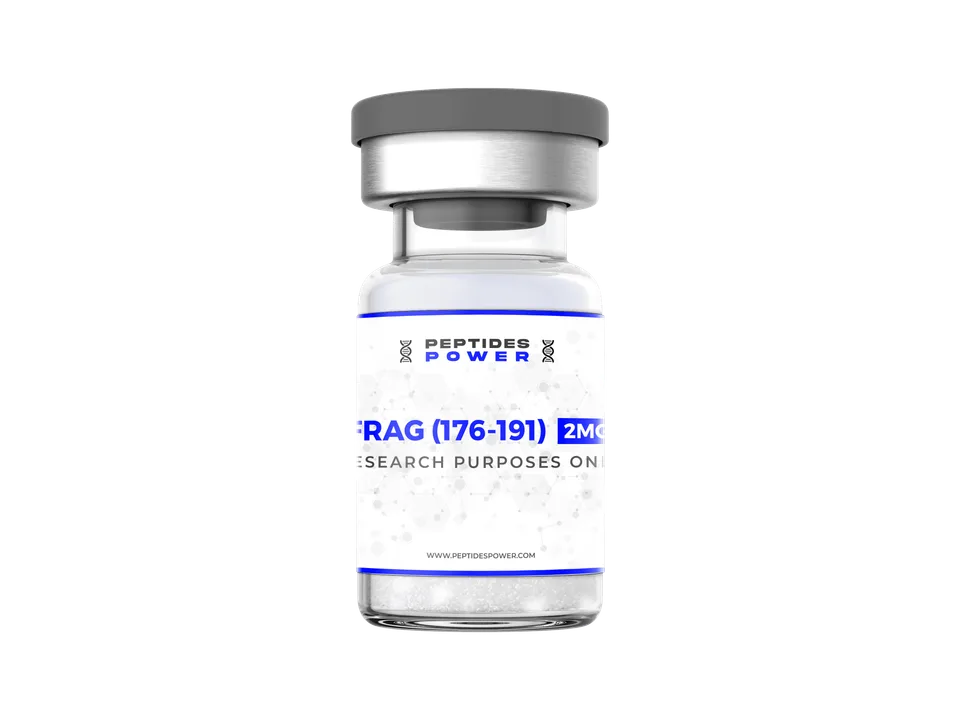
HGH Fragment 176-191
$30
In stock
View product
Profile
HGH Fragment 176-191 is a lab-made peptide matching the final 16 amino acids of human growth hormone, held in a loop by one disulfide bond.12 In rats and mice, related tail peptides reduced weight gain and fat production.34 ClinicalTrials.gov lists no human trial of the fragment, it is not an approved drug, and WADA prohibits it in sport.5678
This page summarizes published sources for information only. It is not medical advice and does not tell anyone to use a product. Questions about your own health belong with a licensed clinician. For questions about an order or a product, contact us.
| Class | Synthetic peptide hormone fragment: residues 176 to 191 of the 191-amino-acid human growth hormone, looped by one disulfide bond129 |
|---|---|
| Also known as | HGH Frag 176-191, Frag 176-191, hGH 176-191, somatotropin (176-191), human growth hormone (176-191)10811 |
| Forms we sell | One research vial, 2 mg of white freeze-dried solid12 |
| Human evidence | No trial of the fragment on ClinicalTrials.gov; the human trials found all tested its tyrosine version, AOD-9604 (six trials, 893 adults, 2001 to 2006)513 |
| Regulatory status | Not an approved drug; not among the substances nominated for 503A pharmacy compounding (FDA list updated May 14, 2026)6714 |
| WADA status | Prohibited at all times, in and out of competition (2026 list, S2.2.3, growth hormone fragments)8 |
Human growth hormone is a chain of 191 amino acids.9 HGH Fragment 176-191 is a synthetic copy of the last 16 of them, FLRIVQCRSVEGSCGF, which match the tail of the natural hormone's reference sequence.12 A disulfide bond between its two cysteines closes the chain into a loop.1 Synthetic tail pieces of growth hormone, 176-191 among them, were tested in rats as early as 1978.20
The name is used loosely. AOD-9604, the version tested in people, is hGH 177-191 with an extra tyrosine at the front, so it differs from the native fragment by one amino acid.615 Some sources even apply the fragment's name to AOD-9604: a 2026 review says it is sometimes labeled hGH 176-191.7 The supplier listing behind the HGH Fragment 176-191 for sale page gives the tyrosine-first sequence, and that page sets it against PubChem's records.12
| Year | Model | Peptide | Reported result |
|---|---|---|---|
| 1978 | Normal rats | hGH 172-191, 176-191, 177-191 and 178-191 | Each raised blood glucose briefly and insulin for longer; one 5 nmol/kg dose of the peptides containing 178-191 lowered insulin sensitivity20 |
| 1982 | Normal rats | Shortened forms of hGH 177-191 | Insulin-opposing activity traced to residues 178 to 190; shorter pieces were inactive21 |
| 1993 | Rats | hGH 177-191 | Reduced fat production as much as the intact hormone did; no significant fat breakdown22 |
| 1994 | Obese (ob/ob) mice | hGH 177-191, long term | Less cumulative weight gain and fat tissue mass; fat production inhibited3 |
| 2000 | Obese Zucker rats | AOD9401 (hGH 177-191), 20 days | Less weight gain; mean fat-cell diameter fell from 110 to 80 micrometers; no insulin resistance4 |
| 2000 | Obese mice; isolated human fat tissue | AOD-9401 by mouth, 30 days (10 treated, 8 on saline) | Lower weight gain from day 16 with unchanged food intake; more fat breakdown and less fat production in tissue23 |
| 2000 | Obese Zucker rats | AOD9604 by mouth, 19 days | Weight gain of 15.8 g versus 35.6 g; no harm to insulin sensitivity16 |
| 2001 | Obese and lean mice | AOD9604 by mini-osmotic pump, 14 days | Obese mice gained less weight and oxidized more fat; unlike hGH, no high blood sugar19 |
| 2001 | Obese mice; beta-3 receptor knockout mice | AOD9604 injected into the abdominal cavity, 14 days | Body weight and fat fell in obese mice; body weight did not change in knockout mice24 |
Three patterns stand out. The weight effects were reported in obese animals.319 The AOD versions did not show the blood-sugar rise reported for the native fragment in 1978.20419 And the mechanism is unsettled: AOD-9604 did not compete for the growth hormone receptor in cell tests, and FDA's 2024 review concluded that its molecular target is unknown.196
A ClinicalTrials.gov search for 176-191, HGH fragment, growth hormone fragment and AOD-9604 returned no studies in October 2026.5 All the human data found come from AOD-9604.13 Its developer, Metabolic Pharmaceuticals, funded six randomized, placebo-controlled trials in 893 adults from 2001 to 2006, with the peptide given by vein or by mouth.13
A safety summary by authors tied to the developer reported side effects similar to placebo, no change in IGF-1 or glucose tolerance, and no antibodies to the peptide.13 Efficacy did not hold up: the largest trial gave AOD-9604 or placebo by mouth to 502 randomized adults on diet and exercise, and found no significant difference in weight loss at its 12-week primary endpoint.67 Development for obesity stopped, and FDA says the trial does not appear to have been published.6 A 2026 review calls the human evidence limited and largely short-term.7
Trial-by-trial detail: What is AOD-9604?. Other compounds researched for weight are compared in Peptides and weight loss.
A 2022 drug-delivery study loaded chitosan nanoparticles with both the fragment and the cancer drug doxorubicin.25 Against MCF-7 breast cancer cells in the lab, the dual-loaded particles slowed growth more than particles carrying doxorubicin alone.25
No human side-effect data were found for hGH 176-191 itself.513 The list draws on AOD-9604 trials, animal work and FDA's reviews. Trial-by-trial detail: AOD-9604 side effects.
No human dose of hGH 176-191 has been established, and ClinicalTrials.gov lists no human trial of it.513 The doses below come from published animal studies and AOD-9604 trials, and they are not guidance for people.
| Study | Subjects | Peptide | Dose, route and length |
|---|---|---|---|
| 1978 | Normal rats | hGH fragments containing residues 178 to 191 | One dose of 5 nmol per kg; route not stated in the abstract20 |
| 2000 | Obese Zucker rats | AOD9604 | 500 micrograms per kg by mouth, once daily for 19 days16 |
| 2001 | Obese mice | AOD9604 | Continuous pump infusion or daily injection into the abdominal cavity for 14 days; FDA gives the dose as 250 micrograms per kg per day19246 |
| 2001 to 2006 | 15 healthy men; 23 obese men | AOD-9604 | Single IV doses from 25 to 400 micrograms per kg (healthy men) and of 25, 50 or 100 micrograms per kg (obese men)13 |
| 2001 to 2006 | Adults in four oral trials | AOD-9604 | Single doses of 9, 27 and 54 mg; 9 to 54 mg daily for 7 days; 1 to 30 mg daily for 12 weeks (300 adults); 0.25 to 1 mg daily for 24 weeks (502 adults)13 |
FDA found no human data for AOD-9604 given by injection under the skin or applied to the skin.6 A 2026 review notes that daily injection regimens circulate on bodybuilding forums, and says such online protocols must not be interpreted as clinically validated or safe.7 Study-by-study notes for the tyrosine version: AOD-9604 dosage.
The vial holds 2 mg of white freeze-dried solid, and no diluent comes with it.12 The supplier lists 36 months at -20 °C or 30 days at 2 to 8 °C, without saying whether the 30 days applies to the powder or the solution, and asks for refrigeration once mixed.12 These are supplier statements, not published stability data.
Published handling data come from AOD-9604. In its IV trials, the freeze-dried study drug was mixed with sterile water for injection before use.13 For the acetate form of AOD-9604, FDA cites supplier documents that give -20 °C for storage, with stability reported beyond four years, and 2 to 8 °C only for periods under six months.6 FDA adds that peptides like it are sensitive to pH and heat: the disulfide bridge can break down, and the chains can form aggregates that may lose activity.6
The same pattern shows in stored blood: hGH 176-191 was extensively degraded after one week in serum or plasma kept at 4 °C or 22 °C, yet stable for two months or more at -20 °C.18 No published data were found on how the fragment holds up after mixing with bacteriostatic water.
General lab technique is set out in How to reconstitute a peptide vial, and the same steps for the tyrosine version, with its published figures, are in How to reconstitute AOD-9604. The reconstitution calculator does the concentration math, and How to store peptides covers temperatures.
United States. hGH 176-191 is not an approved drug.67 It does not appear on FDA's list of bulk substances nominated for 503A pharmacy compounding (updated May 14, 2026), so FDA is not evaluating it for that list.14 For AOD-9604, FDA's 2024 review judged the evidence that it works for obesity, by any route, to be lacking.6 FDA's Pharmacy Compounding Advisory Committee then voted 12 to 0, on December 4, 2024, against putting AOD-9604 on the 503A list.17 FDA's safety-risks page names AOD-9604 among withdrawn nominations and warns of immune reactions and impurities; hGH 176-191 is not named there.27
Enforcement. A full-text search of FDA's warning letter database for 176-191 returned no letters in October 2026.28 In an August 24, 2026 warning letter to a research-peptide seller, FDA said 'for research use only' labels did not change its finding that the products were drugs for human use.29 The letter added that marketing bacteriostatic water for reconstitution provided the means to prepare an injectable drug for human administration.29
Sport. hGH 176-191 is a named example in section S2.2.3, growth hormone fragments, of WADA's 2026 Prohibited List, so it is banned in and out of competition.8 FDA's 2024 review notes that AOD-9604 has been used in sport as a doping agent.6 A 2015 paper from a US anti-doping laboratory reports AOD9604 in confiscated vials and describes a urine test that detects it down to 50 pg/mL.30
$30
In stock
View productHGH Fragment 176-191 for sale: strengths, stock and shipping are on the product page.
For research use only. Not for human or veterinary use. Read the research use policy.
Not quite. PubChem lists the native fragment as FLRIVQCRSVEGSCGF and AOD-9604 as YLRIVQCRSVEGSCGF, so they differ only in the first amino acid: phenylalanine versus tyrosine.115 AOD-9604 is built from hGH 177-191 plus one extra tyrosine at the start.6 Every human trial found used AOD-9604,513 and a 2026 review says the hGH 176-191 label is sometimes put on it.7 More: What is AOD-9604?
The supporting evidence is from animals. In obese mice, long-term hGH 177-191 reduced weight gain and fat tissue mass,3 and in obese rats, oral AOD9604 more than halved weight gain over 19 days.16 In people, weight loss was tested only with AOD-9604 by mouth: its 24-week trial in 502 adults found no significant difference from placebo, and development for obesity stopped.67 No human study of the native fragment was found.5
No. Neither the fragment nor its tyrosine version, AOD-9604, is an approved drug, and FDA states that AOD-9604 is not a component of any FDA-approved drug.67 The native fragment does not appear on FDA's list of bulk substances nominated for 503A pharmacy compounding, updated May 14, 2026.14 For AOD-9604, FDA's advisory committee voted 12 to 0 in December 2024 against placing it on the 503A bulks list itself.17
Yes. WADA's 2026 Prohibited List, which took effect on January 1, 2026, gives hGH 176-191 and AOD-9604 as examples of growth hormone fragments in section S2.2.3.8 Every substance in that class is banned at all times, in and out of competition, and none counts as a Specified Substance.8 A 2026 anti-doping method detects hGH 176-191 in dried blood spots, serum and plasma.18
No human study of the native fragment was found.5 For its tyrosine version, AOD-9604, blood IGF-1 did not change compared with placebo in trials lasting up to 24 weeks, and the trial authors concluded it has no growth-promoting effect.13 In cell tests, AOD-9604 did not compete for the growth hormone receptor and did not make cells multiply, unlike growth hormone itself.19
No. HGH (somatropin) is the full 191-amino-acid hormone and an approved prescription drug; the Genotropin label gives an initial US approval year of 1987.9 The fragment is only the last 16 of those amino acids,1 and it is not an approved drug.67 No human study was found testing whether it shares any of the full hormone's actions.5 More: What is HGH?
Not the fragment itself. Data on women come only from AOD-9604: its first four trials enrolled only men, while the two long-term trials included women, who made up 46% and 56% of participants.13 The 12-week trial accepted only women who could not become pregnant,13 and FDA found no reproductive or developmental toxicity studies.6
Written by D2C Peptides Editorial Team.
Pending qualified review.
Updated .
D2C Peptides sells peptides for laboratory research. Please confirm both statements to continue.