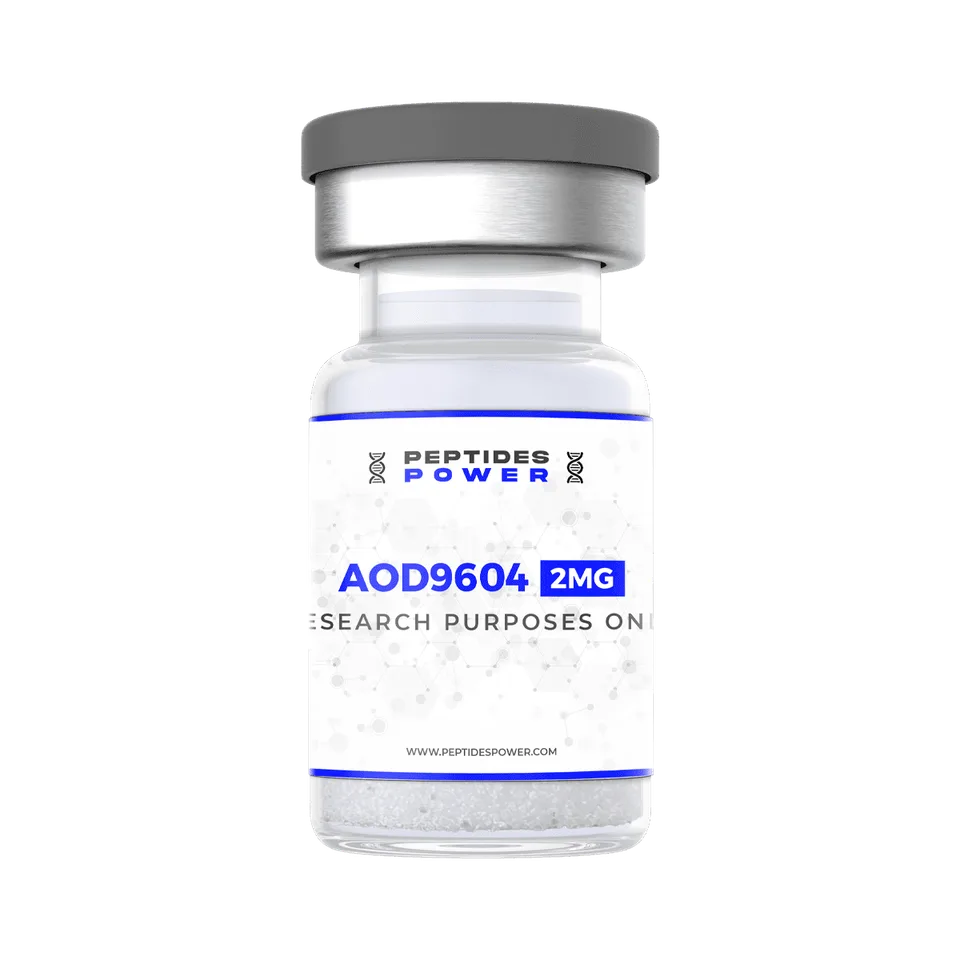
AOD-9604
$25
In stock
View product
Profile
AOD-9604 is a lab-made peptide of 16 amino acids copied from the tail of human growth hormone (residues 177 to 191) plus one extra tyrosine.1 An Australian company developed it as an obesity drug, but its largest trial found no significant weight loss versus placebo.2 It is not FDA-approved, and WADA bans it in sport.13
This page summarizes published sources for information only. It is not medical advice and does not tell anyone to use a product. Questions about your own health belong with a licensed clinician. For questions about an order or a product, contact us.
| Class | Synthetic fragment of human growth hormone: 16 amino acids (hGH 177 to 191 plus an N-terminal tyrosine)1 |
|---|---|
| Also known as | AOD9604, AOD 9604, Tyr-hGH(177-191), anti-obesity drug 960445 |
| Forms we sell | One research vial, 2 mg |
| Human evidence | Six developer-funded trials in 893 adults, by mouth or by vein, 2001 to 20064 |
| Regulatory status | Not FDA-approved; FDA advisers voted 12 to 0 in 2024 against adding it to the 503A Bulks List for pharmacy compounding16 |
| WADA status | Prohibited at all times (S2.2.3, growth hormone fragments)3 |
FDA describes the AOD-9604 peptide as a synthetic chain of 16 amino acids: residues 177 to 191 of human growth hormone (hGH), with an extra tyrosine at the N-terminal end.1 Its two cysteines are linked by a disulfide bond,23 and PubChem's DrugBank-sourced entry calls it a synthetic analogue of the lipolytic, or fat-breaking, domain of hGH.7 The added tyrosine is described as stabilizing the peptide, which is made by solid-phase peptide synthesis.4 Metabolic Pharmaceuticals, an Australian company, developed and patented it in the late 1990s as an obesity drug candidate.12
Its developers hypothesized that it cannot switch on the growth hormone receptor, because it lacks the second receptor-binding site that hGH uses.4 In cell tests, AOD-9604 did not compete with hGH for that receptor and did not make cells multiply.10 In obese mice given 14 days of injections into the abdominal cavity, both hGH and AOD-9604 restored the low RNA levels of the beta-3 adrenergic receptor, the main fat-releasing receptor of fat cells, to those of lean mice.11 In mice bred without that receptor, long-term treatment no longer changed body weight, yet a short experiment still raised fat burning, and the authors concluded that the fat-breaking action is not mediated directly through the receptor.11 FDA's 2024 review concluded that the molecular target and mechanism of action remain unknown.1
Most of the encouraging data come from rodents.1210 Obese Zucker rats given AOD-9604 by mouth for 19 days gained less than half as much weight as untreated rats.12 Obese mice treated for 14 days gained less weight and burned more fat, and unlike hGH, AOD-9604 did not raise their blood sugar.10 A 2015 study in rabbits with induced knee arthritis found that injections into the joint improved cartilage regeneration.13 Full list with evidence levels: AOD-9604 benefits and uses.
Between 2001 and 2006, the developer funded six randomized, double-blind, placebo-controlled trials in 893 adults, all but one in people with obesity, giving AOD-9604 by vein or by mouth.4 In a 12-week trial in 300 adults taking capsules, every dose group lost more weight on average than placebo, but the best dose fell short of significance overall (p=0.1) and reached it only in the female subgroup.42 The larger 24-week OPTIONS trial randomized 502 adults, all on a dietitian-supervised diet and exercise program,42 and found weight loss beyond placebo of under 1 kg in every dose group, too small to reach statistical significance.2 The company ended obesity development on February 21, 2007.2
FDA found no report of the 24-week trial in the medical literature, and a 2026 review notes that the conclusion of no benefit rests mainly on sponsor-reported results.18 FDA's 2024 review found a lack of evidence that it is effective for obesity by any route.1 Researchers who need the compound for laboratory work can find AOD-9604 for sale as a research vial.
The trial authors note that long-term hGH treatment is linked to glucose intolerance, insulin resistance, diabetes, acromegaly, cancer, edema and high blood pressure.4 In the AOD-9604 trials, by contrast, they found no effect on blood IGF-1 and no worsening of glucose tolerance, and they conclude that it does not act through IGF-1.4 The cell tests above also found that it does not bind the hGH receptor.10 More on the full hormone: What is HGH?.
In the developer's trials, headache was the most common complaint, the oral studies also recorded gut symptoms such as diarrhea, and the authors judged the overall profile indistinguishable from placebo.4 A few events were judged possibly related to AOD-9604, including euphoria in 5 of 23 men during IV dosing and one case of chest tightness.4 Five tumors in the 12-week trial, four of them cancers and all in AOD-9604 groups, were judged not related to treatment by the investigator, but FDA says the information is insufficient to decide.41 Full list: AOD-9604 side effects.
AOD-9604 has no established human dose and no approved use.8 Oral doses in the trials ranged from 0.25 to 54 mg and single IV doses from 25 to 400 micrograms per kg of body weight, and FDA found no human study of injection under the skin.41 These are research doses, not guidance for people. Published doses by species, route and duration: AOD-9604 dosage.
No USP monograph or approved product label sets a preparation standard for AOD-9604.1 In the two early IV trials, the drug was supplied as a freeze-dried powder and mixed with sterile water for injection before use.4 Supplier documents cited by FDA list the free base as soluble in water up to 2 mg per mL and give long-term storage temperatures of -18 to -20 °C.1 Lab steps, concentration math and storage after mixing: How to reconstitute AOD-9604.
United States. AOD-9604 is not FDA-approved and is not an ingredient of any FDA-approved drug,1 and a 2026 review states that no major regulator has approved it for any indication.8 It sat in FDA's category 2, bulk substances for compounding that may present significant safety risks, until its nominations were withdrawn.16 FDA's safety-risks page, current as of April 22, 2026, still names it and warns of possible immune reactions, impurity and characterization problems, and serious adverse events whose cause is not clear.16 FDA then reviewed it on its own initiative and proposed not adding it to the 503A Bulks List, its list of bulk drug substances that can be used to compound drugs under section 503A.1 On December 4, 2024, FDA's Pharmacy Compounding Advisory Committee voted 12 to 0 against adding it.6 It is absent from FDA's 503A nominations list updated May 14, 2026, and was not on the agenda of the July 23 to 24, 2026 advisory meeting on peptides.1718 As of October 25, 2026, the list in federal regulations (21 CFR 216.23) names six substances, and no peptide is among them.24
Sport. The 2026 WADA Prohibited List, in force since January 1, 2026, names AOD-9604 under S2.2.3 (growth hormone, its analogues and fragments), banned at all times, in and out of competition.3 An Australian Crime Commission report listed it among peptides supplied to athletes.1 US anti-doping scientists report that it has been found in confiscated vials in the USA, and they validated a urine test that detects it down to 50 pg/mL.15
Australia. FDA's 2024 review reports that Australia's Advisory Committee on Medicines Scheduling recommended and confirmed adding AOD-9604 to the Poisons Standard as a performance and image enhancing drug, which is illegal to possess without authority.1
Food ingredient claim. Papers by authors tied to the developer say a GRAS expert panel judged AOD9604 generally recognized as safe for foods, drinks and supplements, on condition that its safety data were published.1441 FDA's GRAS Notice Inventory held no notice for AOD9604 when searched on October 24, 2026, so no FDA response to that claim is on record.19
Trial registries. ClinicalTrials.gov returned no AOD9604 studies when queried on October 24, 2026.20 The 24-week trial was registered in Australia in August 2005 as ACTRN12605000067673, is marked completed, and has no result documents posted.21
Published dosing information for AOD-9604 from clinical trials and published studies, with its source, and why it is not advice for you.
What published sources report about AOD-9604 and its uses, with the evidence level of each finding. No promises.
Side effects of AOD-9604 as reported in clinical trials and published studies, with links to the full profile. Reviewed by a qualified reviewer.
How AOD-9604 is reconstituted, the supplies used, and the calculator, step by step. Sourced and reviewed.
$25
In stock
View productAOD-9604 for sale: strengths, stock and shipping are on the product page.
For research use only. Not for human or veterinary use. Read the research use policy.
Oral use is how it was mostly tested in people: four of the developer's six trials gave it by mouth as capsules or tablets, and two gave it by vein.4 Animal studies suggest some of an oral dose is absorbed, but FDA says the extent of oral bioavailability is unclear even in animals, and no human study has measured how the body absorbs or clears it.1 The oral trials also failed to show significant weight loss versus placebo in the largest study.2
Tirzepatide is an FDA-approved drug that acts on GIP and GLP-1 receptors, and FDA lists it, as Zepbound, among approved treatments for weight management in obesity.1 AOD-9604 is an unapproved fragment of human growth hormone whose largest trial found weight loss beyond placebo of under 1 kg, which was not significant.2 No trial comparing the two was found: ClinicalTrials.gov returned no AOD9604 studies at all when searched in October 2026.20
The evidence cannot rank them: no trial comparing them was found, and ClinicalTrials.gov lists no AOD9604 study at all.20 Tesamorelin (Egrifta WR) is a growth hormone-releasing factor analog approved only to reduce excess abdominal fat in adults with HIV and lipodystrophy, and its label says it is not indicated for weight loss and that it raises IGF-1.22 AOD-9604 is not approved for any use, and in its trials it did not raise IGF-1.84 More: What is Tesamorelin?
No human data are available: FDA identified no clinical study of its pharmacokinetics by any route.1 In pigs, an IV dose had a half-life of about 3 minutes,1 and in rat plasma in a lab test the peptide broke down with a half-life of about 4 minutes.14 Anti-doping scientists found one breakdown fragment, CRSVEGSCG, to be more stable in serum than the parent peptide, and screening for it may lengthen the window in which use can be detected.15
A 2026 review in Sports Medicine spells it out as 'anti-obesity drug 9604'.5 FDA's 2024 review notes that some websites call it 'anti-obesity drug' or 'advanced obesity drug'.1 Both names point to the developer's original goal, a treatment for obesity, which the company abandoned in February 2007 after its largest trial failed to show significant weight loss.2
The names overlap, but they are not defined the same way. PubChem lists AOD-9604 as YLRIVQCRSVEGSCGF: a tyrosine followed by hGH residues 177 to 191.231 A 2026 review labels AOD9604 as 'hGH 176-191',9 while the WADA 2026 list names AOD-9604 and hGH 176-191 as two separate examples of banned growth hormone fragments.3 The native fragment has its own page: What is HGH Fragment 176-191?
Written by D2C Peptides Editorial Team.
Pending qualified review.
Updated .
D2C Peptides sells peptides for laboratory research. Please confirm both statements to continue.