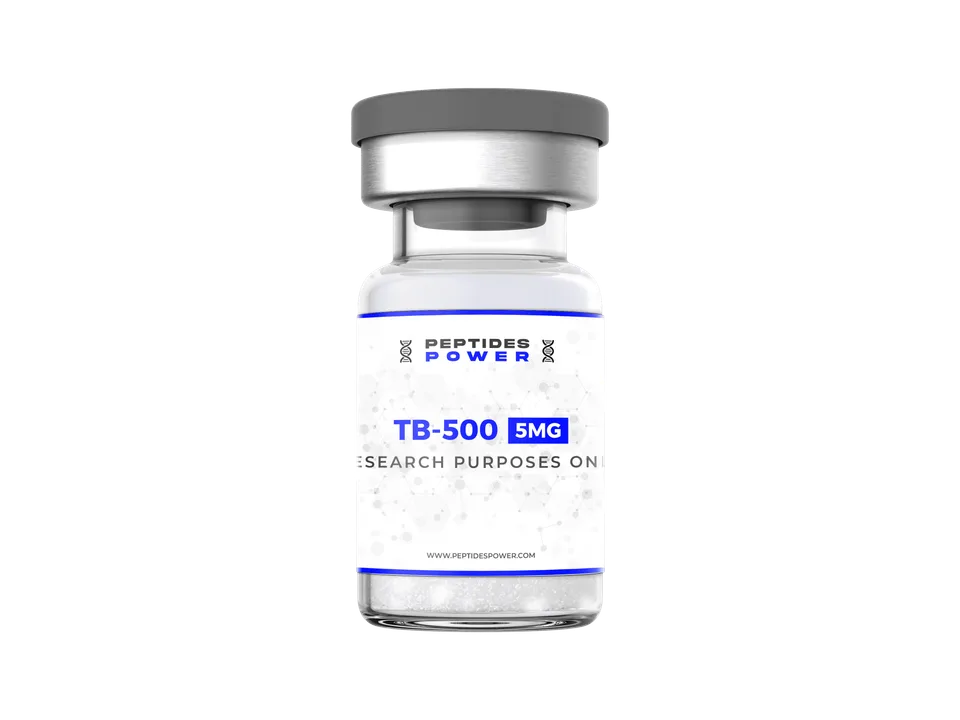
TB-500
$45
In stock
View product
Reconstitution and storage
TB-500 is reconstituted by adding a measured volume of diluent to its powder vial, and that volume sets the concentration.1 Vendor data cited by FDA report that the free base dissolves in water at 50 mg per mL.1 This page covers supplies, lab steps, concentration math for a 5 mg vial, storage before and after mixing, and the routes used in studies.
This page summarizes published sources for information only. It is not medical advice and does not tell anyone to use a product. Questions about your own health belong with a licensed clinician. For questions about an order or a product, contact us.
TB-500 has no official preparation standard: there is no USP or National Formulary monograph, and it is not part of any approved drug.1 The solubility and storage figures on this page are vendor and public data that FDA cited in its 2026 review.1 Because FDA has seen other salts and molecules sold as TB-500, check the lot's certificate of analysis before mixing.1 It should report a mass near 889 g/mol, the value PubChem gives for TB-500.2 The acetate salt is heavier, at 949.1 g/mol.1 Vial sizes also vary: the websites FDA found sold 2 to 15 mg vials, so read the label before doing the math.1
This page covers lab handling only. It does not give instructions for injecting TB-500.
These supplies are listed with the TB-500 vial in this store:
Vendor data cited by FDA describe TB-500 free base as a white to off-white solid that dissolves in water at 50 mg per mL.1 Bacteriostatic water is sterile water with 0.9% or 1.1% benzyl alcohol as a preservative, in a multiple-dose container from which repeated withdrawals may be made.5 Plain sterile water has no preservative and comes only in single-dose containers.6 The bacteriostatic water label warns that some drugs may be incompatible with benzyl alcohol.5
The general reconstitution guide explains each step for any peptide vial.
Concentration (mg/mL) = peptide in the vial (mg) ÷ diluent added (mL). To find the volume that holds a set amount, divide the amount (mg) by the concentration (mg/mL).
For a 5 mg vial:
| Diluent added | Concentration | Peptide in 0.1 mL of solution |
|---|---|---|
| 1 mL | 5 mg/mL | 0.5 mg (500 µg) |
| 1.5 mL | 3.33 mg/mL | 0.33 mg (333 µg) |
| 2 mL | 2.5 mg/mL | 0.25 mg (250 µg) |
| 2.5 mL | 2 mg/mL | 0.2 mg (200 µg) |
| 3 mL | 1.67 mg/mL | 0.17 mg (167 µg) |
Worked example: adding 2 mL to a 5 mg vial gives 5 ÷ 2 = 2.5 mg/mL. A 0.5 mg sample of that solution sits in 0.5 ÷ 2.5 = 0.2 mL. The units converter turns milliliters into insulin-syringe units, and the peptide calculator handles other vial sizes.
Salt form changes the math slightly. TB-500 free base is 889.0 g/mol and the acetate is 949.1 g/mol.21 If a vial's 5 mg is weighed as the acetate, it holds 5 × 889.0 ÷ 949.1 = 4.68 mg of free base. Concentrations then run about 6% below the table. The certificate of analysis should state which form was weighed.
| Form | Temperature | Time | Source detail |
|---|---|---|---|
| Powder (free base) | -20°C | 1 year | Vendor data sheet cited by FDA1 |
| Powder (free base) | -80°C | 2 years | Vendor data sheet cited by FDA1 |
| Solution (free base) | -20°C | 1 month | Same data sheet1 |
| Solution (free base) | -80°C | 6 months | Same data sheet1 |
| TB-500 acetate | 2 to 8°C (refrigerator) or a freezer | Not stated | One certificate of analysis cited by FDA1 |
| TB-500 acetate | Below -15°C | Not stated | Another public source cited by FDA1 |
The data sheet calls for a sealed container kept away from moisture and light, under nitrogen.1 Mixing shortens storage life sharply: at -20°C, the solution keeps 1 month against 1 year for the powder.1 For a vial of diluent, CDC guidance is to date a multiple-dose vial once it is opened and discard it within 28 days unless its maker states another date.8 More storage guidance is in how to store peptides.
No controlled study has tested a TB-500 injection site in people; FDA found no clinical studies or human exposure data by any route.1 Published work used these routes:
The withdrawn compounding nomination that FDA reviewed proposed injection under the skin and into muscle.1 In FDA's general assessment, subcutaneous routes carry more immunogenicity than intramuscular or intravenous ones.1 Sharps disposal and how prescribed injectable medicines are given are covered in the injection guide.
The overview is in What is TB-500?. Study doses are on TB-500 dosage, safety data on TB-500 side effects, and reported results on TB-500 benefits and uses. The research vial and its listed supplies are under TB-500 for sale.
Published dosing information for TB-500 from studies, with its source, and why it is not advice for you.
What published sources report about TB-500 and its uses, with the evidence level of each finding. No promises.
Side effects of TB-500 as reported in FDA reviews and published studies, with links to the full profile. Reviewed by a qualified reviewer.
$45
In stock
View productTB-500 for sale: strengths, stock and shipping are on the product page.
For research use only. Not for human or veterinary use. Read the research use policy.
Rats received TB-500 by injection into the abdominal cavity, and horses by a single injection under the skin.31 In an uncontrolled case series, 3 patients received it by injections under the lining of the mouth.4 FDA found no human data for TB-500 by any route.1 No injection site has been tested in a controlled study or shown to be safe in people.14
No official volume exists, since there is no USP or National Formulary monograph for TB-500.1 The volume sets the concentration: 1 mL gives 5 mg/mL, 2 mL gives 2.5 mg/mL and 2.5 mL gives 2 mg/mL. Vendor data cited by FDA report that the free base dissolves at 50 mg per mL, so solubility does not limit any of these volumes.1 The reconstitution calculator runs the numbers for any volume.
Vendor data cited by FDA give TB-500 free base in solution 1 month at -20°C or 6 months at -80°C.1 The solution should be sealed and kept from moisture and light.1 The same data give the dry powder 1 year at -20°C, so mixing cuts storage life twelvefold at that temperature.1 No source here gives a refrigerator figure for TB-500 solution. Water-for-injection labels say to use reconstituted solutions promptly unless the maker of the dissolved product directs otherwise.6
It depends on the form: for the free base, vendor data cited by FDA call for frozen storage, -20°C for 1 year or -80°C for 2 years.1 For TB-500 acetate, FDA cites 2 to 8°C or a freezer in one certificate of analysis, and below -15°C in another public source.1 The lot's certificate of analysis should name the form.
Written by D2C Peptides Editorial Team.
Pending qualified review.
Updated .
D2C Peptides sells peptides for laboratory research. Please confirm both statements to continue.