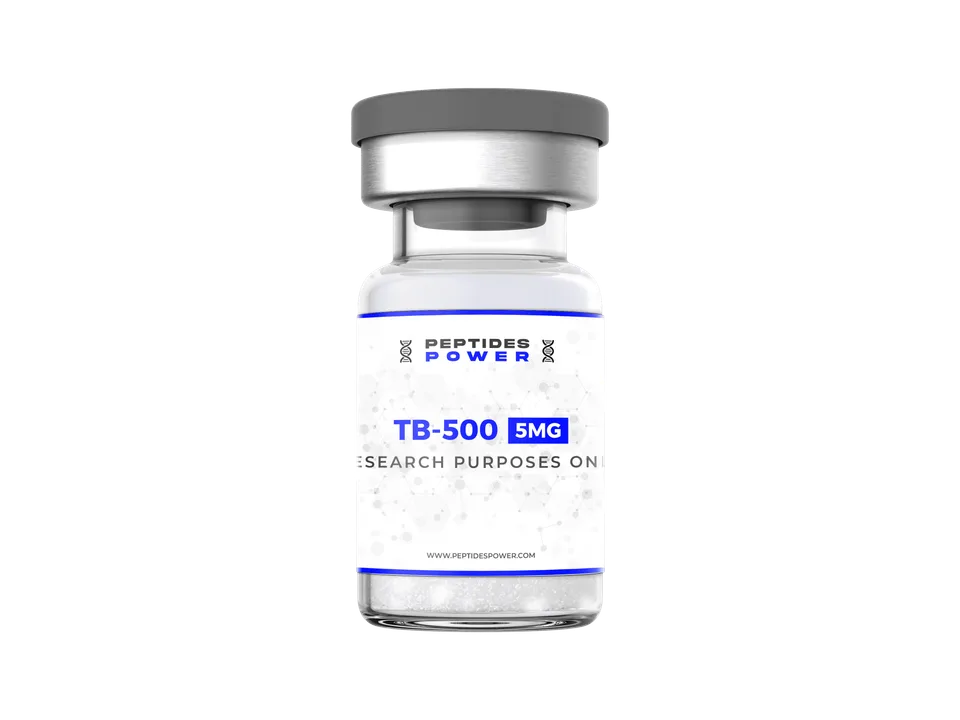
TB-500
$45
In stock
View product
Benefits and uses
Reported TB500 benefits rest on animal and cell studies and one small case series, not on controlled human trials.12 An exploratory 2026 study in 32 rats linked TB-500 to better Achilles tendon healing at 4 weeks.3 A 2024 cell study found TB-500 itself did not speed wound closure, though one of its breakdown products did.4
This page summarizes published sources for information only. It is not medical advice and does not tell anyone to use a product. Questions about your own health belong with a licensed clinician. For questions about an order or a product, contact us.
Each row pairs a reported use with the best published evidence found for it.
| Reported use | What sources found | Evidence level |
|---|---|---|
| Tendon repair | Better tissue scores and higher load to failure 4 weeks after Achilles repair, in one exploratory study of 32 rats (8 given TB-500)3 | Animal |
| Wound healing | TB-500 did not significantly speed scratch-wound closure in fibroblasts; its fragment Ac-LKKTE gave a small but significant effect41 | Cell study |
| Skin wounds in old mice | LKKTETQ without the acetyl group, not TB-500, improved closure and collagen by day 71 | Animal, related peptide |
| Nerve recovery | 3 patients improved after a multi-drug mix that included TB-500, with no control group52 | Human case series |
| Blood vessel growth | Thymosin beta-4's seven-amino-acid actin-binding motif was about as active as the full protein in vessel-forming tests; TB-500 itself was not tested6 | Cell and tissue, related peptide |
| Hair growth | Thymosin beta-4 stimulated hair growth in rats and mice; no TB-500 hair study was found7 | Animal, parent protein |
| Muscle growth | Listed by FDA as a marketed use; FDA found no study in which TB-500 was given to people1 | None |
| Inflammation | Listed by FDA as a marketed use; no human data1 | None for TB-500 in people |
The most direct evidence is an exploratory 2026 study of 32 male rats whose Achilles tendons were cut and surgically repaired.3 The rats were split into four groups of 8: a control group, BPC-157, TB-500, or both.3 Treatment was given by injection into the abdominal cavity for four weeks after surgery.3 Doses are listed on TB-500 dosage.
The TB-500 group had significantly lower, meaning better, total Bonar tissue scores than the control group (p = 0.016).3 Its repaired tendons also withstood a significantly higher maximum load before failing (p < 0.05).3 BPC-157 alone scored numerically better but missed statistical significance on total scores.3 Combining the two gave no added benefit over either one alone.3 The authors say the peptides warrant further study, pending dose-optimization and longer-term studies.3
In a 2024 cell study, TB-500 did not significantly speed the closure of scratch wounds in cultured fibroblasts over 8 hours.1 One of its breakdown products, Ac-LKKTE, produced a small but significant wound closure under the same conditions.14 The authors suggest that the wound-healing activity reported earlier for TB-500 may be due to this metabolite.4 Ac-LKKTE forms as TB-500 loses amino acids one by one from its tail end.1
An older mouse study found a benefit, but it did not test TB-500.1 In 26-month-old mice, a version of the peptide without the acetyl group (LKKTETQ) was applied to skin wounds.1 It increased epidermal closure and collagen content by day 7.1 FDA cautions that this result cannot be directly extrapolated to acetylated TB-500, and that the study had no dose-response assessment.1 Weighing the evidence, FDA concluded there is a lack of evidence to evaluate TB-500 for wound healing.1
The blood-vessel evidence comes from a 2003 cell and tissue study of thymosin beta-4 and synthetic fragments of it, not of TB-500.6 In migration tests with human umbilical vein cells and sprouting tests with chick aortic tissue, a peptide of the protein's seven-amino-acid actin-binding motif was about as active as the full protein.6 Fragments missing any part of that motif were inactive, so the authors concluded it is essential for thymosin beta-4's vessel-forming (angiogenic) activity.6 TB-500 contains LKKTET, the actin-binding region of thymosin beta-4.1 FDA says it remains to be determined whether actin binding contributes to the effects reported for the LKKTETQ peptide.1 Those effects include blood-vessel growth, mast cell degranulation and wound healing.1
In 2026, clinicians described 3 patients with injury to the inferior alveolar (lower jaw) nerve.2 Each received weekly injections under the lining of the mouth for 4 weeks.2 The mix held TB-500, ARA-290, BPC-157 and other medicines.2 The patients showed neurosensory recovery during follow-up.5
The authors call these hypothesis-generating cases.2 With no control group, spontaneous recovery and other confounding factors cannot be excluded, and causality cannot be established.2 They add that the outcomes should not be read as evidence that the treatment worked.2 ARA-290 has its own profile: ARA-290.
FDA lists promoting hair growth and increasing muscle growth and tone among the uses TB-500 is marketed for online.1 For hair, the closest study is a 2004 report on thymosin beta-4, the full parent protein.7 It stimulated hair growth in normal rats and mice by activating hair follicle stem cells.7 No hair study of TB-500 itself appears in the sources reviewed here.
For muscle, there is no study finding to report: FDA found no article in which TB-500 was given to people.1 Related overviews: skin and hair research, muscle research and healing research.
Several websites use the two names interchangeably, but FDA states that thymosin beta-4 and TB-500 are not the same substance.1 The human results below concern the full protein only.
The evidence levels in the table mean different things. A cell study tests cells or tissue in a dish. An animal study tests rats, mice or horses. A case series reports a few treated patients without a comparison group, so it cannot show cause and effect.2 A controlled trial compares treated people with an untreated or placebo group. TB-500 has results at the first three levels and none at the last.12
For the overview, see What is TB-500?. Safety data are on TB-500 side effects, and lab handling is on How to reconstitute TB-500. The research vial is listed under TB-500 for sale.
Published dosing information for TB-500 from studies, with its source, and why it is not advice for you.
Side effects of TB-500 as reported in FDA reviews and published studies, with links to the full profile. Reviewed by a qualified reviewer.
How TB-500 is reconstituted, the supplies used, and the calculator, step by step. Sourced and reviewed.
$45
In stock
View productTB-500 for sale: strengths, stock and shipping are on the product page.
For research use only. Not for human or veterinary use. Read the research use policy.
It has not been shown to work in people.1 FDA found no human studies and concluded there is a lack of evidence to evaluate TB-500 for wound healing.1 Animal and cell results are limited and mixed: one rat study found better tendon healing scores, while a cell study found TB-500 itself did not speed wound closure.34
No study in these sources tested TB-500 for hair growth. The related 2004 study tested the full thymosin beta-4 protein, which stimulated hair growth in normal rats and mice.7 FDA lists hair growth among the uses TB-500 is marketed for online, and it found no human studies of TB-500.1 Read more: Peptides and skin and hair.
No human study has compared them, so there is no evidence that either is better for people.1 In one 2026 rat Achilles study, TB-500 significantly improved tissue scores versus controls, while BPC-157 did not reach significance on total scores.3 Combining them added no benefit over either alone.3 FDA staff recommended against adding either to the 503A Bulks List for compounding.112 Read more: What is BPC-157?.
No study in these sources shows that it does: FDA lists increasing muscle growth and muscle tone only among the uses TB-500 is marketed for online.1 It found no article in which TB-500 was given to people.1 The TB-500 studies reviewed here tested tendon repair, wound healing and drug detection, not muscle growth.3413 Read more: Peptides and muscle growth.
Written by D2C Peptides Editorial Team.
Pending qualified review.
Updated .
D2C Peptides sells peptides for laboratory research. Please confirm both statements to continue.