Bacteriostatic Water
$10
In stock
View product
Calculator
This converter changes mg to mcg and mL to U-100 syringe units, in either direction, and turns IU into mg only with a factor stated for that exact product. A syringe unit is a volume,1 a milligram is a weight and an IU measures biological activity,7 so the converter keeps them apart. FDA said confusion between mL, mg and units may have contributed to dosing errors reported to it.3
Convert between mg and mcg, and between mL and U-100 syringe units. Shows the formula. For reference only.
This page summarizes published sources for information only. It is not medical advice and does not tell anyone to use a product. Questions about your own health belong with a licensed clinician. For questions about an order or a product, contact us.
The converter has three separate sections. Fill in any one of them; each works on its own.
Each result comes with the formula line it used, built from your own number. Clear empties all three sections. Each section converts a single number. Going from a whole vial, through the water added, to a syringe reading is a chain of steps, and the peptide calculator handles that chain.
The factor of 100 comes from the U-100 scale, which puts 100 units in each mL.1 Volumes written in cc convert the same way as mL, since 1 cc and 1 mL are the same amount.2
Every number here is invented for the arithmetic.
Quick reference on the U-100 scale:
| mL | Units |
|---|---|
| 0.01 | 1 |
| 0.05 | 5 |
| 0.1 | 10 |
| 0.25 | 25 |
| 0.3 | 30 (a full 0.3 mL syringe) |
| 0.5 | 50 (a full 0.5 mL syringe) |
| 1 | 100 (a full 1 mL syringe) |
Quick reference for mass:
| mg | mcg |
|---|---|
| 0.01 | 10 |
| 0.1 | 100 |
| 0.5 | 500 |
| 1 | 1,000 |
| 2.5 | 2,500 |
| 10 | 10,000 |
A syringe unit measures volume only. On a U-100 syringe, 10 units is 0.1 mL whatever the liquid, and how much compound those 10 units hold depends on the concentration in the vial.3 That is why the converter keeps mg and units in separate sections and never turns one into the other.
FDA's 2024 alert on compounded injectable semaglutide shows what happens when the two are confused. Most reports involved patients who drew too much from a multiple-dose vial, taking 5 to 20 times the intended amount. In several reports, patients told to give 5 units (0.05 mL) with a U-100 syringe gave 50 units (0.5 mL), ten times as much.3 FDA also described prescribers converting mg to units incorrectly: one intended 0.25 mg (5 units) but prescribed 25 units, and another prescribed 20 units instead of 2. It said unfamiliarity with drawing from a vial and confusion between mL, mg and units may have contributed.3
A habit follows from the arithmetic: keep amounts in mg or mcg, and turn them into units only as the last step, by dividing by a known concentration. The peptide calculator does that division and shows it.
The factor of 100 belongs to the U-100 scale. U-100 is the most common insulin strength, but stronger insulins such as U-300 and U-500 also exist.41 embecta, a syringe maker, says to always use a U-500 insulin syringe for U-500 insulin.5 On any other scale the marks mean something else, so confirm a syringe is U-100 before converting its reading.
IU work differently again. Menopur (menotropins) vials hold 75 IU of FSH activity and 75 IU of LH activity, measured with rat bioassays that are standardized against WHO international standards for urinary FSH and LH.7 Somatropin has its own WHO International Standard, assigned 3.0 IU per mg.6 Because each substance's IU rests on its own standard, the converter asks for the factor stated for the exact product and gives no result without one.
If you are converting readings for a vial that still has to be mixed, start with the reconstitution guide, which covers the diluent and the steps; bacteriostatic water has its own page. Insulin syringes carry the unit marks this page converts; check which scale yours use. Everything else for lab handling is on the supplies page. For the concentration of a mixed vial, per mL and per unit, use the reconstitution calculator, and look up terms such as U-100 and IU in the glossary.
$10
In stock
View product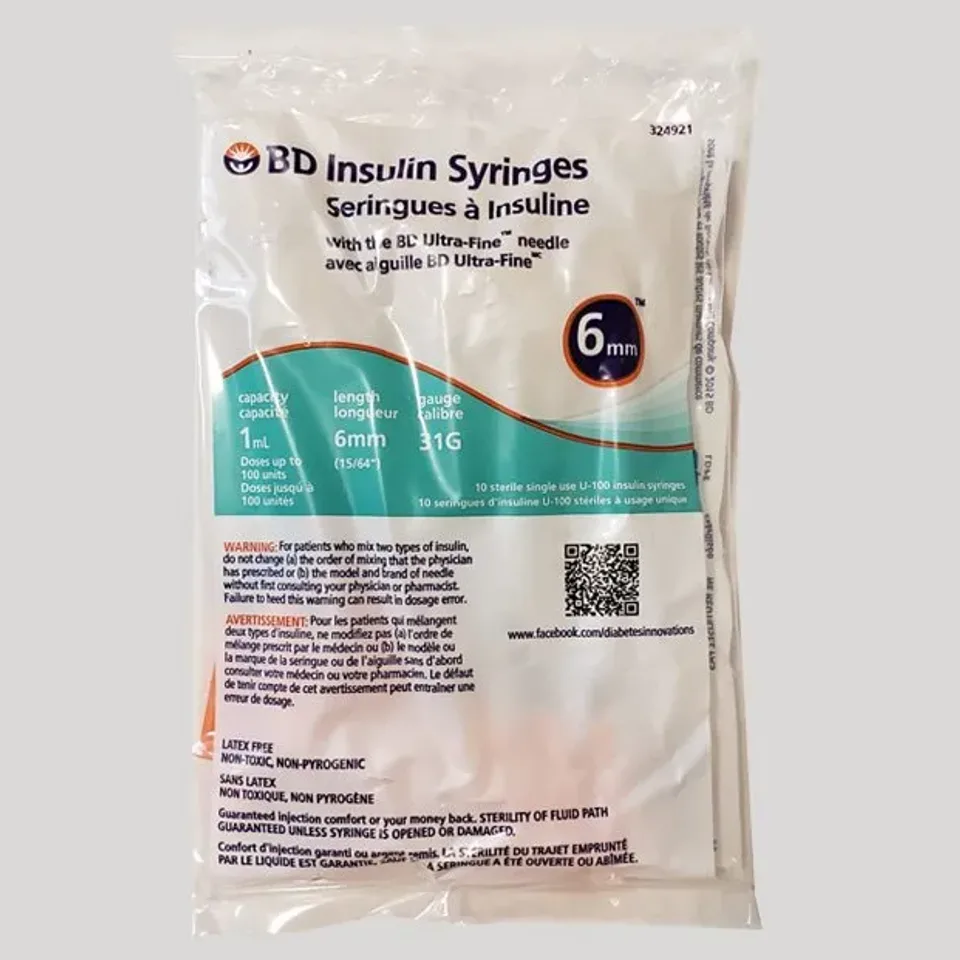
$10
In stock
View productNo products match these filters.
For research use only. Not for human or veterinary use. Read the research use policy.
Reconstituting a lyophilized peptide step by step: the supplies, the diluent, the math and storage after mixing.
Enter the vial amount, the water added and the amount to measure, and get the concentration and U-100 syringe units. Shows the formula. For reference only.
Enter the peptide amount and the diluent volume and get the concentration per mL and per syringe unit. Shows the formula. For reference only.
On a U-100 syringe, 100. U-100 means 100 units in each mL; it is the most common insulin strength, and most insulin syringes are marked for it.14 Each unit is therefore 0.01 mL. Stronger insulin, such as U-500, has its own syringe: embecta, a syringe maker, says to always use a U-500 syringe for U-500 insulin.5 Check which scale a syringe is made for before converting a reading.
On a U-100 syringe, divide the units by 100: 10 units is 0.1 mL, 25 units is 0.25 mL, and 5 units is 0.05 mL, the example FDA uses in its 2024 alert.3 To go the other way, multiply mL by 100, so 0.35 mL is 35 units. The converter's middle section does both directions and shows the line of arithmetic it used.
Yes. MedlinePlus states that 1 cc is the same amount as 1 mL, and notes that a syringe may be marked in cc while the medicine bottle says mL.2 A 1 cc syringe therefore holds 1 mL, which is 100 units on a U-100 scale. An insulin syringe is marked in units rather than mL or cc, which is why its readings need the U-100 factor.1
Only through the concentration. On a U-100 syringe a unit is 0.01 mL of liquid, and the mg it holds equals the concentration in mg per mL divided by 100. At 5 mg per mL, one unit holds 0.05 mg (50 mcg); at 2 mg per mL, it holds 0.02 mg (20 mcg). Without the concentration, a number of units says nothing about mg. The reconstitution calculator gives the amount per unit for a mixed vial.
1,000. A microgram (mcg, also written µg) is one thousandth of a milligram, so 0.4 mg is 400 mcg and 1,500 mcg is 1.5 mg. The conversion only moves the decimal point three places. Because a slip in either direction is a factor of 1,000, the converter shows the line of arithmetic with every result so the direction can be checked.
Only with a factor stated for that exact product, and the converter will not guess one. Each IU is tied to its own reference standard:7 the WHO International Standard for somatropin, for example, is assigned 3.0 IU per mg.6 Type the stated IU-per-mg factor into the IU section and the converter works in both directions. Without a factor, it says that no conversion is possible and shows no number.
Written by D2C Peptides Editorial Team.
Pending qualified review.
Updated .
D2C Peptides sells peptides for laboratory research. Please confirm both statements to continue.