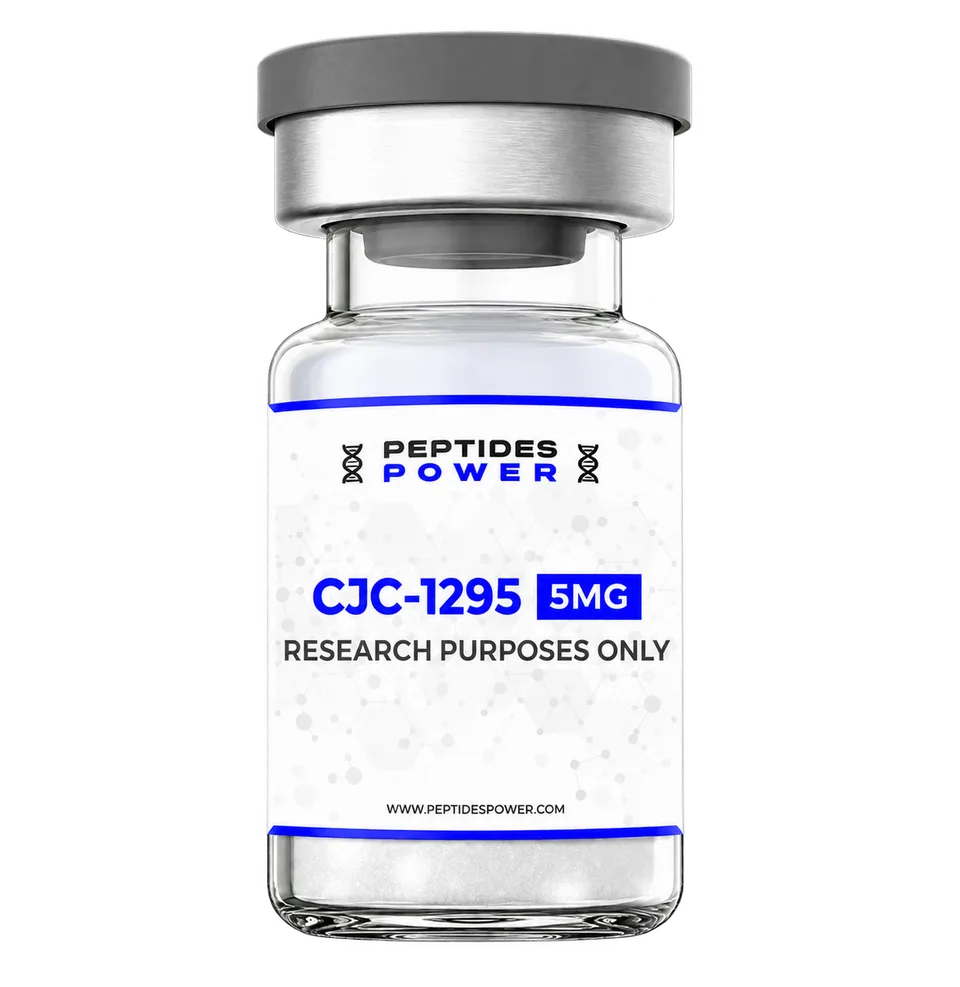
CJC-1295 No DAC
$40
In stock
View product
Profile
CJC-1295 No DAC, also called Mod GRF 1-29, is a lab-made 29-amino-acid analog of growth hormone-releasing hormone (GHRH) with four amino acids changed.12 It is designed to signal the pituitary to release growth hormone.12 No published human study has tested it, and neither FDA nor the European Medicines Agency has approved it.12
This page summarizes published sources for information only. It is not medical advice and does not tell anyone to use a product. Questions about your own health belong with a licensed clinician. For questions about an order or a product, contact us.
| Class | Synthetic peptide: a 29-amino-acid growth hormone-releasing hormone (GHRH) analog with swaps at positions 2, 8, 15 and 271 |
|---|---|
| Also known as | Mod GRF 1-29, modified GRF 1-29, CJC-1295 without DAC, tetrasubstituted GRF(1-29); FDA calls it CJC-1295 (free base)12 |
| Forms we sell | 5 mg research vial (freeze-dried powder); also one of the two peptides in the CJC-1295 + Ipamorelin vial |
| Regulatory status | Not FDA approved; FDA's compounding advisers voted 13 to 0 against adding it to the 503A bulks list in December 202413 |
| WADA status | Prohibited at all times (S2.2.4, GHRH and its analogues, which names CJC-1295)823 |
Mod GRF 1-29 starts from GHRH(1-29), the first 29 of the 44 amino acids in human growth hormone-releasing hormone and the part that carries its full activity.1 Four positions are changed: alanine 2 becomes D-alanine, asparagine 8 becomes glutamine, glycine 15 becomes alanine and methionine 27 becomes leucine.1 Citing the developers, FDA says the swaps at 8 and 27 were meant to prevent chemical breakdown and oxidation, and D-alanine 2 is linked to resistance to DPP-IV, the main blood enzyme that inactivates GHRH(1-29); how much each swap adds to stability remains to be determined.1 By FDA's reading, the form without the DAC first appears in a 2010 report on a preparation seized by Norwegian police and customs in 2009.141
GHRH binds receptors on somatotroph cells in the front (anterior) pituitary, which then release growth hormone; growth hormone in turn raises IGF-1.12 CJC-1295 forms are designed to act the same way, but FDA found no study showing whether the form without DAC is pharmacologically active.12 Claims that it releases growth hormone in natural pulses are extrapolated from related compounds, mainly sermorelin.2 In 12 healthy men, one dose of the DAC form left pulse frequency and size unchanged while trough growth hormone rose 7.5-fold.9
No published study has given Mod GRF 1-29 to people; FDA's 2024 review found no human, pharmacokinetic or toxicity studies of either form.12 The human figures often quoted come from 63 healthy adults given CJC-1295 with DAC in studies published from 2006 to 2009, most of them after a single dose.12 One injection of the DAC form lifted average growth hormone two- to tenfold for at least 6 days and IGF-1 1.5- to threefold for 9 to 11 days, but those are hormone levels, not health outcomes.5
FDA lists CAS 446036-97-1 for the free base and calls 863288-34-0 a deleted number; 446262-90-4 belongs to the DAC form.113 PubChem's record CID 56841945 mixes "with DAC" and "no DAC" labels in its synonyms.13 FDA found that research-use sellers did not state whether their CJC-1295 was the free base, acetate or TFA form, and powders seized in Denmark held versions of modified GRF 1-29 with an extra glycine at the front.115 Two 2026 reviews raise product quality concerns, and one calls CJC-1295 investigational.2512
| Peptide | Structure | Status |
|---|---|---|
| Sermorelin | The natural GHRH(1-29) sequence2 | Once approved as Geref; withdrawn in 200912 |
| CJC-1295 No DAC (Mod GRF 1-29) | GHRH(1-29) with four swaps1 | Never approved1 |
| CJC-1295 with DAC | The same core plus an albumin-binding lysine4 | Never approved; withdrawn from trials in 2006 after a participant died1 |
| Tesamorelin | GHRH analog with a hexenoyl group at the front2 | FDA-approved for excess abdominal fat in adults with HIV and lipodystrophy24 |
| HGH (somatropin) | Growth hormone itself, active even when the pituitary cannot make it1 | Several products FDA-approved for growth hormone deficiency1 |
A 2026 review grades the human evidence: tier A for tesamorelin, tier B for the DAC form and tier D, its lowest, for Mod GRF 1-29, which has no peer-reviewed human studies.2 Related profiles: What is Tesamorelin? and What is Ipamorelin?. The research vial is listed as CJC-1295 No DAC for sale.
No published study has reported side effects of Mod GRF 1-29 in people.12 The nearest data come from small phase 1 trials of the longer-lasting DAC form in healthy adults:12
| Reaction with CJC-1295 with DAC | How often it was reported |
|---|---|
| Injection-site irritation, redness, hardening, pain or itching, worse at higher doses | About 70% after one dose; every treated person in the repeat-dose trial (placebo: mild redness in 3 of 4)1 |
| Headache | 63% versus 14% on placebo after one dose; 20% to 80% versus 50% on placebo with repeat doses1 |
| Flushing, warmth or brief low blood pressure | 30% after one dose; flushing in 40% after low and 100% after high repeat doses, starting within 30 minutes and clearing in 1 to 2 hours1 |
| Diarrhea or loose stools | 43% after one dose, more at higher doses1 |
| Hive-like rash at the injection site | Almost 30%1 |
| Faster heart rate, rising with dose | Seen in 12 healthy men, not quantified1 |
| Less common | Nausea or abdominal pain (20%), dizziness with low blood pressure (2 people), brief leg contractions with some loss of coordination (1 person)1 |
FDA lists increased heart rate and systemic vasodilatory reaction among serious adverse events associated with CJC-1295.16 Per anecdotal reports FDA cites, in ConjuChem's phase 2 trial in HIV lipodystrophy, a participant had a heart attack 2 hours after an 11th weekly dose of the DAC form and died about an hour later; the attending physician suspected underlying coronary artery disease.1 The trial is listed as terminated, and its data were never published.171
General precautions are in Peptide safety basics.
No human dose of CJC-1295 No DAC is established. No published human or animal study of this form reports a dose, and amounts circulating online come from websites and bodybuilding forums, not trials.12 A 2026 sports medicine primer likewise lists dosing, frequency and duration for these peptides as unknown.10
The only published doses belong to CJC-1295 with DAC, and FDA says DAC results cannot be extrapolated to the form without it.1 They show what was studied, not guidance for anyone:
| Study | Who and route | Amounts given | Length |
|---|---|---|---|
| Two phase 1 trials (2006) | Healthy adults aged 21 to 61, under the skin | One of four single doses (30 to 250 mcg/kg), or two or three doses of 20 to 60 mcg/kg weekly or every 2 weeks | Trials of 28 and 49 days512 |
| Pulse study (2006) | 12 healthy men aged 20 to 40, under the skin | 60 mcg/kg (4 men) or 90 mcg/kg (8 men) | One dose91 |
| Phase 2, HIV lipodystrophy | Adults with HIV, injection route not reported | Reported: weekly, rising over 3 weeks (60, 90 and 120, or 60, 120 and 240 mcg/kg), then 9 more weeks | Stopped after a participant died117 |
Peptide dosage basics explains how to read study doses.
No CJC-1295 form is approved, so no official mixing or storage instructions exist; FDA relayed this vendor data in 2024:1
No published study shows how long Mod GRF 1-29 stays stable after mixing, and FDA notes that peptides like it can be extremely sensitive to pH, heat, concentration, impurities and excipients, which can cause clumping (aggregation), breakdown and loss of activity.1 Whether a water-based diluent such as bacteriostatic water dissolves a vial fully depends on its salt form, so check the lot's certificate of analysis, where one exists, before mixing. The Reconstitution calculator does the concentration math; How to reconstitute a peptide vial and How to store peptides cover the lab steps.
FDA has not approved CJC-1295 No DAC for any use; its 2024 review found no USP or NF monograph for any CJC-1295 form and no approved drug containing one.1 Under section 503A, pharmacies may compound only with bulk substances that have such a monograph, are components of approved drugs, or appear on FDA's 503A bulks list.18 After the nominations were withdrawn, FDA evaluated five CJC-1295 substances on its own initiative and proposed listing none, and its advisory committee agreed on December 4, 2024: 13 to 0 against the free base, 12 to 1 against the acetate and 13 to 0 against each DAC form.13 As of October 2026, the only Federal Register document naming CJC-1295 is the 2024 notice of that meeting.19
FDA's page on bulk substances that may present significant safety risks, updated April 22, 2026, lists CJC-1295 among substances previously in category 2 whose nominations were withdrawn. It cites possible immune reactions, impurity and characterization problems, serious adverse events and limited clinical data.16
An April 1, 2020 warning letter told a Kentucky compounding pharmacy that drugs it made from substances including CJC 1295 were not eligible for the 503A exemptions.20 In August 2026, FDA told an online peptide seller that "for laboratory, research, and analytical use" labels did not change its finding of intended human use, citing bacteriostatic water sold with a "peptide calculator".21 CJC-1295 was not on the agenda of FDA's July 2026 advisory meetings on peptides.22
FDA found no approved CJC-1295 product in 12 countries it checked, including Australia, Canada, Japan and the UK, none authorized by the European Medicines Agency, and no entry in the European or Japanese pharmacopoeias.1 WADA prohibits GHRH and its analogues under S2.2.4, naming CJC-1295; S2 substances are banned at all times on both the 2026 list and the 2027 list, in force from January 1, 2027.823 A 2026 urine test, validated to WADA guidelines, detects GHRH analogs including CJC-1295 at 0.5 ng/mL or lower.7
$40
In stock
View productCJC-1295 No DAC for sale: strengths, stock and shipping are on the product page.
For research use only. Not for human or veterinary use. Read the research use policy.
Yes. CJC-1295 without DAC, Mod GRF 1-29 and tetrasubstituted GRF(1-29) name one 29-amino-acid peptide, which FDA's 2024 review calls CJC-1295 (free base).12 CJC-1295 first named ConjuChem's long-acting version with a drug affinity complex (DAC).41 FDA warns that this inconsistent naming is a safety risk, because a person may receive a different substance than ordered.1
They share the same modified 29-amino-acid core. The DAC version adds a lysine with a maleimidopropionamide group that latches onto albumin in the blood, which makes it larger (3647.95 against 3367.95 g/mol) and far longer-lasting.14 Every published human trial of CJC-1295 used the DAC form, and FDA says those results cannot be extrapolated to the version without it.12 More: What is CJC-1295 with DAC?
No, though both start from the first 29 amino acids of GHRH. Sermorelin keeps the natural sequence; Mod GRF 1-29 changes four of them to resist breakdown.12 Sermorelin was FDA-approved as Geref for children with growth hormone deficiency until its approvals were withdrawn in 2009, which FDA later found was not for safety or effectiveness reasons; no CJC-1295 form has been approved.12 More: What is Sermorelin?
No human half-life has been published for it.2 The nearest measurements come from a 1994 infusion study in 10 healthy men: unmodified GHRH(1-29) had a disappearance half-time of 4.3 minutes, and a version carrying only Mod GRF 1-29's D-alanine swap, 6.7 minutes.6 The DAC form, by contrast, has an estimated half-life of 5.8 to 8.1 days.5 Descriptions of the no-DAC form as short-acting rest on no published measurement.2
Ipamorelin acts on a different target, the ghrelin receptor (GHSR-1a), while CJC-1295 mimics GHRH, so the two are combined in the hope of a larger growth hormone release.2 A 2026 review says the practice rests mostly on anecdote and that controlled evidence of synergy is limited.2 FDA reports that one outsourcing facility compounded a CJC-1295 and ipamorelin injection in 2019 and 2020.1 More: What is CJC-1295 + Ipamorelin?
No study has given any CJC-1295 form to people with growth hormone deficiency.1 FDA notes that GHRH analogs act through the pituitary, so people with complete deficiency would likely not respond.1 FDA reviewed the CJC-1295 forms for this use in 2024 and proposed keeping them off the 503A bulks list; approved growth hormone products exist for the condition.1 More: What is HGH?
Written by D2C Peptides Editorial Team.
Pending qualified review.
Updated .
D2C Peptides sells peptides for laboratory research. Please confirm both statements to continue.