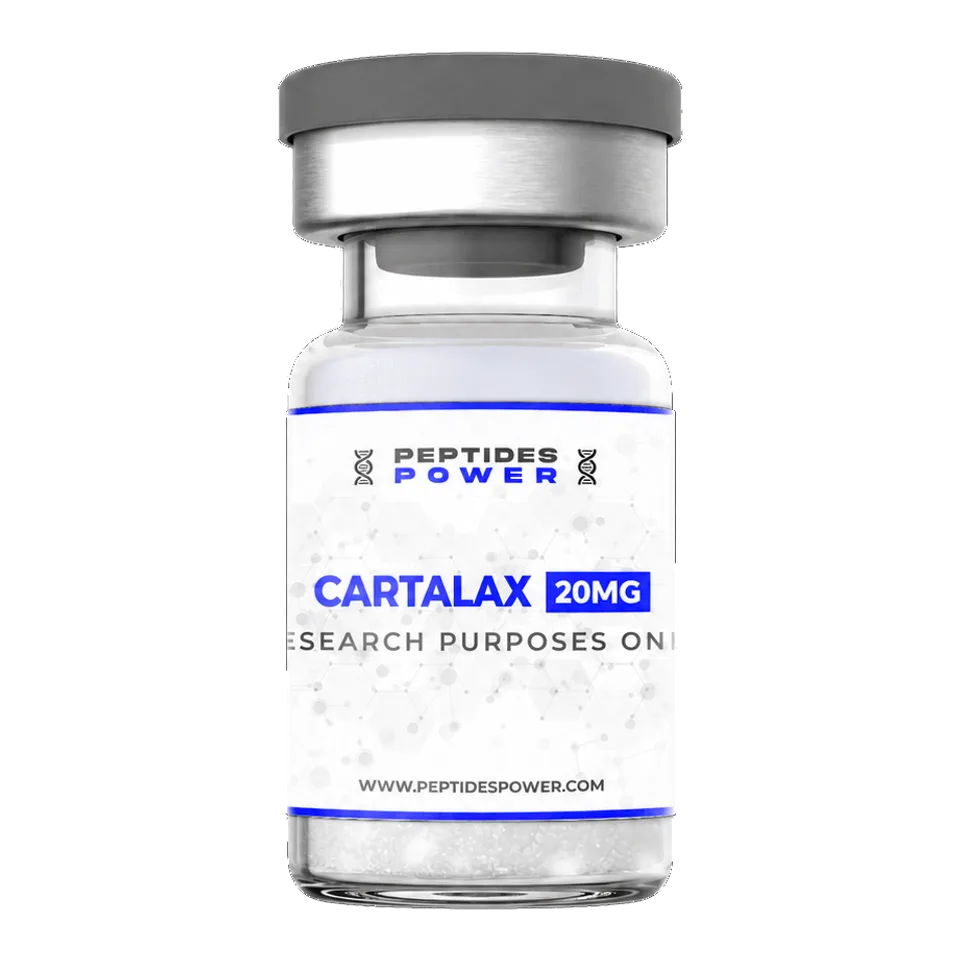
Cartalax
$60
In stock
View product
Profile
Cartalax is a three-amino-acid peptide (Ala-Glu-Asp, or AED) studied by Vladimir Khavinson's group in St. Petersburg, Russia.3 The group describes it as a regulator of cartilage and skin fibroblasts.3 Its evidence is almost entirely cell culture from that group, and no human trial is registered.416 It is not an FDA-approved drug.18
This page summarizes published sources for information only. It is not medical advice and does not tell anyone to use a product. Questions about your own health belong with a licensed clinician. For questions about an order or a product, contact us.
| Class | Synthetic tripeptide; one of the Khavinson 'bioregulator' short peptides3 |
|---|---|
| Also known as | AED, Ala-Glu-Asp, alanyl-glutamyl-aspartic acid, Kartalax, T-3132513 |
| Forms we sell | 20 mg research vial (freeze-dried powder)1 |
| Regulatory status | Not FDA approved; not on FDA's list of substances nominated for pharmacy compounding1819 |
| WADA status | Not named; class S0 bans at all times any substance not covered elsewhere on the list that has no government approval for human therapeutic use2317 |
| Evidence base | Cell and tissue culture studies plus developer reviews, almost all from one St. Petersburg group; no registered human trial43516 |
Cartalax is a synthetic chain of three amino acids: alanine, glutamic acid and aspartic acid, written AED.3 PubChem lists it as alanyl-glutamyl-aspartic acid (CID 87815447), with the formula C12H19N3O8 and a molar mass of 333.29 g/mol.2 It is one of the short "bioregulator" peptides studied at the St. Petersburg Institute of Bioregulation and Gerontology in Russia.3 That group's 2021 review classes it as "polyfunctional," with effects on cartilage, skin fibroblasts and nerve cell differentiation.3 Some of its studies use the lab code T-31.13
The research base is narrow. PubMed indexes 6 records under Cartalax or its chemical name, all cell or tissue culture studies, and every one lists authors from the St. Petersburg group.4 Labs that need the compound itself can find Cartalax for sale as a freeze-dried research vial.
In human mesenchymal stem cells aged in culture, AED at 200 ng/ml switched on four cartilage markers: SOX9, aggrecan, type II collagen and COMP.7 A cartilage polypeptide complex needed 2,000 ng/ml, ten times as much, for the same effect.7 Aging chondrocytes, the cells that build cartilage, showed an aging "secretory phenotype": more p16, p21, p53, TNF-alpha and IL-1 alpha, and less Sirt1.6 AED and a cartilage polypeptide complex normalized the synthesis of these molecules.6 Both are cell culture results, published in Russian in 2023.67
A 2023 review by the same group goes further. It says the AED tripeptide (spelled Kartalax there) showed "high efficacy" in animal models of osteoarthritis and in older patients who took it by mouth.5 The review's abstract gives no study sizes, designs or results, and we could not locate the primary studies.5 No Cartalax trial is registered on ClinicalTrials.gov.16
In human skin fibroblasts aged by repeated passages, AED raised production of sirtuin-1, sirtuin-6 and collagen I (2020).8 A 2016 study of fibroblasts aging in culture tested AED with three other short peptides. All four lowered MMP-9, which rises as these cells age, and raised the growth markers Ki-67 and CD98hc.9 AED and AEDG (Epitalon) also reduced caspase-dependent cell death.9 A 2020 developer review groups AED with "polyfunctional" peptides said to stimulate skin cell growth and fibroblast activity.15 We found no study that tested Cartalax on skin in people or animals.4
The developer group's hypothesis is that short peptides bind DNA and change gene activity.12 In the 2014 kidney study, computer models placed AED in the minor groove of DNA at AT-rich sequences.12 The authors linked this to the aging-gene changes they measured.12 That is a modeling result, not a demonstrated mechanism.
Cartalax shares its three-amino-acid core with two related peptides. Cardiogen adds arginine (AEDR), and the developer group describes it as acting on the cardiovascular system rather than on cartilage.3 Epitalon adds glycine (AEDG).3 FDA's page on compounding substances that may present significant safety risks lists Epitalon among nominations withdrawn from its category 2.20 FDA says compounded epitalon may pose a risk of immune reactions for certain routes, due to possible aggregation and peptide-related impurities.20 Cartalax does not appear on that page.20 See What is Cardiogen? and What is Epithalon?. Research by goal is mapped in Peptides and healing and recovery and Peptides and skin and hair.
No side effect data exist for Cartalax.164 No clinical trial is registered,16 and the published studies are cell experiments that do not report adverse effects.4 Long-term safety, use in pregnancy or in children, and use alongside other medicines have not been studied.1816
Health Canada's 2025 advisory names sister Khavinson peptides, not Cartalax.22 It warns that unauthorized injectable peptides may cause infection and allergic reactions, interact with other medicines, or contain high-risk ingredients or contaminants that may not be listed on the label.22 General background on reading safety claims is in Peptide safety basics.
No human dose of Cartalax is established.1816 It has no FDA-approved label and no registered clinical trial.1816 The only published amounts are concentrations in cell culture:
We found no animal or human dose, route or duration in the published abstracts.4 The 2023 review mentions oral use in patients without stating a dose.5 Cell culture concentrations are research conditions, not guidance for people.1816 Background on how study doses are reported is in Peptide dosage basics.
The research vial holds 20 mg of freeze-dried powder.1 The supplier advises keeping the dry vial refrigerated and away from light, and mixing it with bacteriostatic water (sold separately).1 It says to keep the mixed vial cold and use it within 30 days.1 These are supplier statements, not published stability data.1
Peptide makers' general guidance fills some gaps. GenScript says peptides that contain Asp or Glu tend to absorb moisture from the air and should stay tightly capped, ideally in a desiccator.25 It adds that peptides keep far less well in solution than as powder, especially sequences that contain Asp, as Cartalax does.25 Bachem notes that a powder's peptide content may be only 70 to 90% of its weight, which matters when making a solution of a set concentration.26
In a published stem cell study, researchers dissolved AED in phosphate-buffered saline (PBS) before adding it to cultures.11 Lab steps are in the reconstitution guide and in How to store peptides. The reconstitution calculator handles the concentration math.
Cartalax is not an FDA-approved drug.18 A search of FDA's Drugs@FDA data for it as an active ingredient returned no matches in October 2026.18 It is not on FDA's list of substances nominated for 503A pharmacy compounding, updated May 14, 2026.19 Federal rules allow a new drug meant solely for test-tube or lab animal research to be shipped if its label carries a caution ending "Not for use in humans."24 In an August 2026 warning letter, FDA told a peptide seller that, despite "for research use only" labels, evidence from its website showed the products were intended as drugs for human use.21 That letter did not name Cartalax.21
In Canada, Health Canada says injectable peptides are regulated as prescription drugs.22 Its 2025 advisory names sister peptides but not Cartalax.22 WADA's 2026 Prohibited List does not name Cartalax.23 Its class S0 bans at all times any substance not covered elsewhere on the list that has no current government approval for human therapeutic use.23 USADA says the 2027 list, in effect January 1, 2027, names "peptides" in general in S0.17 Cartalax's status in Russia, where it was developed, could not be confirmed from an official source.
$60
In stock
View productCartalax for sale: strengths, stock and shipping are on the product page.
For research use only. Not for human or veterinary use. Read the research use policy.
That has not been shown. In cell culture, Cartalax switched on cartilage-building genes in aging stem cells and normalized aging markers in chondrocytes.76 A 2023 review by its developers says older osteoarthritis patients took it by mouth with 'high efficacy'.5 The review's abstract gives no study size, design or results, and we could not find the primary data.5 No Cartalax trial is registered on ClinicalTrials.gov.16
Not in any study we could verify. ClinicalTrials.gov lists no Cartalax trial; the one record a search returns is an unrelated nutrition study.16 PubMed indexes 6 records under its name or chemical name, all cell or tissue culture studies.4 The only mention of patients is a 2023 developer review whose abstract reports oral use in older adults with osteoarthritis, with no dose, design or results.5
No, but the three are related. Cartalax is Ala-Glu-Asp (AED). Epitalon adds glycine (AEDG), and Cardiogen adds arginine (AEDR).3 The developer group links Cartalax to cartilage, skin fibroblasts and nerve cell differentiation, Epitalon to neuro-immuno-endocrine function and circadian rhythm, and Cardiogen to the cardiovascular system.3 For Cartalax, that link rests on cell work by one group.4
No. A search of FDA's drug approval data found no product with Cartalax as an active ingredient.18 It does not appear on FDA's May 2026 list of substances nominated for pharmacy compounding.19 In an August 2026 warning letter, FDA told an online peptide seller that, despite 'for research use only' labels, its website showed the products were intended as drugs for human use.21 Its status in Russia, where it was developed, is unverified.
WADA's 2026 Prohibited List does not name Cartalax. Its class S0, however, bans at all times any pharmacological substance not covered elsewhere on the list that has no current approval from a government health authority for human therapeutic use.23 USADA reports that the 2027 list, in effect January 1, 2027, names 'peptides' in general in S0.17
Written by D2C Peptides Editorial Team.
Pending qualified review.
Updated .
D2C Peptides sells peptides for laboratory research. Please confirm both statements to continue.