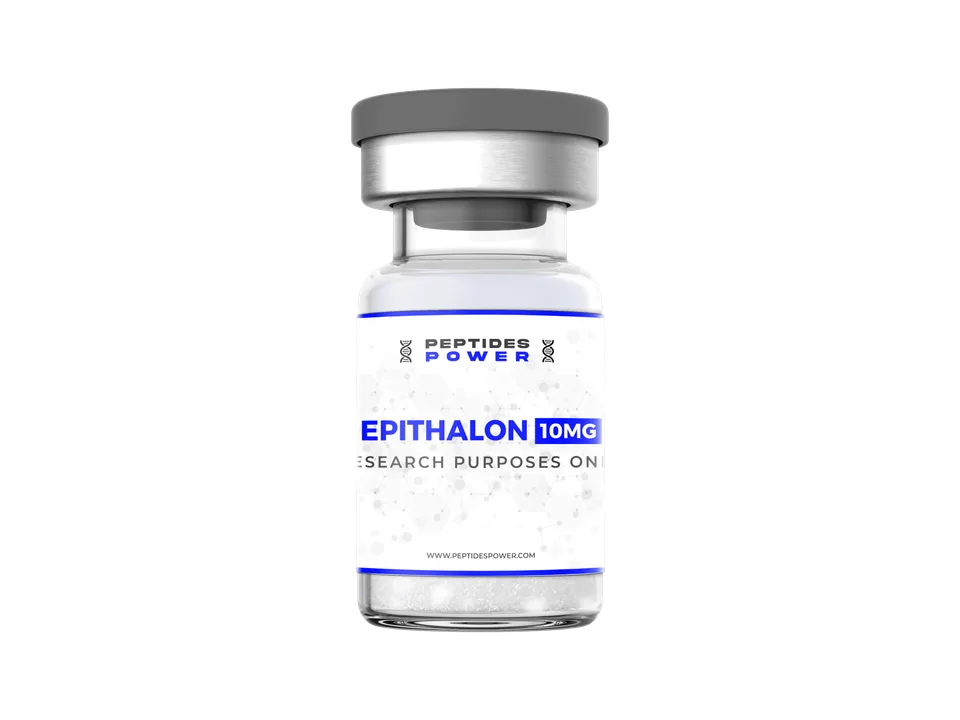
Epithalon
$30
In stock
View product
Profile
Epithalon, or epitalon, is a synthetic four-amino-acid peptide (Ala-Glu-Asp-Gly) that Russian researchers modeled on an extract of cattle pineal glands.12 Studies of it, mostly in cells and animals, focus on telomeres, melatonin and aging.3 FDA has not approved it, and FDA found no clinical data showing it is safe in people.2
This page summarizes published sources for information only. It is not medical advice and does not tell anyone to use a product. Questions about your own health belong with a licensed clinician. For questions about an order or a product, contact us.
| Class | Synthetic tetrapeptide: a chain of 4 amino acids (Ala-Glu-Asp-Gly)21 |
|---|---|
| Also known as | Epitalon, Epithalone, AEDG peptide, AE-0 peptide41 |
| Forms we sell | 10 mg research vial (white freeze-dried powder)5 |
| Regulatory status | Not FDA approved; not an eligible 503A compounding ingredient as of October 202626 |
| WADA status | Not named; USADA says the 2027 Prohibited List, in effect January 1, 2027, names peptides in general in class S07 |
Papers spell it epitalon, epithalon or epithalone, and some use the one-letter code of its four amino acids, AEDG.114 It was developed by Vladimir Khavinson's research group in St. Petersburg, modeled on epithalamin, a mixture of peptides taken from cattle pineal glands.13 That group also ran most of the pharmacology studies, FDA notes, and a 2026 review finds little independent confirmation.23
FDA counts the synthetic peptide and the extract as separate substances, and the 2026 review warns that findings for the extract are not direct evidence for epitalon.23 That matters because the best-known human results belong to the extract: 1.6 to 1.8-fold lower mortality over 6 to 8 years in the epithalamin group of a 266-person study of older adults, and 28% fewer deaths after 12 years among elderly heart patients.1516 Neither result transfers to epitalon.3
Khavinson's lab reported in 2003 that human fetal lung fibroblasts, which normally make no telomerase, began producing the enzyme and grew longer telomeres when epitalon was added to the culture.92 In a 2004 follow-up, untreated fibroblasts stopped dividing at passage 34, while treated cells made 10 extra divisions, to passage 44, and kept dividing.17 An independent lab at Brunel University London repeated the work in 2025. Normal human fibroblasts and breast epithelial cells gained telomere length through more telomerase, while two breast cancer cell lines gained it mainly through ALT (alternative lengthening of telomeres).183 The journal later corrected three of the paper's figures, and the 2026 review urges caution with the telomerase results.193 No human study identified by FDA or the review measured telomere length in the body.32
None of these studies measured sleep itself.2 Other compounds researched for sleep are compared in Peptides and sleep.
In a 2002 paper, epitalon injected near the eye preserved retinal structure and electrical activity in rats with inherited retinal degeneration. The same paper reported 162 patients with retinitis pigmentosa given injections next to the eyeball, with a positive clinical effect in 90%, but the 46 comparison patients received conventional therapy, not placebo.263 Skin evidence is limited to rat skin explants and rat skin cells.3 Cell studies also report less oxidative stress in damaged human retinal cells and more nerve-development gene activity in human gum stem cells.314 These do not establish tissue repair in living animals or people, and no completed human study has measured skin outcomes.3 Related research is mapped in Peptides and skin and hair.
As of October 24, 2026, ClinicalTrials.gov listed no trial of epitalon alone.27 No adequately powered randomized trial has tested sleep, telomeres in the body, lifespan or disease outcomes.3 Researchers who need the compound for lab work can find Epithalon for sale as a research vial.
No side-effect profile exists for epitalon in people, because no clinical study has assessed its safety.2 FDA found no reports in its adverse event database (FAERS) through December 8, 2025, but notes that reporting is voluntary and incomplete, so an empty search does not show safety.2 Two small Russian studies said they saw no side effects or treatment complications without describing how they checked, and the night-shift spray study reported no safety data.2532
No human dose of epitalon is established.3 FDA identified no pharmacokinetic studies in people, and the 2026 review says dose-ranging data are inadequate and that the mix of species, routes, doses and schedules prevents a reliable estimate of an optimal human regimen.23 The table records what researchers gave in published studies; it is not guidance for anyone, and animal amounts must not be converted into human doses.23
| Study | Who took part | Route | Amount and schedule |
|---|---|---|---|
| Elderly people with low pineal function, 2007 | 15 people on epitalon | Injection into muscle | 0.01 mg (10 µg) a day for 10 days325 |
| Night-shift women, 2020 | 20 women on epitalon | Spray under the tongue | 3 sprays twice a day for 20 days, reported as about 0.5 mg a day224 |
| Retinitis pigmentosa, 2002 | 162 patients | Injection next to the eyeball | 5 µg per eye once daily for 10 days326 |
| Old monkeys, 2001 | Female rhesus monkeys | Injection into muscle | 2 µg/kg once daily for 10 days210 |
| Lifespan and tumor studies, 2001 to 2003 | Female mice | Injection under the skin | 0.1 or 1 µg per mouse on 5 days in a row each month until natural death122021 |
| Telomerase experiments | Human fetal lung cells | Added to the culture | 50 ng/mL for 4 days2 |
FDA found clinic websites quoting daily doses in milligrams, by injection or by mouth, often in cycles.2 No human study identified by FDA or the 2026 review used amounts like these: the one published study of epitalon injected into muscle in people used 0.01 mg a day, hundreds of times less.3 Injections of 10 mg belong to studies of epithalamin, a different product.316
Epithalon is supplied as a white freeze-dried powder, 10 mg per vial, with no diluent included.5 As it is not an approved drug, there are no FDA-reviewed mixing or storage directions; the figures below come from the supplier and from vendor data cited by FDA.2
Lab steps are in the reconstitution guide, concentration math in the reconstitution calculator, and storage basics in How to store peptides.
United States. FDA has never approved epitalon. Its May 2026 review found that no approved drug contains it and that it has no USP or National Formulary monograph.2 A US orphan drug designation for retinitis pigmentosa, granted September 2, 2010, was withdrawn or revoked on January 6, 2016.2
Compounding. Epitalon was once in category 2 of FDA's interim compounding policies until its nominators withdrew it, and FDA still notes a possible risk of immune reactions for certain routes.30 FDA then reviewed it on its own initiative for insomnia, and its staff proposed keeping it off the 503A bulks list, citing poor characterization, no evidence of effectiveness, no clinical safety data and immunogenicity concerns.2 The Pharmacy Compounding Advisory Committee took separate votes on the free base and the acetate on July 24, 2026. Healio reported 7 yes, 4 no and 1 abstention on epitalon, a recommendation to list it that went against FDA's reviewers.313233 Committee advice is not binding, and a listing would not amount to a drug approval.33 As of October 24, 2026, FDA had posted no minutes or decision, and the Federal Register showed no new 503A bulk substance documents since July 25, 2026.3435 Until that changes, epitalon meets none of the conditions section 503A sets for a compounding ingredient.3626
Enforcement. FDA's 2020 warning letter to a Kentucky compounding pharmacy listed Epitalon among ineligible substances it had compounded.36 In an August 2026 letter to an online peptide seller, which did not name epitalon, FDA wrote that "research use only" labels did not change the fact that the seller's website showed its products were drugs for human use.37
Elsewhere. FDA found no approved epitalon product in the ten countries it checked, including Canada, Australia and the United Kingdom, and none authorized by the European Medicines Agency.2 In Canada, injectable peptides are prescription drugs; Health Canada named Epitalon among unauthorized injectable peptides it seized in 2025 and 2026, and says a research-use label does not make such a product legal.2829 Belgian public health scientists identified epitalon in two illegal pharmaceutical preparations in 2015.38
Sport. USADA says the 2027 WADA Prohibited List, in effect from January 1, 2027, names peptides in general in class S0, banned at all times; its advisory does not name epitalon.7
$30
In stock
View productEpithalon for sale: strengths, stock and shipping are on the product page.
For research use only. Not for human or veterinary use. Read the research use policy.
Its effectiveness in people is unproven. A 2026 review calls epitalon 'biologically active but clinically unproven', with human evidence limited to small biomarker studies and an older eye-disease study.3 FDA reviewed it for one use, insomnia, and concluded there is a lack of evidence that it works for that.2
In cell and animal studies, mostly from its developers' group, epitalon switched on telomerase in cultured human cells, raised evening melatonin in old monkeys, and lengthened lifespan in fruit flies and some mice.9101112 The few human studies measured melatonin markers, clock genes or retinal function, so its effects on aging or disease in people are not established.3
There is no good evidence either way. In a Russian study of 40 night-shift women, the authors reported better 'psycho-emotional and general physical condition' in 83% on an epitalon spray against 25% on placebo, but FDA notes they did not say how this was measured.2 The human studies that FDA and a 2026 review examined reported no validated mood or energy outcome.23
The epitalon sold for research is synthetic. Researchers designed it from the amino acid makeup of epithalamin, an extract of cattle pineal glands, and a 2025 review says the same chain was later found in that pineal peptide mixture.1 FDA calls it the putative active component of the extract.2 We found no source showing it is a normal human hormone.
No study has shown this in people. Skin evidence is limited to rat skin tissue and aged rat skin cells.3 A topical serum containing epitalon among several peptides entered a single-group early phase 1 study, first posted October 22, 2026, with no results yet.13 Anti-aging claims circulate in marketing: FDA found wellness clinics promoting epitalon online as an anti-aging agent.2
No injection site can be recommended, because there is no approved or established way to use epitalon in people.23 Studies used injections under the skin in mice, into muscle in monkeys and in a small study of elderly people, and next to the eyeball in people with retinitis pigmentosa.32 None of these studies was designed to test safety, and FDA found no clinical data supporting epitalon's safety in people.32
Written by D2C Peptides Editorial Team.
Pending qualified review.
Updated .
D2C Peptides sells peptides for laboratory research. Please confirm both statements to continue.