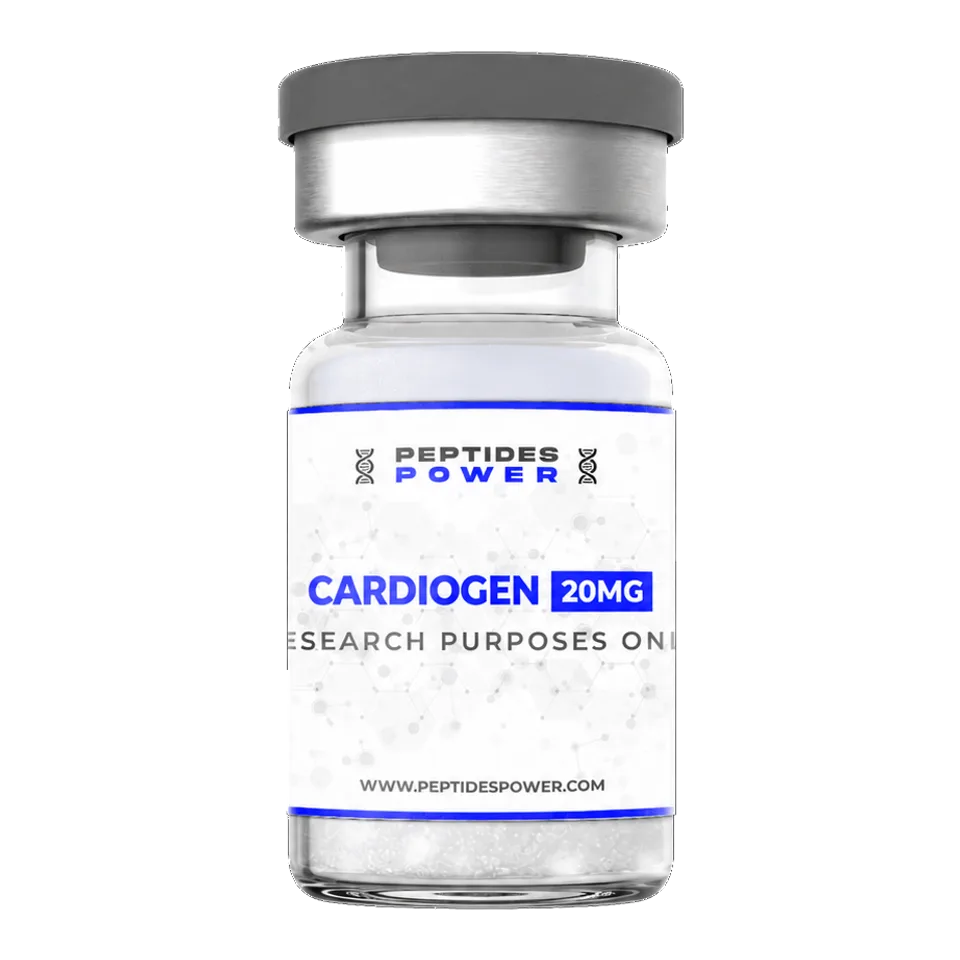
Cardiogen
$55
In stock
View product
Profile
Cardiogen is a lab-made peptide of four amino acids, Ala-Glu-Asp-Arg (AEDR), that Vladimir Khavinson's group in St. Petersburg links to the heart and blood vessels.12 Its research is cell and tissue culture plus a few rat studies, and no human study was found.345 It is unrelated to the imaging product CardioGen-82.6
This page summarizes published sources for information only. It is not medical advice and does not tell anyone to use a product. Questions about your own health belong with a licensed clinician. For questions about an order or a product, contact us.
| Class | Synthetic tetrapeptide; one of the short 'bioregulatory' peptides from Khavinson's group1213 |
|---|---|
| Also known as | AEDR, Ala-Glu-Asp-Arg, H-Ala-Glu-Asp-Arg-OH27 |
| Not to be confused with | CardioGen-82, an FDA-approved rubidium Rb 82 generator for heart PET imaging6 |
| Forms we sell | 20 mg research vial (freeze-dried powder)8 |
| Regulatory status | Not FDA approved; not on FDA's May 2026 list of bulk substances nominated for 503A compounding910 |
| WADA status | Not named; class S0 bans at all times any substance not covered elsewhere on the list that has no government approval for human therapeutic use1112 |
Cardiogen is a synthetic peptide of four amino acids: alanine, glutamic acid, aspartic acid and arginine (H-Ala-Glu-Asp-Arg-OH, or AEDR).2 Vladimir Khavinson's group reports detecting AEDR in a polypeptide complex from heart tissue, using chromato-mass spectrometry.7 Its 2021 review classes Cardiogen as a "monofunctional" peptide that regulates cardiovascular function.1
Two naming traps matter when reading about it. CardioGen-82 is an FDA-approved rubidium Rb 82 generator for heart PET imaging, unrelated to the peptide.6 A PubChem name search for "cardiogen" returns (-)-carnitine, CID 10917, not AEDR.15 The research itself is cell and tissue culture plus a few rat studies.34 Almost all of it comes from the St. Petersburg Institute of Bioregulation and Gerontology and its collaborators.234 Labs that need the compound can find Cardiogen for sale as a freeze-dried research vial.
A 2022 developer-group review describes rats whose coronary artery was tied off to cause a heart attack.7 Rats given AEDR had one third the deaths of controls.7 The review says AEDR also shrank zones of dead tissue and kept glycogen in heart muscle.7 For these data the review cites a US patent, not a peer-reviewed study.7 We could not review the patent's doses, routes or animal numbers.
In a test-tube study, AEDR and other short peptides bound wheat histone proteins H1, H2B, H3 and H4.14 The authors suggest such binding could regulate gene activity.14 Computer docking ranked AEDR among the short peptides that bind best to the cell transporters LAT1, LAT2 and PEPT1, a possible route into cells.17 Neither result has been tested in people.5
Cardiogen overlaps two other short peptides from the same group: its first three amino acids are Cartalax (AED), and its last three are Pinealon (EDR).1 The developer group links Cartalax to cartilage and skin fibroblasts and Pinealon to nerve cells.1 See What is Cartalax? and What is Pinealon?.
No side effect data exist for the Cardiogen peptide.5 No clinical trial is registered, and the published cell and rat studies do not report adverse effects.534 Long-term safety, and use in pregnancy, in children, in people with heart disease or with other medicines, are unstudied.95
One animal finding deserves attention: in the rat sarcoma study, cardiogen changed tumor behavior by acting on the tumor's blood vessels, and what that means for safety is unknown.4 Health Canada's 2025 advisory does not name Cardiogen.18 It warns that unauthorized injectable drugs, such as the peptides it seized, may cause infections and allergic reactions, interact with other medicines, or contain contaminants that may not be listed on the label.18 More background is in Peptide safety basics.
No human dose of the Cardiogen peptide is established.95 It has no FDA-approved label and no registered clinical trial.95 The published amounts found are tissue culture concentrations:
The rat tumor study abstract says only that cardiogen was injected, and the review of the heart attack data gives no dose, route or schedule.47 Tissue culture concentrations are lab conditions, not guidance for people.95 Background on how study doses are reported is in Peptide dosage basics.
The research vial holds 20 mg of freeze-dried powder.8 The supplier advises storing it in a refrigerator away from light and reconstituting it with bacteriostatic water, sold separately.8 It says to keep the mixed vial refrigerated and use it within 30 days; these are supplier statements, not published stability data.8
General guidance from peptide makers adds context. Bachem says freeze-dried peptides may be shipped at room temperature and kept in a refrigerator at 4 °C for short-term use.19 Bachem advises against storing peptides in solution, because they may slowly break down even when sterile; frozen solutions may keep for a few weeks.19 GenScript notes that peptides containing Asp, Glu or Arg tend to absorb moisture, so the vial should stay tightly capped.20
Lab steps are in the reconstitution guide and How to store peptides. The reconstitution calculator handles the concentration math.
The Cardiogen peptide is not an FDA-approved drug: a search of FDA's Drugs@FDA data for it as an active ingredient returned no matches in October 2026.9 CardioGen-82, the FDA-approved product with a similar name, is a radioactive diagnostic agent.6 The peptide is not on FDA's May 14, 2026 list of bulk substances nominated for 503A compounding, nor on FDA's page of bulk substances that may present significant safety risks.1021
A federal rule lets a drug meant only for test-tube or lab-animal research be shipped if it is labeled "Not for use in humans," and the shipper must use due diligence to make sure the recipient regularly does such research.22 In an August 2026 warning letter to one peptide seller, FDA said evidence from the seller's website showed its products were intended as drugs for human use, despite "for research use only" labels.23
Health Canada says injectable peptides are regulated as prescription drugs in Canada and that selling unauthorized drugs is illegal there.18 Its August 1, 2025 advisory names other short peptides such as Livagen and Pinealon, but not Cardiogen.18 WADA's 2026 list does not name Cardiogen, but its class S0 bans at all times any substance not covered by the list's other sections that has no government approval for human therapeutic use.11 USADA says the 2027 list, in force January 1, 2027, names "peptides" in general in S0.12 Cardiogen's status in Russia could not be confirmed from an official source.
$55
In stock
View productCardiogen for sale: strengths, stock and shipping are on the product page.
For research use only. Not for human or veterinary use. Read the research use policy.
No. CardioGen-82 is an FDA-approved diagnostic product, not a peptide.6 Its label describes a generator that produces rubidium Rb 82 injection for PET scans of blood flow to the heart muscle.6 The Cardiogen peptide, AEDR, is a research compound with no FDA approval and no connection to it.9 A ClinicalTrials.gov search for 'cardiogen' even returns a study about CardioGen-82 scans.5
That has not been shown in people. In tissue culture, cardiogen stimulated cell growth in heart tissue from young and old rats.313 A 2022 developer review reports a threefold drop in deaths among rats after an induced heart attack.7 For those data the review cites a patent, not a peer-reviewed study.7 No human study of the Cardiogen peptide was found.5
We found no human study: ClinicalTrials.gov lists no trial of the Cardiogen peptide, and the four records a 'cardiogen' search returns are unrelated, including a genistein heart failure study and a study of patients after CardioGen-82 scans.5 The published work is cell, tissue and rat research, almost all from the St. Petersburg developer group and its collaborators.234
They share building blocks. Cardiogen (AEDR) is Cartalax's three amino acids (AED) plus arginine, and its last three amino acids are Pinealon's sequence (EDR).1 The developer group calls Cardiogen 'monofunctional,' acting on the cardiovascular system, and Cartalax 'polyfunctional.'1 In one test-tube study, AEDR and EDR both bound histone proteins.14
Cardiogen is not on WADA's 2026 Prohibited List by name, but WADA's class S0 covers, at all times, any pharmacological substance not addressed elsewhere on the list that no government health authority has approved for human therapeutic use.11 USADA reports that from January 1, 2027, the list names 'peptides' in general as S0 examples.12
Written by D2C Peptides Editorial Team.
Pending qualified review.
Updated .
D2C Peptides sells peptides for laboratory research. Please confirm both statements to continue.