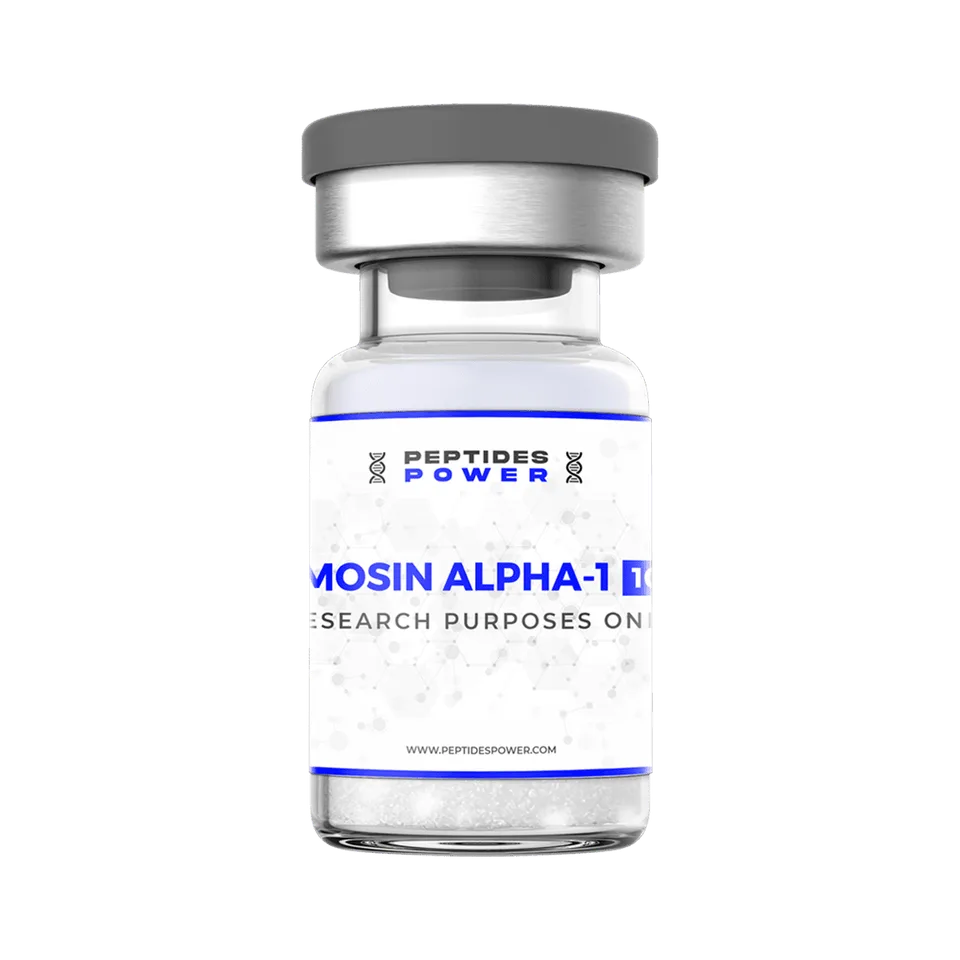
Thymosin Alpha-1
$80
In stock
View product
Profile
Thymosin Alpha-1 (thymalfasin) is a 28-amino-acid peptide first isolated from calf thymus in 1977.1 In lab and animal studies it acts on immune cells, including T cells and dendritic cells.3 A brand version, Zadaxin, is approved in Italy and some other countries, mostly for hepatitis B or as a vaccine adjuvant, but FDA has approved no drug containing it.34
This page summarizes published sources for information only. It is not medical advice and does not tell anyone to use a product. Questions about your own health belong with a licensed clinician. For questions about an order or a product, contact us.
| Class | Synthetic 28-amino-acid peptide with an acetylated N-terminus; an immune modulator that PubChem files under immunologic adjuvants36 |
|---|---|
| Also known as | Thymalfasin, Ta1, Tα1, thymosin α1, Zadaxin (brand); a separate acetate salt form exists74 |
| Forms we sell | Freeze-dried research vial, labeled for research use only (strength per vial not yet listed) |
| Regulatory status | Not FDA approved; approved abroad as Zadaxin, including in Italy, India and Hong Kong43 |
| WADA status | Not named in USADA's advisory on the 2027 List, which names peptides in general in class S0 from January 1, 2027 and warns that an unnamed peptide may still be prohibited14 |
Thymosin alpha-1 was isolated in 1977 by Goldstein and colleagues from calf thymus, as one of several peptides in thymosin fraction 5, a crude thymus extract.13 The body makes its own Ta1 in many tissues by cutting it from a larger protein, prothymosin alpha.2 The drug form, thymalfasin, is made by chemical synthesis and has the same 28-amino-acid sequence as the natural peptide.34 Researchers who need the compound itself can find Thymosin Alpha-1 for sale as a research vial.
FDA's 2024 review describes Ta1 as an immune modulator whose effects are mediated at least in part by Toll-like receptor 9 (TLR9) on dendritic cells and early immune cells, based on lab and animal work.43 Lab and animal studies summarized by FDA report higher natural killer cell activity, a shift of CD4+ helper T cells toward the Th1 type, more IL-2 and interferon-gamma, more cytotoxic CD8+ T cells and activated dendritic cells.3
A 2007 review of lab and animal work found that Ta1 switched on plasmacytoid dendritic cells and induced an enzyme called IDO in dendritic cells.2 The authors linked this to immune tolerance and to protection from allergic inflammation in animals.2 FDA describes a related feedback loop, in which IDO expands regulatory T cells that release IL-10 and could keep inflammation in check, as a proposed mechanism from nonclinical studies only.3
Ta1 has been tested in people since the early 1980s, mostly as an add-on treatment in hepatitis B and C, HIV, cancers, sepsis and COVID-19, and to boost vaccine responses, usually at 1.6 mg under the skin.34 Many of these trials were small, unblinded or compared against treatments that are now outdated.4
Some smaller trials reported benefits: a 1998 randomized trial in 98 people with chronic hepatitis B reported more complete virological responses at 18 months after a 26-week course than with no treatment (40.6% vs 9.4%).16 Stronger trials did not confirm such results: a double-blind phase 3 hepatitis B trial in 97 patients found no significant benefit, and the 1,106-patient TESTS sepsis trial found almost identical 28-day mortality on Ta1 and placebo (23.4% vs 24.1%).1718
In 2024, FDA concluded there is a lack of evidence of effectiveness for all 12 uses it reviewed.4 None of those uses was a wellness, fitness or anti-aging goal: they were infections, cancers, vaccine response, COPD and chronic fatigue syndrome.4 Each condition, with its numbers and evidence level, is covered on Thymosin Alpha-1 benefits and uses.
Ta1 and TB-500 are different molecules: TB-500 is a fragment of thymosin beta-4 (LKKTETQ, per FDA), a different protein, while Ta1 is a 28-amino-acid peptide that acts on immune cells in lab and animal studies.83 Ta1 was studied as an immune treatment, and none of the 12 uses FDA reviewed involved wound or injury healing.4 Zadaxin is the brand of synthetic Ta1 sold abroad as a 1.6 mg powder for injection.3 FDA says Ta1 and thymalfasin are interchangeable names for the substance, but Zadaxin is a finished drug product that cannot be used interchangeably with them.3
In clinical studies, mostly at 1.6 mg under the skin, the most common side effects were local irritation, redness or discomfort at the injection site, and in most studies Ta1 was not linked to significant adverse events.4 The Indonesian Zadaxin label, as summarized by FDA, puts drug-related adverse events under 1% in over 2,000 people.3 The larger concerns are FDA's warning of a possible significant risk of immune reactions to compounded Ta1, and the fatal immune hemolytic anemia and engraftment failure reported in stem cell transplant recipients.84 Full list: Thymosin Alpha-1 side effects.
No dose of Ta1 is approved in the US, because FDA has approved no Ta1 drug.4 Published schedules come from foreign Zadaxin labels and from clinical trials under medical care, most often 1.6 mg under the skin.3 FDA notes a lack of well-defined dose-response studies, so the minimum dose that produces a response is hard to determine.4 None of these figures is guidance for a person, and a research vial is not Zadaxin.3 Full detail: Thymosin Alpha-1 dosage.
Zadaxin, the approved product abroad, is a 1.6 mg powder that makes a 1.6 mg/mL solution once reconstituted.3 In the TESTS trial, each vial of powder was reconstituted with 1 mL of the provided diluent before use.19 FDA reported water solubility of up to 2 mg/mL for the free base and up to 1 mg/mL for the acetate salt, and said the acetate is difficult to reconstitute in water.4 The highest strength FDA found in clinical studies was 2 mg/mL, and it said a more concentrated solution could aggregate and could raise the risk of immune reactions.48
For storage, FDA reports that the free base powder should be kept desiccated below -18 °C, and that in solution it stays stable for 2 to 7 days at 4 °C, or below -18 °C for later use.4 For the acetate, FDA cites a maker's advice to keep it in a sealed container at 2 to 8 °C or in a freezer.4 FDA also found key data on impurities, aggregates and bacterial endotoxin missing for both forms.4 The lab steps are in How to reconstitute a peptide vial, the math in the reconstitution calculator and storage steps in How to store peptides.
United States: FDA states it has approved no drug products containing thymosin alpha-1.4 FDA also reports that Ta1 has no USP drug substance monograph.4 The free base and acetate were nominated for the 503A bulks list; the nomination was withdrawn, but FDA chose to present both to its advisory committee anyway and proposed that neither be added.104 On December 4, 2024, FDA's Pharmacy Compounding Advisory Committee voted 4 yes and 17 no for each form, with members who voted no citing a lack of compelling evidence of effectiveness and safety.9
FDA's page on bulk substances that may present significant safety risks lists Ta1 among nominations that were withdrawn, and keeps its warning that compounded Ta1 may pose a significant risk of immunogenicity for certain routes.8 FDA's 503A category list updated May 14, 2026 does not place Ta1 in any of its three categories.11 On the separate 503B list for outsourcing facilities, Ta1 sits in category 3, nominated without adequate support.12 A "research use only" label does not settle a product's status: in a December 2025 warning letter about other compounds labeled that way, FDA said the seller's website showed they were intended as drugs for human use.15
Outside the US: FDA's 2024 review reports approval in Italy as an adjuvant to flu vaccination in immunocompromised people, in India for chronic hepatitis B in adults with compensated liver disease, and in Hong Kong.3 The European Medicines Agency says thymalfasin is authorised in Italy and gave it an orphan designation for liver cancer in July 2002, which is not a marketing approval.5 In Canada, Health Canada warned in August 2025 about unauthorized injectable peptides sold by one company, a list that included thymosin alpha, and said it had authorized none of them.13
Published dosing information for Thymosin Alpha-1 from clinical trials and published studies, with its source, and why it is not advice for you.
What published sources report about Thymosin Alpha-1 and its uses, with the evidence level of each finding. No promises.
Side effects of Thymosin Alpha-1 as reported in clinical trials and published studies, with links to the full profile. Reviewed by a qualified reviewer.
$80
In stock
View productThymosin Alpha-1 for sale: strengths, stock and shipping are on the product page.
For research use only. Not for human or veterinary use. Read the research use policy.
In the US there is no approved use, because FDA has approved no drug containing Ta1.4 Abroad, Zadaxin labels cover specific medical uses: chronic hepatitis B in adults in India and Indonesia, and boosting the flu vaccine response of immunocompromised people in Italy.3 FDA found that no clinical practice guideline for US health professionals recommends Ta1.4 The vial sold on this site carries the label: For research use only. Not for human or veterinary use.
No. Thymosin alpha-1 is a 28-amino-acid immune peptide,1 while TB-500 is a short fragment (LKKTETQ) of a different protein, thymosin beta-4, according to FDA.8 They have only the thymosin family name in common, a name taken from thymus extracts.1 Sport rules differ as well: USADA names thymosin beta-4 and TB-500 as prohibited under class S2, but it does not name Ta1.14 For the other peptide, see What is TB-500?.
In the US no Ta1 product is FDA approved, so there is no approved medicine to prescribe.4 Under section 503A, pharmacists and physicians may compound with a bulk substance only if it meets a USP or NF monograph, is a component of an FDA-approved drug, or is on the 503A bulks list.10 FDA reports that Ta1 has no USP monograph, and its advisory committee voted 17 to 4 in December 2024 against adding it to that list.49 Abroad, Zadaxin is an approved medicine in countries such as Italy.5
Its drug name is thymalfasin, and Zadaxin is the brand sold in some countries. It is also written thymosin α1, Tα1 or Ta1, and PubChem lists other spellings such as thymalfasine, timalfasina and alpha1-thymosin.7 There is also an acetate salt form, and FDA treats the free base and the acetate as two distinct bulk substances.3
No. FDA says it has approved no drug products containing Ta1, and its 2024 review states that Ta1 is not approved in the US, in Japan or in Europe outside Italy.4 In the same review, FDA noted that one website advertised a compounded Ta1 injection as FDA approved, which FDA's own statement contradicts.3 An EU orphan designation for liver cancer, granted in 2002, is not a marketing approval either.5
USADA's advisory on the 2027 WADA Prohibited List, in effect from January 1, 2027, names thymosin beta-4 and TB-500 as prohibited under class S2 but does not name thymosin alpha-1.14 The same advisory says peptides in general are now named in class S0, and it warns that a peptide missing from the List may still be prohibited.14 Athletes should check with their own anti-doping organization.
Written by D2C Peptides Editorial Team.
Pending qualified review.
Updated .
D2C Peptides sells peptides for laboratory research. Please confirm both statements to continue.