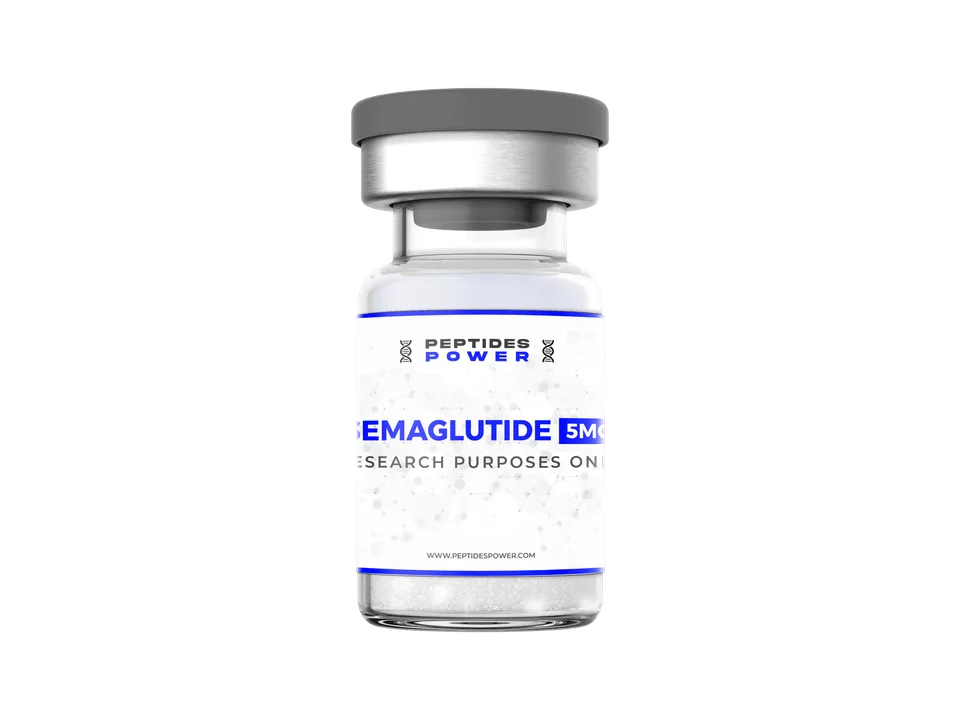
Semaglutide
From $50
In stock Research vial
Choose strength
Reconstitution and storage
The approved semaglutide medicines need no mixing: pens hold a ready-made solution and tablets are taken by mouth.12 Research vials hold a freeze-dried solid that is dissolved in a diluent, and no FDA-reviewed mixing or storage instructions exist for them.3 The approved pens' labels name three injection sites: abdomen, thigh and upper arm.4
This page summarizes published sources for information only. It is not medical advice and does not tell anyone to use a product. Questions about your own health belong with a licensed clinician. For questions about an order or a product, contact us.
Ozempic injection is a clear, colorless solution of 0.68, 1.34 or 2.68 mg/mL in prefilled pens, and it is also supplied as single-dose prefilled syringes.1 Wegovy injection is supplied as a solution too, including Wegovy HD (7.2 mg in 0.75 mL) and a FlexTouch pen (9.6 mg in 3 mL).7 Rybelsus and the other semaglutide tablets are taken by mouth.2 Only research vials, which hold a dry freeze-dried solid, need reconstitution.
The semaglutide injection site options in the approved pens' instructions are the stomach area (abdomen), the thigh and the upper arm, with the injection given under the skin.4 The label lists the three areas without ranking them and says to rotate the site with each injection.4 Pens must never be shared between people, even if the needle is changed.1
This section describes how the prescribed pens are used. It is not guidance for research vials. How subcutaneous injections are given covers prescribed injections and sharps disposal.
A research vial holds semaglutide as a white, freeze-dried (lyophilized) solid. The vials in our shop come in 2 mg, 5 mg, without diluent. No approved application covers research-labeled semaglutide, so FDA has reviewed no mixing or storage instructions for it.3
Check the label or certificate for the exact chemical form. FDA calls semaglutide salt forms, such as semaglutide sodium and semaglutide acetate, different active ingredients from the one in approved drugs.9 Check the lab results page for testing documentation.
The general method, with more detail on technique, is in How to reconstitute a peptide vial.
Concentration (mg/mL) = semaglutide in the vial (mg) ÷ diluent added (mL).
Amount in a volume (mg) = concentration (mg/mL) × volume (mL).
| Vial | Diluent added | Concentration | Semaglutide in 0.1 mL |
|---|---|---|---|
| 2 mg | 1 mL | 2 mg/mL | 0.2 mg |
| 2 mg | 2 mL | 1 mg/mL | 0.1 mg |
| 5 mg | 2.5 mL | 2 mg/mL | 0.2 mg |
| 5 mg | 5 mL | 1 mg/mL | 0.1 mg |
More diluent makes a weaker solution; the total amount in the vial stays the same. The labeled mg may not all be peptide: Bachem notes that peptide powders also hold counter-ions and water, so peptide content may be 70 to 90% even at high purity, and says this must be taken into account when preparing a solution of defined concentration.13 The peptide calculator and the units converter run the same arithmetic for other numbers.
FDA has received reports of people taking five to 20 times the intended amount of semaglutide from compounded vials, and some needed hospital care.1011 It traced the errors to self-measured doses and to confusion between milliliters, milligrams and 'units', and it urged that patients get the right syringe size and instruction on measuring.10 In the lab, writing the concentration in mg/mL on the vial and recording every volume in mL keeps the units consistent.
No FDA-reviewed storage instructions exist for research-labeled semaglutide.3 No stability data specific to it were found in the sources used for this page, so these are reference points, not tested limits:
General guidance is in How to store peptides.
Bacteriostatic water is the diluent listed for semaglutide vials. Hospira's label for Bacteriostatic Water for Injection describes sterile water with 0.9% or 1.1% benzyl alcohol as a preservative in a multiple-dose vial, and warns that it is not for use in newborns.15 A 3 mL Luer-Lok syringe with an 18G 1-inch needle draws and transfers diluent, insulin syringes measure small volumes, and alcohol swabs clean the stopper. Peptide supplies explained describes each item.
Back to What is Semaglutide?. See also Semaglutide dosage, Semaglutide side effects and Semaglutide benefits and uses.
Side effects of Semaglutide as reported in labels, trials and published studies, with links to the full profile. Reviewed by a qualified reviewer.
Published dosing information for Semaglutide from labels and studies, with its source, and why it is not advice for you.
What published sources report about Semaglutide and its uses, with the evidence level of each finding. No promises.
From $50
In stock Research vial
Choose strengthSemaglutide for sale: strengths, stock and shipping are on the product page.
For research use only. Not for human or veterinary use. Read the research use policy.
For the approved pens, the label names three areas for injection under the skin: the abdomen, the thigh and the upper arm. It lists them without ranking one as better, for weight loss or anything else, and says to change (rotate) the site with each injection.4 This describes the prescribed pens. Research vials are not for human use, and FDA treats research-labeled semaglutide intended for people as an unapproved new drug.3
Ozempic pens go in the refrigerator (2°C to 8°C) before first use and can then be kept for up to 56 days at 15°C to 30°C.5 Wegovy pens are refrigerated and can be kept at 8°C to 30°C in the original carton for up to 28 days.6 Neither may be frozen.56 No FDA-reviewed storage instructions exist for research-labeled vials.3
Not in its approved forms. Ozempic and Wegovy injections are supplied as solutions in pens, and the tablets are taken by mouth.172 Research vials are different: they hold a freeze-dried solid that has to be dissolved in a diluent such as bacteriostatic water before lab use, and no FDA-reviewed mixing instructions exist for research-labeled semaglutide.3
No FDA-reviewed in-use period exists for research-labeled semaglutide.3 Peptide makers advise against storing peptides in solution, because they slowly break down even in sterile solution.12 For opened multiple-dose vials in general, CDC guidance is to discard them within 28 days unless the manufacturer states another date, and FDA gives the same 28-day limit for compounded GLP-1 vials.148 Approved Ozempic pens, a different product, can be kept for up to 56 days after first use.5
Written by D2C Peptides Editorial Team.
Pending qualified review.
Updated .
D2C Peptides sells peptides for laboratory research. Please confirm both statements to continue.