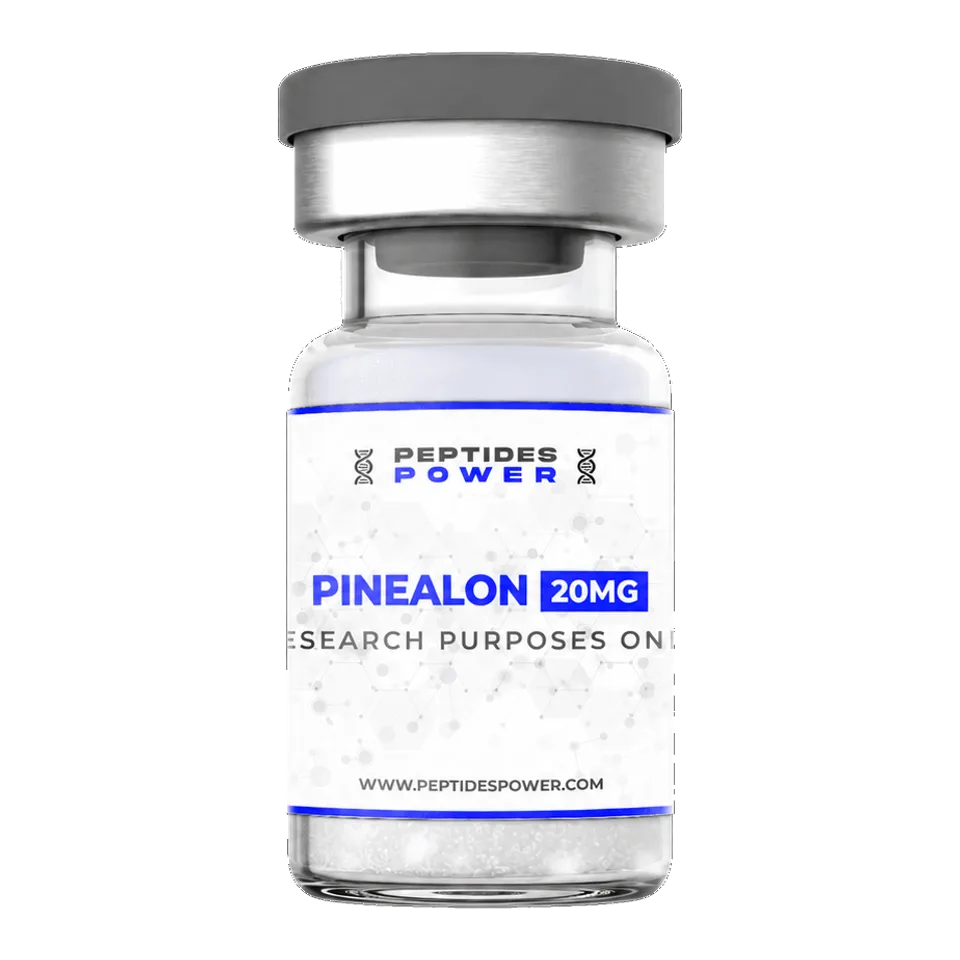
Pinealon
$55
In stock
View product
Profile
Pinealon is a lab-made tripeptide, Glu-Asp-Arg (EDR), from Vladimir Khavinson's group at the St. Petersburg Institute of Bioregulation and Gerontology in Russia.12 Studies test whether it protects nerve cells against oxidative stress, low oxygen and amyloid, mostly in cells, rats and mice.23416 Human data come from a few small Russian studies, and it is not FDA-approved.5678
This page summarizes published sources for information only. It is not medical advice and does not tell anyone to use a product. Questions about your own health belong with a licensed clinician. For questions about an order or a product, contact us.
| Class | Synthetic tripeptide from the Khavinson group's short-peptide research21 |
|---|---|
| Also known as | EDR, Glu-Asp-Arg, H-Glu-Asp-Arg-OH, L-glutamyl-L-aspartyl-L-arginine, T-339101 |
| Forms we sell | 20 mg research vial (freeze-dried powder)11 |
| Regulatory status | Not FDA approved; named by Health Canada in 2025 among unauthorized injectable peptide drugs812 |
| WADA status | Not named; class S0 bans at all times any substance not covered elsewhere on the list that has no government approval for human therapeutic use1314 |
| Human evidence | A few small Russian studies (for example 32 adults, 110 people, a truck-driver group); no registered trial56715 |
Pinealon is a synthetic peptide of three amino acids: glutamic acid, aspartic acid and arginine (Glu-Asp-Arg, or EDR).921 PubChem lists it as CID 10273502, with the formula C15H26N6O8, a molar mass of 418.40 g/mol and CAS number 175175-23-2.2324 It comes from the St. Petersburg Institute of Bioregulation and Gerontology in Russia, and many of its studies come from that institute and its partners.217421 The 2012 rat study used peptide made by the Russian firm Garmonika.16
Most of the evidence is cell and animal work: a PubMed search for "pinealon" returned 22 records in October 2026, and no Pinealon trial is registered on ClinicalTrials.gov.2515 A 2026 US review of therapeutic peptides in orthopedics, which mentions pinealon, noted a current lack of clinical trials.19 For lab work, the compound is listed as Pinealon for sale in a freeze-dried research vial.
Human data come from a few small Russian studies published in Russian with English abstracts, including these three:
None of these three abstracts reports randomization, blinding, doses or how long the peptides were used.567 A developer review states that EDR "improves memory issues in elderly patients," but we could not locate the study behind that statement.18
The developer group's hypothesis is that EDR enters cells and binds histone proteins and/or ribonucleic acids, changing gene expression and protein synthesis.18 Some lab data fit parts of this idea:
Direct gene regulation remains the developers' hypothesis, not an established mechanism.18
Research by goal is mapped in Peptides and focus and memory and Peptides and sleep.
No registered trial has collected side effect data for Pinealon.15 In the 32-person Russian study of Pinealon and Vesugen, the authors reported pro-oxidant activity and a fall in blood CD34+ stem cell markers, without saying in the abstract which peptide caused them.5 They described the fall as significant inhibition of blood cell formation.5 A 110-person comparison, by contrast, rated the peptide preparations among the safest methods tested.6 Full list: Pinealon side effects.
No human dose of Pinealon is established.815 It has no FDA-approved label and no registered clinical trial.815 Published studies used these amounts:
| Study | Species and model | Amount and route | Duration |
|---|---|---|---|
| Rats, 2012 | Pregnant rats, high-homocysteine model | 10 micrograms per kg per day, intraperitoneal, in 0.9% saline16 | 5 days before methionine loading16 |
| Mice, 2021 | 5xFAD Alzheimer's model mice | 400 micrograms per kg, intraperitoneal4 | Once a day for 2 months4 |
| Cells, 2017 | Mouse hippocampal neurons | 200 ng/ml in the culture medium17 | Not stated in the abstract |
| Humans, 2012 to 2016 | The three Russian studies above | Not reported in their English abstracts567 | Not reported |
These are research conditions in animals and cells, not guidance for people.815 Background on how study doses are reported is in Peptide dosage basics.
The research vial holds 20 mg of white freeze-dried solid.11 The supplier lists a shelf life of 36 months at -20 °C or 30 days at 2 to 8 °C, and sells bacteriostatic water separately.11 These are supplier statements, not published stability data.11 In published animal work, researchers dissolved pinealon in 0.9% sodium chloride for rats and in a physiological solution for mice.164
Peptide makers' general guidance applies here. GenScript notes that peptides containing Glu, Asp or Arg tend to absorb moisture.34 So the vial should stay tightly capped and reach room temperature before it is opened.34 Bachem adds that a peptide powder may be only 70 to 90% peptide by weight, which affects the true concentration of a mixed solution.35 For the bacteriostatic water vial, CDC guidance says an opened multiple-dose vial should be dated and discarded within 28 days unless its maker states another date.36
Lab steps are in the reconstitution guide and How to store peptides. The reconstitution calculator does the concentration math.
Pinealon is not an FDA-approved drug: an October 2026 search of FDA's Drugs@FDA data found no product with it as an active ingredient.8 It is not on FDA's May 14, 2026 list of bulk substances nominated for 503A compounding, nor on FDA's page of bulk substances that may present significant safety risks.2237 A federal rule lets a drug meant only for test-tube or lab-animal research be shipped if it is labeled "Not for use in humans," and the shipper must use due diligence to make sure the recipient regularly does such research.38 In an August 2026 warning letter to one peptide seller, FDA said evidence from the seller's website showed its products were intended as drugs for human use, despite "for research use only" labels.39
Canada has acted on Pinealon by name. Health Canada's August 1, 2025 advisory lists it among unauthorized injectable peptide drugs seized from and sold by the seller Canada Peptide.12 The advisory says injectable peptides are regulated as prescription drugs in Canada.12 It adds that the products had not been assessed for safety, efficacy and quality, and that selling unauthorized drugs is illegal in Canada.12
WADA's 2026 Prohibited List does not name Pinealon, but class S0 bans at all times any substance not covered by the list's other sections that has no current government approval for human therapeutic use.13 USADA says the 2027 list, in effect January 1, 2027, names "peptides" in general in S0.14 Pinealon's status in Russia could not be confirmed from an official source.
Side effects of Pinealon as reported in published studies, with links to the full profile. Reviewed by a qualified reviewer.
$55
In stock
View productPinealon for sale: strengths, stock and shipping are on the product page.
For research use only. Not for human or veterinary use. Read the research use policy.
In cell studies, Pinealon (Glu-Asp-Arg) limited the buildup of reactive oxygen species and necrotic death in nerve cells under oxidative stress.2 Rat pups learned better when their mothers, given extra methionine to raise homocysteine, received it first,16 and it restored or preserved dendritic spines in cell and mouse models of Alzheimer's disease.174 Its developers propose that it enters cells and changes gene activity.18 No well-designed clinical trial has shown a benefit in people.1519
Nobody knows for people: no registered clinical trial has measured how quickly Pinealon acts, or whether it acts.15 Published animal designs give some timelines: pregnant rats were treated for 5 days before a dietary stress test, and Alzheimer's model mice for 2 months.164 Those schedules describe research designs, not results anyone should expect in humans.
No. Epitalon has four amino acids (Ala-Glu-Asp-Gly), while Pinealon has three (Glu-Asp-Arg).1 Both come from the same St. Petersburg group, and both entered cell nuclei when tagged with a fluorescent label.120 In rat pineal gland culture, though, Epitalon raised the growth marker Ki-67 and the secretion marker CGRP, and Pinealon raised neither.21
There is no published human sleep study of Pinealon; none of the 22 PubMed records for it tests sleep in people.25 Despite its name, it did not reproduce Epitalon's effects in a rat pineal gland culture.21 A 2026 US orthopedics review lists pinealon among agents it says target circadian and mitochondrial regulators, while noting a current lack of clinical trials.19 Claims about sleep or circadian rhythm therefore rest on no clinical evidence.2119
Only in a few small Russian studies, published in Russian with English abstracts.567 Examples are 32 adults with chronic illness (2015), a 110-person comparison of anti-aging methods (2016) and a group of truck drivers (2012).567 None of those three abstracts reports randomization, blinding or a dose.567 No Pinealon trial is registered on ClinicalTrials.gov.15
No. A search of FDA's drug approval data found no product with pinealon as an active ingredient.8 It is not on FDA's May 14, 2026 list of bulk substances nominated for compounding under section 503A.22 In Canada, Health Canada's 2025 advisory lists Pinealon among unauthorized injectable peptide drugs seized from and sold by a Canadian seller.12
Written by D2C Peptides Editorial Team.
Pending qualified review.
Updated .
D2C Peptides sells peptides for laboratory research. Please confirm both statements to continue.