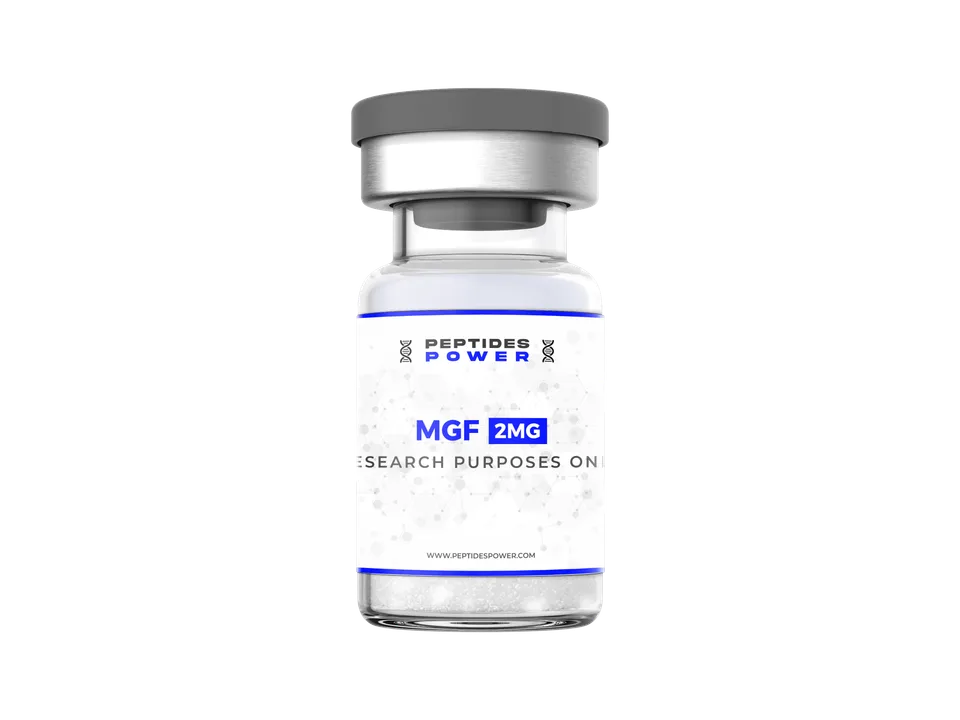
MGF
$35
Out of stock
View product
Profile
MGF (mechano growth factor) is the name for IGF-1Ec, a splice form of the IGF-1 gene whose muscle mRNA rose after some exercise in human studies.1217 The research peptide called MGF copies the last 24 amino acids of that form's tail.34 It is not an approved drug, and published studies of the peptide are preclinical.5206
This page summarizes published sources for information only. It is not medical advice and does not tell anyone to use a product. Questions about your own health belong with a licensed clinician. For questions about an order or a product, contact us.
| Class | Synthetic peptide of 24 amino acids copied from the E-domain of human IGF-1Ec34 |
|---|---|
| Also known as | Mechano growth factor, IGF-1Ec peptide, MGF E peptide (MGF-E), MGF-Ct24E, MGF24; the rodent form is IGF-1Eb3178 |
| Forms we sell | Research vial, 2 mg |
| Regulatory status | Not approved for therapeutic use; FDA 503A compounding list Category 3 (nominated without adequate support)59 |
| WADA status | Prohibited at all times under class S2.3 (mechano growth factors), on the 2026 and 2027 lists1011 |
The human IGF-1 gene is read into several precursor forms, IGF-1Ea, IGF-1Eb and IGF-1Ec. Each is cut into mature IGF-1, the part that acts on the IGF-1 receptor, plus a leftover tail called the E-peptide.13 MGF is the IGF-1Ec form: a 49-base insert gives it a unique E-domain, and the rodent equivalent is called IGF-1Eb.1
Goldspink and colleagues reported the mRNA of this form in 1996, made in response to mechanical stress.20 In a 1999 rabbit study, stretching a muscle in a cast raised both muscle forms of IGF-1 mRNA within 4 days, and the authors described MGF as a form for local action inside the muscle.26
The research peptide called MGF is a synthetic copy of the last 24 amino acids of the E-domain, a sequence that matches the end of the E-peptide in one human IGF-1 isoform.427 A 2010 review noted that no matching peptide had been identified in or isolated from cells, animal tissues or body fluids, so whether the body makes a free MGF peptide was unproven.4 The MGF for sale listing on this site is a 2 mg research vial sold under this name.
Human data cover the body's own MGF, measured as mRNA (and in one study as protein) in muscle biopsies:
An animal finding fits the age pattern: older rat muscles that failed to adapt to overload expressed considerably less MGF.28
A 2002 cell study reported that the MGF E-domain raised the number of dividing muscle precursor cells while blocking their final maturation, unlike mature IGF-1.29 Blocking the IGF-1 receptor suggested MGF acted through a different receptor.29 A 2007 study found the E peptide increased progenitor cell numbers in muscle cell cultures from healthy people and from muscular dystrophy and ALS patients.30
Other labs disagree. A 2012 study of rodent E-peptides in mouse muscle cells found their effects depended on the IGF-1 receptor after all.31 In 2014, scientists at two pharmaceutical companies tested MGF peptide at up to 500 ng/ml on mouse cells, human muscle cells and mouse muscle stem cells, saw no effect, and questioned whether MGF has a physiological role.12 In a 2016 receptor assay, the short human MGF peptide and a stabilized version did not activate the IGF-1 receptor. A larger "full-length MGF" protein did, but needed about 9 times the concentration of IGF-1 for half its maximal effect.14
| Area | Animal | Finding |
|---|---|---|
| Muscle cell transplants | Mice | The synthetic E peptide, injected into muscle or given systemically, improved engraftment of human muscle precursor cells32 |
| Muscle injury | Mice | After a contusion with macrophages depleted, MGF did not improve fiber regeneration but reduced scarring (fibrosis)33 |
| Muscle size | Mice | Sustained viral expression of the rodent EB peptide enlarged muscles, which were weaker16 |
| Heart attack | Sheep | The MGF E domain preserved heart function, with 35% less compromised heart muscle than controls34 |
| Heart attack | Mice | The E-domain peptide preserved contractility; released from microrods injected into the heart muscle, it reduced deaths3536 |
| Bone | 27 rabbits | Injections for 5 days after surgery improved healing of a 5 mm bone defect at the higher dose7 |
| Tendon | Rats | A synthetic E peptide improved Achilles tendon function and stiffness compared with saline37 |
| Brain | Gerbils, rats | The C-terminal peptide protected neurons after brain ischemia (gerbils) and reduced dopamine cell loss in a Parkinson's model (rats)388 |
These are animal results; they do not show effects in people. Goal pages on muscle growth, healing and recovery and cognitive health place MGF next to the other compounds searched for each goal.
Side effects of MGF in people have not been described: published studies of the synthetic peptide are preclinical.206 For PEG-MGF, FDA says it has not identified any human exposure data and lacks information on whether it would cause harm in humans, and that compounded PEG-MGF may pose a significant risk of immune reactions for certain routes.23 For unregulated peptides acting on the growth hormone and IGF-1 axis as a group, a 2026 review lists hormone and blood sugar changes, fluid retention, muscle and joint pain and injection-site reactions; these are class-level reports, not MGF data.21
There is also a theoretical cancer concern. MGF (IGF-1Ec) is overexpressed in prostate cancer and pre-cancerous prostate tissue, and the synthetic E peptide made prostate cancer cells grow in the lab.39 In tumor samples from 83 prostate cancer patients, higher IGF-1Ec levels went with more advanced stage and higher Gleason score.40 A 2026 review lists a theoretical proliferative concern for PEG-MGF on the same basis.15
No human dose of MGF has been established: published studies of the synthetic peptide are preclinical, a 2026 review found no peer-reviewed human studies of PEG-MGF, and FDA has not identified any human exposure data for it.20623 The same review labels the dosing patterns that circulate online as self-reported, not clinical recommendations.6 The published doses reviewed here come from animal and cell work:
These animal and cell figures are not guidance for people.
No approved MGF product exists, so there is no official label with mixing or storage directions.5 Researchers built stabilized versions of the peptide, such as Goldspink-MGF, and PEG-MGF is marketed to increase stability, but how long the plain peptide lasts in a vial is not documented in the sources reviewed.1415 Handling therefore follows general rules for injectable diluents and dissolved peptides:
For the bench steps, see the reconstitution guide; for dilution arithmetic, the reconstitution calculator; and for freezer and refrigerator choices, how to store peptides.
MGF is not approved for therapeutic use. A 2012 doping-lab paper described it as readily available on the black market even so.5 On FDA's list of bulk substances nominated for 503A compounding (updated May 14, 2026), MGF is in Category 3, nominated without adequate support; Category 2, for substances that raise significant safety risks, held six entries, none of them MGF.9
PEG-MGF has a separate history. It sat in FDA's Category 2 until its nominators withdrew it.23 FDA's advisory committee is set to discuss it, with LL-37, GHK-Cu, dihexa acetate and melanotan II, at a meeting FDA says it will hold before the end of February 2027; no date was posted as of October 25, 2026.24 The committee's July 2026 meeting covered seven other peptides (BPC-157, KPV, TB-500, MOTS-c, DSIP, semax and epitalon), and its advice is non-binding: FDA generally follows it but is not legally bound to.46 In a 2020 warning letter, FDA said drugs a pharmacy compounded from PEG-MGF did not qualify for the 503A exemptions, because the substance has no USP or NF monograph, is not a component of an FDA-approved drug and is not on the 503A bulks list.25
In sport, mechano growth factors are prohibited at all times under WADA class S2.3, on the 2026 list and on the 2027 list, which WADA published on September 21, 2026 and which takes effect on January 1, 2027.101147 Doping labs have identified MGF products from the black market and from confiscated vials.519
$35
Out of stock
View productMGF for sale: strengths, stock and shipping are on the product page.
For research use only. Not for human or veterinary use. Read the research use policy.
No. Mature IGF-1 is the 70-amino-acid hormone cut from every IGF-1 precursor, the part that acts on the IGF-1 receptor; the synthetic MGF peptide copies a different piece, the last 24 amino acids of one precursor's tail.1213 In a 2016 receptor test, the short MGF peptide did not activate the IGF-1 receptor.14 The IGF-1 profile covers the hormone itself.
PEG-MGF is MGF with polyethylene glycol attached, marketed to increase stability and prolong exposure.15 A 2026 review notes that PEGylation changes how a peptide moves through the body, so results from plain MGF or E-domain peptides cannot be assumed to apply to PEG-MGF. The same review found no peer-reviewed human studies of PEG-MGF.6
This has not been shown. Human studies only measured the body's own MGF mRNA after exercise, and a 2026 review calls claims that PEG-MGF improves body composition in people unproven.26 Cell results conflict, with one two-company replication finding no effect on muscle cells.12 In mice, extra E-peptide made muscles bigger but weaker.16
In some studies, yes. Heavy resistance exercise raised MGF mRNA in young adults but not in older adults, while an hour of eccentric cycling raised it in both age groups.217 Over 21 weeks of resistance training in 17 men, MGF mRNA and protein did not change in a consistent way.18 These studies measured the body's own MGF, not the synthetic peptide.
Not always. Doping labs found black-market MGF products to be a C-terminal amidated analog of the peptide, found an R23H variant in confiscated vials, and characterized a larger full-length MGF protein offered to athletes.51920 A 2026 review warns that composition and dose are uncertain in unregulated supply chains.21
No. IGF-1 LR3 is an 83-amino-acid analog of the whole IGF-1 hormone, while the research peptide MGF has 24 amino acids, and in a 2016 test the short MGF peptide did not activate the IGF-1 receptor.2214 A 2026 review placed IGF-1 LR3 and PEG-MGF, the pegylated form of MGF, in its lowest evidence tier, with no peer-reviewed human studies.6
Yes. Mechano growth factors are named in class S2.3 of the WADA Prohibited List, growth factors, and are prohibited at all times, in and out of competition. This applies on the 2026 list and on the 2027 list, which takes effect on January 1, 2027.1011 Anti-doping scientists report that MGF has been prohibited since 2005.20
MGF is in Category 3 of FDA's list of substances nominated for 503A pharmacy compounding, meaning it was nominated without adequate support.9 PEG-MGF was withdrawn from Category 2 by its nominators and is due to be discussed by FDA's advisory committee before the end of February 2027.2324 In 2020, FDA told a pharmacy that drugs it compounded from PEG-MGF did not qualify for the 503A exemptions.25
Written by D2C Peptides Editorial Team.
Pending qualified review.
Updated .
D2C Peptides sells peptides for laboratory research. Please confirm both statements to continue.