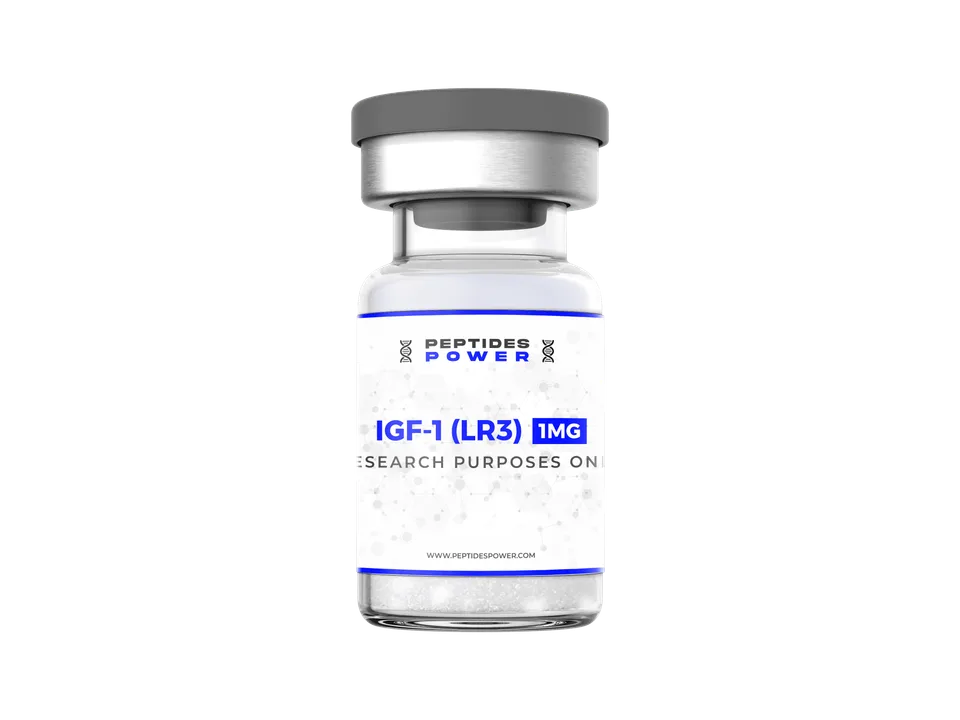
IGF-1
From $35
In stock
Choose strength
Dosage information
No human dose of IGF-1 LR3 has been established: no human trial of it is registered, and its published doses come from rats given the peptide by implanted pump.12 The approved IGF-1 dosing reviewed here is the Increlex (mecasermin) label for children with severe primary IGF-1 deficiency, where a prescriber sets a weight-based dose.34
This page summarizes published sources for information only. It is not medical advice and does not tell anyone to use a product. Questions about your own health belong with a licensed clinician. For questions about an order or a product, contact us.
No human dose of IGF-1 LR3 has been established. A ClinicalTrials.gov search run on October 24, 2026 returned no registered study of LR3 under five spellings of its name.1 The published LR3 doses reviewed here come from rats that received the peptide through a pump implanted under the skin, which delivers it continuously for days.112 Doses quoted online for LR3 therefore have no human study behind them.1
Two facts make rat numbers a poor guide. First, rats cleared LR3 from the blood much faster than IGF-1, so how long it lasts in a human body is unknown.737 Second, IGF-1 can lower blood sugar, and how strongly LR3 does this in people has never been measured.101 Nothing on this page is a dose for any person.
Increlex (mecasermin) is labeled for growth failure in children aged 2 and up who have severe primary IGF-1 deficiency, or a growth hormone gene deletion with neutralizing antibodies to growth hormone.3 A prescriber chooses and adjusts each child's dose. The label schedule:
| Label item | What the Increlex label says |
|---|---|
| Starting dose | 0.04 to 0.08 mg/kg twice daily, by injection under the skin4 |
| Dose increase | If well tolerated for at least 1 week, up by 0.04 mg/kg per dose4 |
| Maximum dose | 0.12 mg/kg twice daily4 |
| Timing | Within 20 minutes before or after a meal or snack; no dose when the meal or snack is skipped6 |
| Route | Under the skin only, never into a vein12 |
| After a dose | Avoid high-risk activities such as driving or exercise for 2 to 3 hours, especially when treatment starts13 |
| Not for | Secondary IGF-1 deficiency (such as growth hormone deficiency or malnutrition), growth promotion after the growth plates have closed, or as a substitute for growth hormone in its approved uses1415 |
The ceiling matters. The label reports tumors more often in children given higher than recommended doses, or doses that pushed IGF-1 above the normal range for age and sex, and warns that long-term overdose may cause signs of acromegaly.1617 Patients who use insulin or other diabetes medicines may need those doses changed.18
These studies used recombinant human IGF-1 (in one, bound to IGFBP-3), not LR3. They show the dose ranges researchers tested and what happened, not doses anyone should copy.
| Study | People | Dose and route | Length | Outcome |
|---|---|---|---|---|
| Long-term pediatric study (2007) | 76 children with growth hormone insensitivity | 60 to 120 micrograms/kg twice daily, under the skin | Up to 12 years | Growth rose from 2.8 to 8.0 cm a year in year one, depending on dose1920 |
| Phase 3 ALS trial (2008) | 330 adults at 20 centers | 0.05 mg/kg twice daily, under the skin | 2 years | No difference from placebo2122 |
| Randomized trial (2001) | 16 healthy postmenopausal women, average age 71 | 15 micrograms/kg twice daily, self-injected | 1 year | No change in body composition, bone density or strength2324 |
| Clinical study (1994) | 7 obese adults with type 2 diabetes | 120 and 160 micrograms/kg twice daily | 4 to 52 days | Side effects in every patient; all stopped before 8 weeks2526 |
| Randomized trial (2015) | 56 recreational athletes | 30 or 60 mg a day of the IGF-1/IGFBP-3 complex | 28 days | No change in fat or lean mass2728 |
The weight-based doses run from 15 to 160 micrograms/kg per injection, and at the highest, 120 and 160 micrograms/kg, side effects ended treatment early in all 7 adults who received them.232526 Because LR3 binds IGF-binding proteins about 1,000 times more weakly and was 2.5 to 6 times more potent than IGF-1 in rats, none of these figures can be converted into an LR3 amount.293031
All three studies dosed rats for 7 to 14 days from implanted osmotic pumps, which release the peptide continuously.11535
These are total daily amounts per rat, not amounts per kilogram of body weight.25 They describe animal experiments and are not guidance for people.
Read the full IGF-1 profile for what IGF-1 and LR3 are, and IGF-1 side effects for what was reported at these doses. Peptide dosage basics explains how peptide amounts are written and why research vials come with no human dose.
Side effects of IGF-1 as reported in labels, trials and published studies, with links to the full profile. Reviewed by a qualified reviewer.
From $35
In stock
Choose strengthIGF-1 for sale: strengths, stock and shipping are on the product page.
For research use only. Not for human or veterinary use. Read the research use policy.
No amount has been established for people, because no human trial of LR3 is registered.1 Published LR3 doses come from rats given the peptide by implanted pump for 7 to 14 days, and rat doses are not human doses.25 The approved IGF-1 schedule reviewed here is the Increlex label for children, which a prescriber sets by body weight and times around meals.46
There is no evidence-based schedule for LR3 in people, daily or otherwise, because no human trial of it is registered.1 In rats it left the blood much faster than IGF-1.7 Recombinant IGF-1 (Increlex) is a prescription drug for children with severe primary IGF-1 deficiency, given twice daily within 20 minutes of a meal or snack, and its label warns of severe low blood sugar that has caused seizures.348
No human half-life has been published; a 2026 review lists it as not documented.137 In rats, LR3 was removed from the blood much faster than IGF-1, a difference the authors linked to its poor binding to plasma binding proteins.7 For comparison, the Increlex label gives a mean terminal half-life of 5.8 hours after a single 0.12 mg/kg injection in children with severe primary IGF-1 deficiency.9
Because it has insulin-like effects that lower blood sugar: IGF-1 suppresses glucose output from the liver and increases glucose use by other tissues, and severe hypoglycemia leading to seizures has occurred with Increlex treatment.108 The label therefore ties every dose to a meal or snack, given within 20 minutes on either side, and says to skip the dose when the meal is skipped.6
Written by D2C Peptides Editorial Team.
Pending qualified review.
Updated .
D2C Peptides sells peptides for laboratory research. Please confirm both statements to continue.