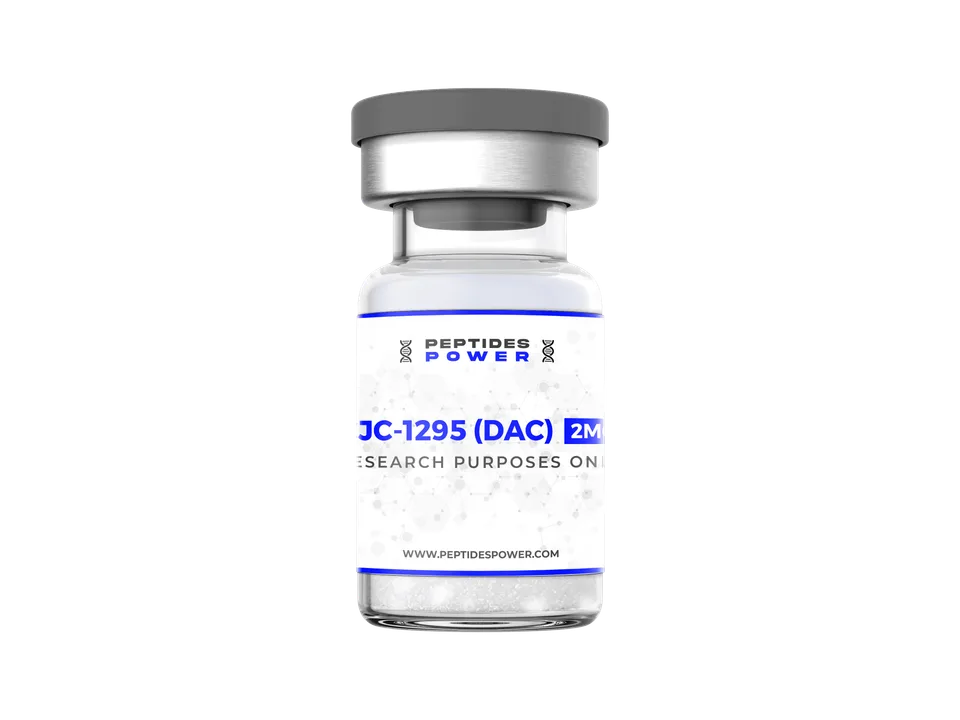
CJC-1295 with DAC
$30
In stock
View product
Reconstitution and storage
Reconstituting CJC-1295 with DAC means dissolving its freeze-dried powder in a measured volume of liquid for lab use. No official method exists, because no form of CJC-1295 is part of an approved drug or has a USP monograph.1 FDA, citing a supplier source, reports a water solubility of about 2 mg per mL.2
This page summarizes published sources for information only. It is not medical advice and does not tell anyone to use a product. Questions about your own health belong with a licensed clinician. For questions about an order or a product, contact us.
CJC-1295 with DAC has no label, so no official diluent, volume or use-by time exists.1 The handling figures published for it come from FDA's 2024 review, which cites supplier sources for most of them.32 This page covers lab handling: what is in the vial, the supplies, the concentration math and storage. It does not give instructions for injecting CJC-1295.
The vial is listed as 2 mg of dry powder; the diluent is listed separately. FDA describes CJC-1295 DAC free base as a fine white lyophilized (freeze-dried) powder.3 The listing does not say whether the powder is the free base or a salt. FDA evaluated the DAC free base, DAC acetate and DAC trifluoroacetate (TFA) as separate bulk substances, and its formula for the acetate adds acetate units to the peptide.12 The vial and its listed supplies are on the CJC-1295 with DAC for sale page.
Five supplies are listed with this vial:
The steps every freeze-dried vial shares are explained in How to reconstitute a peptide vial.
Divide the milligrams in the vial by the milliliters of diluent added: the result is the concentration in mg per mL. To find the volume that holds a given amount, divide that amount by the concentration.
| Diluent added to 2 mg | Concentration | Micrograms in 0.1 mL | Molar concentration, DAC free base |
|---|---|---|---|
| 1 mL | 2 mg/mL | 200 | about 548 µM |
| 1.5 mL | 1.33 mg/mL | 133 | about 366 µM |
| 2 mL | 1 mg/mL | 100 | about 274 µM |
| 2.5 mL | 0.8 mg/mL | 80 | about 219 µM |
| 3 mL | 0.67 mg/mL | 67 | about 183 µM |
Volumes under 1 mL would take 2 mg past the reported solubility of about 2 mg per mL.2 The molar column uses PubChem's molar mass of 3647.2 g/mol: 0.002 g ÷ 3647.2 g/mol is about 548 nanomoles of peptide.4
Worked example. Adding 2 mL gives 2 ÷ 2 = 1 mg per mL, about 274 µM. To make 1 mL of a 10 µM working solution for a cell assay, use C1 × V1 = C2 × V2: take 10 × 1 ÷ 274 = 0.036 mL (about 36 µL) of stock and add 0.964 mL of diluent.
Two things can shift these numbers:
The peptide calculator handles other vial sizes, and the units converter turns milliliters into insulin-syringe units. These are lab calculations, not amounts for a person.
| Form | Condition | What the source reports |
|---|---|---|
| Powder, DAC free base | -20 °C | The storage temperature in FDA's review, citing supplier sources3 |
| Powder, DAC free base | Below -20 °C | Expected to be stable, per FDA2 |
| Dissolved | 4 °C | Can be kept at this temperature, per FDA citing supplier sources3 |
| Dissolved, to be frozen | Several separate vials | Splitting avoids repeated freezing and thawing3 |
No stability study of dissolved CJC-1295 with DAC was found in the sources for this page, so there is no tested use-by time after mixing. FDA's general advice for multi-dose vials of sterile medicine is to discard them 28 days after first use, a rule for medicine vials rather than a measured figure for this peptide.7 The peptide storage guide covers storage practice in general.
Studies that name a route gave CJC-1295 with DAC under the skin (subcutaneously), but the sources reviewed here do not record where on the body.89 Injection-site reactions such as irritation, redness, hardening, pain or itching were the most common side effect: about 70% of people had one after a single dose, and every participant given repeated doses had one.1011 In FDA's review of animal studies, repeated daily injections under the skin caused bleeding, inflammation and tissue death at the injection site in rats and dogs.12 FDA also says compounded CJC-1295 may pose a risk of immune reactions for certain routes of administration.13
This site gives no injection directions for CJC-1295, which is not an FDA-approved drug.1
Start from What is CJC-1295 with DAC? for the overview. Research doses are on CJC-1295 with DAC dosage, the reactions reported in trials on CJC-1295 with DAC side effects, and the evidence for each claimed use on CJC-1295 with DAC benefits and uses.
Side effects of CJC-1295 with DAC as reported in clinical trials and published studies, with links to the full profile. Reviewed by a qualified reviewer.
Published dosing information for CJC-1295 with DAC from clinical trials and published studies, with its source, and why it is not advice for you.
What published sources report about CJC-1295 with DAC and its uses, with the evidence level of each finding. No promises.
$30
In stock
View productCJC-1295 with DAC for sale: strengths, stock and shipping are on the product page.
For research use only. Not for human or veterinary use. Read the research use policy.
No official volume exists, because CJC-1295 has no approved label or USP monograph.1 The volume simply sets the concentration: 1 mL gives 2 mg per mL, 2 mL gives 1 mg per mL and 3 mL gives about 0.67 mg per mL. FDA reports a water solubility of about 2 mg per mL from a supplier source, so 1 mL is the smallest volume that stays within that figure.2 The reconstitution calculator works out any other volume.
No tested figure exists. FDA's 2024 review, citing supplier sources, says the dissolved peptide can be kept at 4 °C and recommends splitting it into several vials to avoid repeated freezing and thawing, but it gives no time limit.3 For multi-dose vials of sterile medicine in general, FDA recommends discarding the vial 28 days after first use.7 That is a rule for medicine vials, not a stability result for CJC-1295, so label each vial with its mixing date.
Published human studies that report a route gave CJC-1295 with DAC by injection under the skin, but the sources reviewed do not say where on the body.89 Injection-site reactions were its most common side effect, affecting about 70% of people after one dose.10 In rats and dogs, repeated daily injections under the skin caused bleeding, inflammation and tissue death at the injection site.12 FDA calls its long-term safety in people unknown, and this site gives no injection directions for it.11
Written by D2C Peptides Editorial Team.
Pending qualified review.
Updated .
D2C Peptides sells peptides for laboratory research. Please confirm both statements to continue.