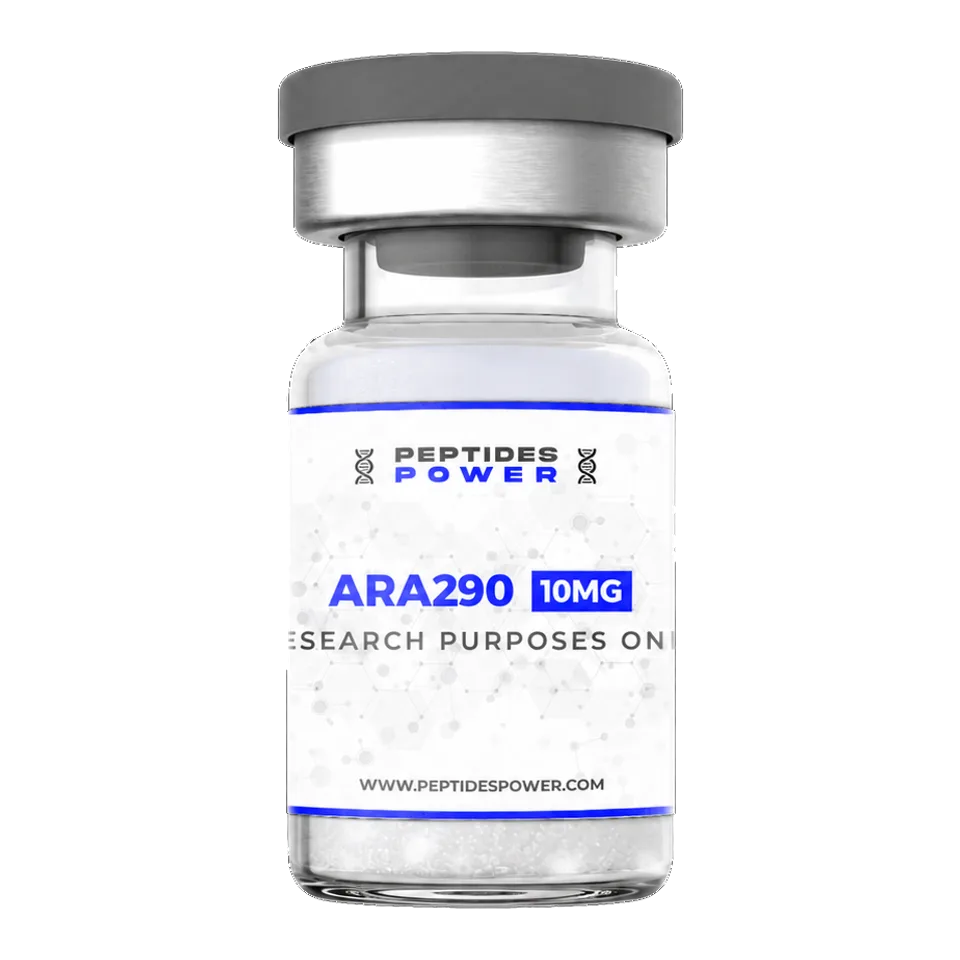
ARA-290
$45
In stock
View product
Profile
ARA-290 (cibinetide) is an experimental 11-amino-acid peptide copied from one face of erythropoietin (EPO), the hormone that drives red blood cell production.12 It was designed to keep EPO's tissue-protective signal without that red cell effect.2 It has been tested in people only in a few small, short studies and is not an approved medicine.34
This page summarizes published sources for information only. It is not medical advice and does not tell anyone to use a product. Questions about your own health belong with a licensed clinician. For questions about an order or a product, contact us.
| Class | Synthetic 11-amino-acid peptide modeled on EPO; described as an innate repair receptor agonist; it did not stimulate red blood cell production in lab and animal tests256 |
|---|---|
| Also known as | Cibinetide (INN and USAN), ARA 290, ARA290, pHBSP (pyroglutamate helix B surface peptide); FDA UNII 9W5677JKDA17 |
| Forms we sell | One 10 mg vial of freeze-dried powder, labeled for research use only |
| Regulatory status | Not an approved medicine; four FDA and two EU orphan designations, none a marketing approval; FDA 503A category 3 for compounding4689 |
| WADA status | Not named, but its class, innate repair receptor agonists, is prohibited at all times under S2.1.5 of the 2026 List10611 |
ARA-290 was engineered from the three-dimensional structure of EPO by Michael Brines, Anthony Cerami and colleagues, and described in PNAS in 2008.2 It copies the aqueous, or water-facing, surface of EPO's helix B.2 Its first amino acid, glutamine, closes into a ring called pyroglutamate, which gives the name pHBSP.2 Araim Pharmaceuticals of New York developed it as ARA 290 and sponsored its FDA orphan designations.412 For lab work, the compound is listed as ARA-290 for sale in a freeze-dried research vial.
The developers propose that ARA-290 acts on an innate repair receptor, a pairing of the EPO receptor with the beta-common receptor (CD131).5 Their 2016 review says this receptor is usually absent from normal tissue and is switched on locally by injury, low oxygen or metabolic stress.5 EMA's summary says that, once activated, the receptor blocks the production of inflammatory messengers (cytokines), and that these actions are expected to reduce inflammation.6
The evidence for that model points two ways. In a nerve-injury pain model, ARA-290 relieved pain from light touch or cold in rats and normal mice, but not in mice lacking the beta-common receptor.26 An independent 2018 biophysical study, however, found that the outer regions of the two receptors did not bind each other directly, with or without EPO or ARA-290, and noted that the model is controversial.27
The peptide leaves the blood fast: in people, its elimination half-life is about 20 minutes after an injection under the skin and about 2 minutes after an intravenous one.5 Its effects can outlast it, since in rats pain relief lasted as long as 15 weeks, even when treatment stopped after five doses.26
| Study | People | Design | Main result |
|---|---|---|---|
| Sarcoidosis pilot (2012) | 22 patients with neuropathy symptoms | Double blind, intravenous, 4 weeks | Symptom score (SFNSL) fell 11.5 points against 2.9 on placebo (p < 0.05); pain and fatigue improved equally in both groups15 |
| Sarcoidosis trial (2013) | 38 adults with small nerve fiber loss | Double blind, under the skin, 28 days | Corneal nerve fiber area rose 14.5% (p = 0.022) against a 5.3% fall on placebo; 6-minute walk rose 18.7 m against a 15.1 m drop (p = 0.049); pain fell about 9% in both groups16 |
| Sarcoidosis phase 2b (2017) | 64 patients with nerve fiber loss and pain | Randomized, three doses against placebo, 28 days | Only the 4 mg group gained corneal nerve fiber area over placebo (697 square micrometers, P = 0.012) and regenerating skin nerve fibers (P = 0.035); pain improved in all groups, placebo included17 |
| Type 2 diabetes (2015) | 48 adults with painful neuropathy | Placebo controlled, 28 days, then 28 days of follow-up | HbA1c fell 0.21 points by day 56 against a 0.21 rise on placebo (p = 0.002); lipids and PainDetect scores improved; corneal nerve gains only in a post hoc subgroup2122 |
| Diabetic macular edema (2020) | 9 adults | Open label, single arm, 12 weeks | No gain in visual acuity (-2.9 letters) or retinal thickness (+10 microns); vision quality-of-life score up 2.7 points23 |
| Healthy volunteers (2015) | 36 adults | Double blind, one intravenous dose | No effect on mood a week later; mixed effects on emotional processing2435 |
| Jaw nerve injury case series (2026) | 3 patients | Uncontrolled, 4 weeks, given with TB-500, BPC-157, dexamethasone and a local anesthetic | Sensory problems decreased in all three; the effect of ARA-290 alone cannot be judged25 |
Most of these trials were funded by or run with the developer, whose officers co-authored the papers and owned stock.235 The corneal and skin nerve counts are surrogate markers from short, small trials, and no trial lasted beyond 12 weeks or reached phase 3.16173
These are animal results, not evidence of the same effects in people.
No human trial has tested ARA-290 for wound, tendon, muscle or sports injury healing.16172 It has not been tested for weight loss: the diabetes trial measured safety, HbA1c and nerve symptoms, not weight.22 Human data on mood and thinking come from one single-dose study, and no trial has tested memory, focus or cognitive decline.242 There are no human data on aging.28 Related goal pages: Peptides and healing and recovery, Peptides and blood sugar, Peptides and focus and memory and Peptides and weight loss.
Epoetin alfa, an EPO medicine for anemia such as in chronic kidney failure, makes the bone marrow produce more red blood cells, and MedlinePlus lists risks of blood clots, stroke, serious heart problems and shorter survival in some people with cancer.29 ARA-290 was designed not to raise red blood cells, but its long-term heart and cancer-related safety has not been studied.519 WADA names carbamylated and asialo EPO as examples of innate repair receptor agonists, the class ARA-290 is described as belonging to.105
ARA-290 is a different molecule from BPC-157 and TB-500, which the 2026 case series gave together with it.25 See What is BPC-157? and What is TB-500?.
Multi-dose safety data come from trials lasting 28 days to 12 weeks in groups of 9 to 64 people, so long-term safety is unknown.52317 No approved label exists, so there is no official list of interactions, contraindications or warnings.412
Trial drug was a sterile preparation made for the studies, so these safety data do not describe research-market vials.22
No dose of ARA-290 is approved or established for any human use, and no trial has reached phase 3.43 The doses below come from small, short research studies. They describe what study participants received and are not guidance for any person.5
| Study | People | Route and dose | Schedule |
|---|---|---|---|
| Sarcoidosis pilot (2012) | 12 on ARA-290, 10 on placebo | 2 mg intravenously | Three times weekly for 4 weeks15 |
| Sarcoidosis trial (2013) | 21 on ARA-290, 17 on placebo | 4 mg under the skin | Once daily for 28 days16 |
| Sarcoidosis phase 2b (2017, NCT02039687) | 64 in four groups | 1, 4 or 8 mg under the skin, or 1 mL placebo | Once daily for 28 days3117 |
| Type 2 diabetes (2015) | 48, 24 per group | 4 mg under the skin, self-injected | Once daily for 28 days, then 28 days without treatment2122 |
| Diabetic macular edema (2020, NCT06626971) | 9 | 4 mg under the skin, self-given | Once daily for 12 weeks2320 |
| Healthy volunteers (2015, NCT02070783) | 36 | 2 mg intravenously | One dose2435 |
| Prediabetes or type 2 diabetes (NCT01933529) | Registry record only | 4.0 mg under the skin | Every morning for 28 days; no results posted32 |
| Jaw nerve case series (2026) | 3 | 4 mg inside the mouth, combined with other drugs | Weekly for 4 weeks25 |
The 4 mg dose under the skin was chosen after a crossover study in 10 healthy volunteers compared the earlier 2 mg intravenous dose with 2, 4 or 6 mg under the skin.16
Rat studies used 30 micrograms per kg into the abdomen for nerve pain, 30 micrograms per kg under the skin daily for 4 weeks in diabetic rats, and 100 micrograms per kg into the abdomen three times a week for 15 months in aging rats.261828 These animal figures are not a basis for any human dose. General background is in Peptide dosage basics.
ARA-290 has no approved label, so no official instructions exist for reconstituting it, storing it or judging its stability.412 In the lab, enzymes in blood plasma and serum broke ARA-290 down extensively, leaving one main fragment, PyrEQLERALN.11 Storage figures for the vial sold here come from the supplier and appear on its product page. General lab handling, from sterile technique to concentration math, is in How to reconstitute a peptide vial, the reconstitution calculator and How to store peptides.
United States: ARA-290 is not an approved medicine and has no brand name or prescription label.412 FDA's orphan drug database lists four designations, all sponsored by Araim Pharmaceuticals and all marked "Not FDA Approved for Orphan Indication": delayed graft function after kidney transplant (September 18, 2009), neuropathic pain in sarcoidosis (September 13, 2011), sarcoidosis (June 13, 2016), and survival and function of pancreatic islets after transplant (June 13, 2016).1341214
Compounding: FDA's 503A list updated May 14, 2026 places cibinetide (ARA-290) in category 3, substances nominated without adequate support.9 FDA says category 3 substances are not eligible for the policy that applies to category 1, and that it would consider taking action against a compounder who uses them.33 ARA-290 is not on FDA's page of bulk substances that may present significant safety risks.30 In a March 2026 letter to a research-peptide seller, FDA said the firm's website showed its products were intended to be drugs for human use, despite "Research Use Only" labels.34
Europe: the European Commission granted orphan designations for sarcoidosis (EU/3/13/1191, 7 October 2013) and for preventing graft loss in pancreatic islet transplantation (EU/3/16/1721, 29 August 2016).68 Both showed the status "Positive" when checked in October 2026, and sponsorship moved to Araim Pharmaceuticals Europe Limited, Ireland, in April 2019.68 An orphan designation is not a marketing approval.6
Development and sport: ClinicalTrials.gov lists four ARA 290 studies, none in phase 3: two completed, one of unknown status, and one terminated because the study drug expired with no replacement available.320 No current statement from the developer about its plans was found for this page. Under the 2026 WADA List, its class, innate repair receptor agonists, is prohibited at all times (S2.1.5).106
$45
In stock
View productARA-290 for sale: strengths, stock and shipping are on the product page.
For research use only. Not for human or veterinary use. Read the research use policy.
No. FDA's orphan drug database lists four orphan designations for it, covering sarcoidosis, neuropathic pain in sarcoidosis, delayed graft function after kidney transplant and pancreatic islet survival after transplant, and marks each one 'Not FDA Approved for Orphan Indication'.4121314 An orphan designation is not an approval. No ARA-290 trial has reached phase 3, and no prescription label exists.34
The evidence is small and mixed. In 4-week sarcoidosis trials, symptom questionnaires improved more than on placebo (22 and 38 people), and corneal nerve fiber area rose at 4 mg a day (38 and 64 people).151617 Average pain intensity, however, improved about as much on placebo.151617 In a 48-person type 2 diabetes trial, neuropathy scores improved more than on placebo.2122 No larger or longer trial has confirmed these results.3
It was designed not to. In the 2008 lab and animal studies that described it, the peptide did not stimulate red blood cell production.2 Diabetic rats given it daily for 4 weeks showed no change in hematocrit, and in a 4-week trial in people with sarcoidosis, hemoglobin stayed level against placebo.1819 Effects of longer use in people have not been studied.5
It falls in a banned class. The 2026 WADA Prohibited List bans innate repair receptor agonists at all times, in and out of competition, under class S2.1.5, and the ban is not limited to the examples it names.10 EMA describes ARA-290 as activating the innate repair receptor, and anti-doping scientists in Cologne called it a prohibited peptide in 2017.611 Athletes can confirm its status with their anti-doping organization.
Written by D2C Peptides Editorial Team.
Pending qualified review.
Updated .
D2C Peptides sells peptides for laboratory research. Please confirm both statements to continue.