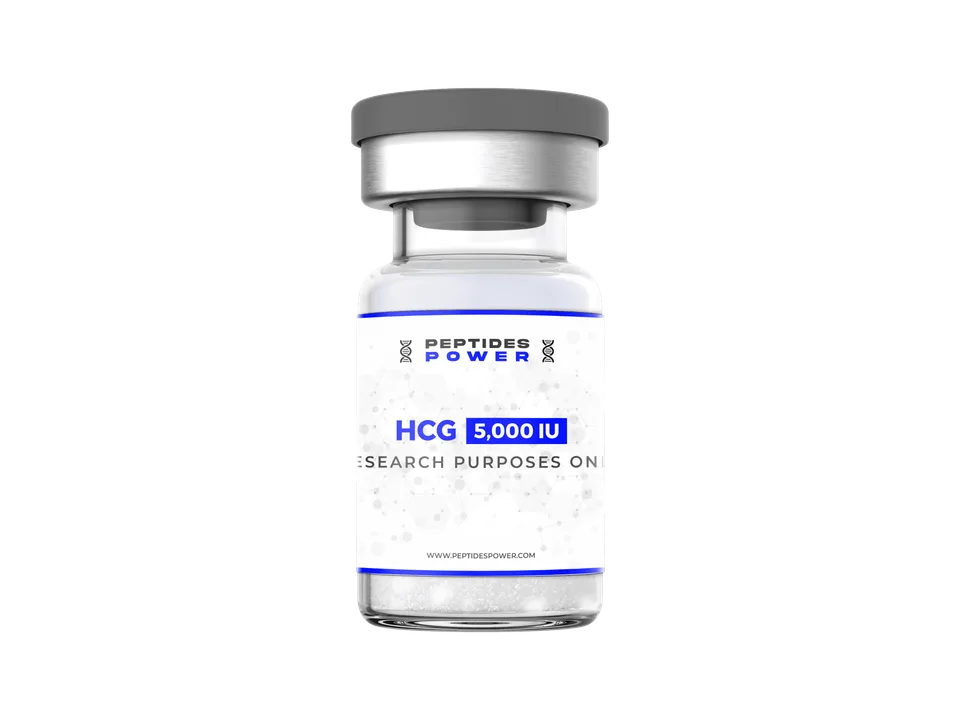
HCG
$70
In stock
View product
Profile
HCG (human chorionic gonadotropin) is the hormone the placenta makes in pregnancy.1 It acts almost exactly like luteinizing hormone (LH), signaling the testes to make androgens and the ovary to make progesterone.1 In the US, hCG shots are prescription biologics23 for fertility care and two conditions in boys and men,1 and none is approved for weight loss.4
This page summarizes published sources for information only. It is not medical advice and does not tell anyone to use a product. Questions about your own health belong with a licensed clinician. For questions about an order or a product, contact us.
| Class | Glycoprotein hormone (a gonadotropin) built from a 92-amino-acid alpha subunit and a 145-amino-acid beta subunit; it activates the LH/choriogonadotropin receptor (LHCGR)56 |
|---|---|
| Also known as | Chorionic gonadotrophin (CG); choriogonadotropin alfa (the recombinant form); US brands Novarel, Pregnyl and Ovidrel7581 |
| Forms we sell | 5000 IU research vial (freeze-dried powder); the licensed brands are not sold here |
| Regulatory status | Prescription biologic in the US (Pregnyl approved October 20, 1976; deemed a biologics license March 23, 2020); not approved for weight loss or for any use without a prescription934 |
| WADA status | Prohibited in males at all times as a testosterone-stimulating peptide (2026 list, S2.2.1)7 |
hCG is a hormone made by the human placenta and found in the urine of pregnant women.2 Its alpha subunit is essentially identical to those of LH, FSH and thyroid-stimulating hormone (TSH), while the beta subunit is distinct and gives hCG its receptor and biological specificity.117 Pregnyl, Novarel and a Fresenius Kabi product are purified from pregnancy urine, and Ovidrel (choriogonadotropin alfa) is made by genetically modified Chinese hamster ovary cells.18185 Novarel is injected into a muscle after mixing, and Ovidrel is injected under the skin from a prefilled syringe.85
In a normal pregnancy, hCG from the placenta keeps the corpus luteum working after LH secretion falls, so estrogen and progesterone secretion continue and menstruation does not start.1 As a medicine, its action is virtually identical to pituitary LH, with a small degree of FSH activity.1 It stimulates the Leydig cells of the testes to make androgens and the corpus luteum of the ovary to make progesterone.1 It can also stand in for the mid-cycle LH surge that triggers ovulation.1 In fertility treatment, FSH-type drugs usually recruit and grow the follicles, and hCG is given when monitoring shows enough follicle development.1
For the recombinant form, a 250 mcg injection under the skin reaches peak blood levels after about 12 to 24 hours, with a mean terminal half-life of about 29 hours.5
| Study | Who | Length | Main result |
|---|---|---|---|
| Stein, 1976 | 51 women aged 18 to 60, randomized and double-blind | 32 days | No significant difference from placebo in weight loss, hip and waist size, or hunger ratings12 |
| Bosch, 1990 | 40 obese women on the same 5,000 kJ a day diet | 6 weeks | No advantage over saline injections on any measure recorded13 |
| Lijesen, 1995 meta-analysis | 8 controlled and 16 uncontrolled trials | Varied | No scientific evidence of weight loss, fat redistribution or less hunger with hCG14 |
| Coviello, 2005 | 29 healthy men on weekly testosterone enanthate | 3 weeks | Testosterone alone cut testicular testosterone by 94%; hCG raised it in a dose-dependent way19 |
| Hsieh, 2013 records review | 26 hypogonadal men on testosterone plus hCG | Mean 6.2 months | Semen measures unchanged, no azoospermia, 9 men contributed to a pregnancy15 |
| Rastrelli, 2014 meta-analysis | 44 studies of men with hypogonadotropic hypogonadism | Varied | Sperm production in 75% (69 to 81%), more often with hCG plus FSH20 |
| Youssef, 2016 Cochrane review | 18 trials, 2,952 people having IVF or ICSI | One trigger dose | No evidence of a difference between recombinant and urinary hCG in live birth, ongoing pregnancy or OHSS21 |
The hCG labels state that it has not been shown to be effective added therapy for obesity and has no known effect on fat mobilization, appetite or body fat distribution.18 FDA advises consumers to avoid HCG weight-loss products.4 The Peptides and weight loss page maps searches on this goal.
The approved use in adult men is narrow: selected cases of hypogonadotropic hypogonadism, where a pituitary deficiency is the cause of low testicular function.1 Wider interest comes from testosterone therapy, which lowers LH, FSH and the testosterone level inside the testes.15 In the 2005 study of 29 healthy men on weekly testosterone, adding one of three low hCG doses left testicular testosterone 25% below baseline in the lowest-dose group, 7% below in the middle group and 26% above in the highest-dose group.19
Post-cycle therapy, the attempt to restart natural testosterone after anabolic steroid use, has little evidence behind it: a 2014 review planned as a meta-analysis found no quality studies that met its criteria, and a 2026 review says no standardized treatment exists and that hCG is often used without medical supervision.2223 Related pages: Peptides and testosterone and Peptides and men's health.
Both forms of hCG serve as the ovulation trigger in fertility care, after other drugs have grown the follicles.15 The Pregnyl label says safe ovulation induction needs regular serum estradiol tests and transvaginal ultrasound.1 HMG is one of the drugs used to grow the follicles before the hCG trigger.24 More on this goal: Peptides and women's health.
For prepubertal cryptorchidism not caused by an obstruction, hCG is thought to bring the testes down where descent would have happened at puberty.1 Therapy usually starts between ages 4 and 9, and the descent is permanent in some boys but temporary in most.1
Recombinant and urinary hCG performed alike as an IVF trigger in the Cochrane review, but in Ovidrel's trials, application-site problems affected 14.6% of patients versus 28% with urinary hCG.215 WADA's 2026 list puts hCG in one class with LH, gonadorelin and other GnRH analogues, and kisspeptin: testosterone-stimulating peptides, banned in males.7 Profiles: Gonadorelin and Kisspeptin-10. The HCG research vial is listed at HCG for sale; it is not one of the licensed hCG products.
The Novarel label lists these reactions without rates: headache, irritability, restlessness, depression, fatigue, edema, early puberty, breast enlargement in males (gynecomastia) and pain at the injection site.8 Allergic reactions range from redness, hives and rash to angioedema and shortness of breath, and anaphylaxis has been reported with urinary-derived hCG.8
Rates come from the trials of recombinant hCG at 250 mcg:
| Reaction | Ovidrel 250 mcg |
|---|---|
| Injection-site pain, assisted reproduction trials (236 patients) | 7.6%5 |
| Injection-site bruising | 4.7%5 |
| Abdominal pain | 4.2%5 |
| Nausea | 3.4%5 |
| Vomiting | 2.5%5 |
| OHSS, assisted reproduction trials | 1.7% (4 of 236)5 |
| OHSS, ovulation induction trial | 3.0% (3 of 99)5 |
| Rise in ALT, a liver enzyme | 3% of 335, versus 4.8% of 328 on urinary hCG5 |
Warnings on the labels:
A prescriber sets every hCG regimen: the label says it depends on the indication, the patient's age and weight, and the physician's preference.1 The labeled schedules are written in USP units:
| Labeled use | Label dosing |
|---|---|
| Undescended testes in boys (Pregnyl) | 4,000 USP units 3 times weekly for 3 weeks; 5,000 USP units every second day for 4 injections; or 15 injections of 500 to 1,000 USP units over 6 weeks1 |
| Undescended testes in boys (Novarel) | 500 USP units 3 times weekly for 4 to 6 weeks; if unsuccessful, another course a month later at 1,000 USP units per injection8 |
| Hypogonadotropic hypogonadism in males, first regimen | 500 to 1,000 USP units 3 times a week for 3 weeks, then the same dose twice a week for 3 weeks1 |
| Hypogonadotropic hypogonadism in males, second regimen | 4,000 USP units 3 times weekly for 6 to 9 months, then 2,000 USP units 3 times weekly for 3 more months1 |
| Ovulation induction | 5,000 to 10,000 USP units 1 day after the last gonadotropin dose; gonadotropin labeling recommends 10,0001 |
| Final follicle maturation in assisted reproduction (Ovidrel) | 250 mcg under the skin 1 day after the last dose of the follicle-stimulating drug5 |
Novarel's reconstitution table writes the same amounts in IU.8 No dose is established for weight loss or for post-cycle therapy, and none of these schedules applies to a research-labeled vial or is guidance for any person.122 Terms such as units and concentration are explained in Peptide dosage basics.
Mixing and storage rules come from the licensed products' labels:
These limits belong to licensed products, and no stability study of research-labeled hCG vials was found. Lab steps are in How to reconstitute a peptide vial, and storage is covered in How to store peptides.
FDA-licensed hCG products sold by prescription are Novarel (5,000 or 10,000 USP unit vials), Pregnyl (10,000 USP unit vials), a Fresenius Kabi product (10,000 USP unit vials) and Ovidrel (250 mcg prefilled syringes).81185 Pregnyl was approved as a new drug on October 20, 1976.9 On March 23, 2020, these approvals were deemed biologics licenses, and FDA said such products are not eligible for the 503A and 503B compounding exemptions; it named hCG as one of four affected bulk substances.3 FDA states that hCG is not approved for use without a prescription for any purpose, and that it is not approved for weight loss.4
Over-the-counter "homeopathic" HCG drops, pellets and sprays sold for weight loss have not been evaluated by FDA, which says all such products are illegally marketed; FDA and FTC sent seven joint warning letters to firms selling them.2 A 2011 letter adds that HCG cannot be a dietary supplement, because FDA knows of no evidence it was marketed as one before Pregnyl's approval.9
In an August 24, 2026 warning letter to a different online peptide seller, which did not name hCG, FDA wrote that evidence from the seller's website showed its "research use only" products were intended as drugs for human use.25 Among the states, New York lists chorionic gonadotropin in Schedule III of its controlled substances law.26
The WADA Prohibited List in force from January 1, 2026 bans chorionic gonadotrophin in males under S2.2.1, testosterone-stimulating peptides, at all times and as a non-Specified Substance.7 In the European Union, the recombinant hCG Ovitrelle has held an EU-wide marketing authorization since February 2, 2001.27
$70
In stock
View productHCG for sale: strengths, stock and shipping are on the product page.
For research use only. Not for human or veterinary use. Read the research use policy.
These sources include no direct comparison of the two. In a 2015 phase 2 trial, 60 women at high risk of ovarian hyperstimulation syndrome (OHSS) received one kisspeptin-54 injection as the IVF trigger: eggs matured in 95%, and none developed moderate, severe or critical OHSS.10 That trial compared kisspeptin doses only, with no hCG group.10 hCG has FDA-approved prescription products, while FDA lists kisspeptin-10 among bulk substances for compounding that may present significant safety risks.211 More: What is Kisspeptin-10?
Prescription hCG injections have three approved uses in the US: undescended testes in young boys when no blockage is the cause, selected males with hypogonadism caused by a pituitary deficiency (hypogonadotropic hypogonadism), and inducing ovulation in certain infertile women first treated with other gonadotropins.1 Ovidrel, the recombinant form, is approved to trigger final egg maturation in IVF and to induce ovulation.5 There are no FDA-approved hCG products for weight loss.2
Controlled trials found no benefit. In a 32-day double-blind trial of 51 women and a 6-week trial of 40 obese women, hCG injections did no better than placebo on the same diet, and a 1995 meta-analysis of 24 trials found no scientific evidence that hCG works against obesity.121314 FDA says any loss on the HCG diet comes from severe calorie restriction, often about 500 calories a day, which raises the risk of gallstones, electrolyte imbalance and heart arrhythmias.42
Small studies suggest it may help, but the evidence is limited. Testosterone therapy lowers the hormones that drive sperm production, and the authors of a 2013 study put the resulting azoospermia at 40% of patients.15 In a records review of 26 hypogonadal men taking testosterone plus hCG, semen measures held steady, no man became azoospermic and 9 contributed to a pregnancy.15 The Endocrine Society recommends against starting testosterone in men who are planning fertility in the near term.16
Written by D2C Peptides Editorial Team.
Pending qualified review.
Updated .
D2C Peptides sells peptides for laboratory research. Please confirm both statements to continue.