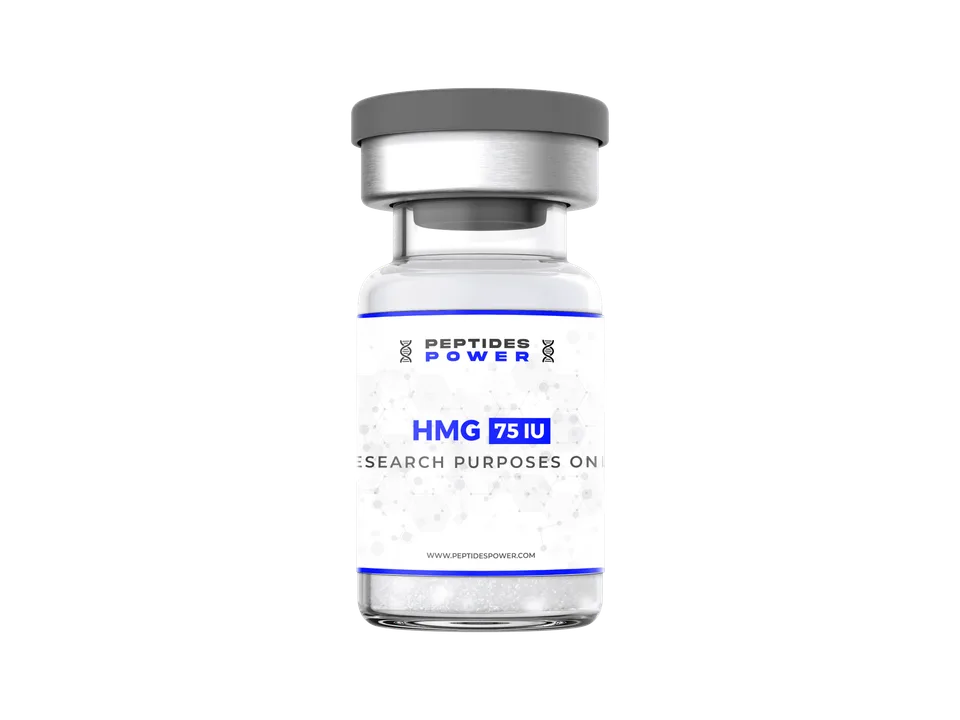
HMG
$40
In stock
View product
Profile
HMG (human menopausal gonadotropin, or menotropins) is a fertility medicine purified from the urine of postmenopausal women.1 It supplies FSH and LH activity, the signals that grow and mature egg follicles.2 The US product, Menopur, is a prescription biologic approved only for women having IVF or other assisted reproduction.31
This page summarizes published sources for information only. It is not medical advice and does not tell anyone to use a product. Questions about your own health belong with a licensed clinician. For questions about an order or a product, contact us.
| Class | Gonadotropin preparation: purified glycoprotein hormones with FSH and LH activity, with hCG adding to the LH activity24 |
|---|---|
| Also known as | Human menopausal gonadotropin, menotropins, urogonadotropin, highly purified hMG (HP-hMG); brands Menopur and the discontinued Pergonal, Humegon and Repronex56789 |
| Forms we sell | 75 IU research vial (freeze-dried powder); Menopur is not sold here |
| Regulatory status | US prescription biologic (Menopur, approved October 29, 2004; menotropins first approved in 1975); biologics are not eligible for compounding exemptions3110 |
| WADA status | Not confirmed for menotropins: the 2026 list bans chorionic gonadotrophin and LH in males at all times (S2.2.1), but that entry does not name menotropins11 |
HMG has been part of US fertility care since the first menotropins product, Pergonal, was approved on August 22, 1975, and Menopur followed on October 29, 2004.173 It is well studied in women having IVF, while the evidence in men comes from small studies, and none of the trials below used a research-labeled vial.1518
FSH activity is the main driver of recruiting and growing ovarian follicles, and LH activity, from both LH and hCG, supports steroid hormone production and the development of a follicle ready to ovulate.2 Menotropins do not trigger ovulation themselves: hCG is given once ultrasound and estradiol monitoring show enough development.1 Without any LH activity, FSH alone can still grow follicles, but they develop abnormally, with low estradiol, and fail to luteinize after a normal trigger.2
Each Menopur vial carries 75 IU of FSH activity and 75 IU of LH activity, units of biological activity rather than weight.31 Every hormone in the mix pairs a shared 92-amino-acid alpha chain with its own beta chain, 111 amino acids for FSH and 121 for LH, and the natural hormones carry sugar chains.202122 In 33 healthy women with pituitary suppression, a single 225 IU dose under the skin brought FSH to a peak at about 18 hours, and with repeated doses its elimination half-life was 11 to 13 hours by either route.1
| Trial | Who | Comparison | Main result |
|---|---|---|---|
| Study 0399E, Europe and Israel | 727 women having IVF or ICSI | Menopur vs recombinant FSH (follitropin alfa) | Continuing pregnancy 23.3% vs 20.6%, non-inferior; peak estradiol 2,213 vs 1,700 pg/mL; 13 vs 14 eggs2 |
| MERiT, 2006 | 731 women having IVF | Highly purified hMG vs recombinant FSH | Ongoing pregnancy 27% vs 22%; non-inferior, superiority not shown13 |
| MEGASET, 2012 | 749 women, single-blastocyst transfer | Highly purified hMG vs recombinant FSH | Ongoing pregnancy 30% vs 27%; cumulative live birth 40% vs 38%14 |
| Platteau, 2006 | 184 women with WHO group II anovulation | Highly purified hMG vs recombinant FSH | Ovulation 85.7% vs 85.5%; OHSS or cancellation 2.2% vs 9.8% (p=0.058)6 |
| Study 2000-02, US | 190 women having IVF | Menopur vs Repronex | Eggs 13.1 vs 14.4, not significant; live birth in 12 of 61 (20%) given Menopur under the skin2 |
| Cochrane review, 2026 | 59 studies, 18,119 women | Recombinant FSH vs HMG or HP-hMG | Live birth probably lower with recombinant FSH (OR 0.83), OHSS probably higher (OR 1.42); moderate certainty15 |
The 2011 version of the same Cochrane review pooled all urinary gonadotropins against recombinant FSH and found no significant difference in live birth or OHSS; the 2026 update separates HMG and supersedes it.2315
In the UK, Menopur is licensed for men with hypogonadotrophic hypogonadism, given with hCG to stimulate sperm production; the US label covers only women.161 In a 1985 study of 21 such men given hCG, sperm counts became normal in all 6 whose condition began after puberty but in only 1 of 15 with prepubertal onset.18 When 14 of the prepubertal-onset men also received hMG, counts normalized in 5 of 7 without a history of undescended testes versus 1 of 7 with it.18 A 2014 meta-analysis of 44 gonadotropin studies found 75% overall success, higher with hCG plus FSH and lower with prepubertal onset; its abstract reports no result for hMG on its own.24 Goal pages: Peptides and men's health, Peptides and testosterone and Peptides and women's health.
Recombinant FSH (follitropin alfa) provides FSH activity only, so estradiol runs higher with menotropins in down-regulated IVF cycles.2 Urofollitropin (Bravelle), an FSH product, may share a syringe with Menopur under the US label.1 In the UK, HMG is licensed for anovulatory women who did not respond to clomiphene citrate, a use the US label does not include.161 Related profiles: HCG, Kisspeptin-10 and Gonadorelin. The HMG research vial is listed at HMG for sale; it is not Menopur.
In two US label trials of 434 women having IVF or ICSI, the most common reactions were:
| Reaction | Rate |
|---|---|
| Abdominal pain | 6.7% (29 of 434)1 |
| Headache | 6.2% (27 of 434)1 |
| OHSS | 6.2% (27 of 434)1 |
| Injection-site pain or reaction | 3.9% (17 of 434)1 |
| Abdominal cramps | 3.0% (13 of 434)1 |
| Abdominal enlargement | 2.3% (10 of 434)1 |
| Injection-site inflammation | 2.3% (10 of 434)1 |
Uncomplicated ovarian enlargement occurs in about 5 to 10% of women given menotropins plus an hCG trigger and usually settles within 2 to 3 weeks without treatment.2 Thrombophlebitis affected less than 1% of trial subjects.1 Reports after marketing add nausea, vomiting, abdominal discomfort, fatigue, dizziness, pelvic pain, ovarian cysts, breast pain or swelling, acne, rash and hot flushes, plus two anaphylaxis events.12
Warnings on the labels:
Menopur is prescribed and dosed by physicians experienced in infertility treatment, with monitoring facilities and the lowest effective dose.1 Label and trial schedules:
| Source | Dosing |
|---|---|
| US label, assisted reproduction after GnRH agonist suppression | 225 IU under the skin daily from cycle day 2 or 3; adjusted after 5 days by ultrasound and estradiol, then no more often than every 2 days and by no more than 150 IU; at most 450 IU a day and 20 days; then hCG, withheld if OHSS risk is high14 |
| US label, with urofollitropin (Bravelle) | One syringe, total starting dose no more than 225 IU (150 IU Menopur plus 75 IU Bravelle, or 75 plus 150)1 |
| Health Canada monograph, 2026 | 225 IU after GnRH antagonist or agonist suppression, the same limits, then hCG 5,000 to 10,000 USP units2 |
| UK licence, men | With hCG to stimulate sperm production; the UK document reviewed gives no dose16 |
| Phase 3 trial 0399E, 727 women | 225 IU daily for 5 days, then individualized; stimulation averaged 11.5 days and 37 vials2 |
No dose is established outside monitored fertility treatment, and none of these schedules applies to a research-labeled vial or is guidance for any person.12 Units and dosing terms are explained in Peptide dosage basics.
From Menopur's labels:
No stability study of research-labeled HMG vials was found. For lab steps, see How to reconstitute a peptide vial; for storage, see How to store peptides.
Menopur (Ferring, BLA 021663) was approved on October 29, 2004, carries marketing status "Prescription", and holds 75 IU of FSH activity and 75 IU of LH activity per vial for injection under the skin.3 Its former new drug application was deemed a biologics license on March 23, 2020.3 The label's only indication is the development of multiple follicles and pregnancy in ovulatory women during an assisted reproduction cycle, and the package is marked "Rx only".14 FDA lists the earlier brands Pergonal (approved August 22, 1975), Humegon (September 1, 1994) and Repronex (August 27, 1999) as discontinued.789
FDA says biological products are not eligible for the 503A and 503B compounding exemptions and that federal law provides no pathway for marketing biologics made outside an approved license; it named menotropins among four bulk substances affected by the 2020 transition.1025
Canada's Menopur monograph, authorized March 23, 2026, lists one indication: multiple follicle development and pregnancy in an assisted reproduction program.2 In the UK, Menopur is prescription only and licensed more broadly: anovulation, including polycystic ovarian disease, after clomiphene fails; controlled ovarian stimulation; and men with hypogonadotrophic hypogonadism.16 For sport, a 2008 review stated that gonadotropins are prohibited only in males.17 WADA's 2026 list bans chorionic gonadotrophin and LH in males at all times (S2.2.1), but that entry does not name menotropins, so HMG's status is not confirmed here.11
$40
In stock
View productHMG for sale: strengths, stock and shipping are on the product page.
For research use only. Not for human or veterinary use. Read the research use policy.
Menopur is one brand of HMG: Ferring's menotropins product, with 75 IU of FSH activity and 75 IU of LH activity per vial.3 In an October 2026 DailyMed search it was the only US menotropins label, and FDA lists the older brands Pergonal, Humegon and Repronex as discontinued.12789 HMG sold as a research vial, including the one listed on this site, is a different product from Menopur.
They do different jobs in a stimulation cycle. HMG supplies FSH and LH activity and is injected daily for 7 to 20 days to grow egg follicles, but it does not trigger ovulation.1 hCG acts like LH and is given once, when monitoring shows enough follicle growth, to trigger final maturation; Canada's Menopur monograph gives 5,000 to 10,000 USP units.2 Menopur itself contains some hCG.4 More: What is HCG?
Single trials found it at least as effective, and a 2026 review leans slightly in its favor. Ongoing pregnancy was 27% versus 22% in 731 women and 30% versus 27% in 749 women; both trials were designed to show HMG was not worse, and both did.1314 Pooling 59 studies, a July 2026 Cochrane review rated live birth probably higher and OHSS probably lower with HMG than with recombinant FSH, on moderate-certainty evidence.15
No study in the reviewed sources tested HMG as a testosterone treatment, and no label lists that use.116 It does carry LH activity, and a 2008 review explains that hCG or LH injections stimulate testosterone production in the testes, which is why gonadotropins are prohibited in sport only for males.17 In men with hypogonadotropic hypogonadism, hMG is added to hCG to support sperm production rather than used alone.18
Yes. Menopur is extracted from the urine of postmenopausal women and further purified, and hCG taken from the urine of pregnant women may be added to balance the LH activity.12 Canada's monograph calls the risk of passing on an infectious agent theoretical: no case linked to urine-derived gonadotropins has been identified, but it cannot be completely ruled out.2
Yes. In October 2022, Ferring suspended all Menopur shipments after learning of unapproved changes to the manufacturing process of the drug substance, according to a 2023 UK letter to health professionals agreed with the medicines regulator, the MHRA.16 The European Medicines Agency now lists the EU shortage as resolved, on a page last updated April 24, 2026.19
Written by D2C Peptides Editorial Team.
Pending qualified review.
Updated .
D2C Peptides sells peptides for laboratory research. Please confirm both statements to continue.