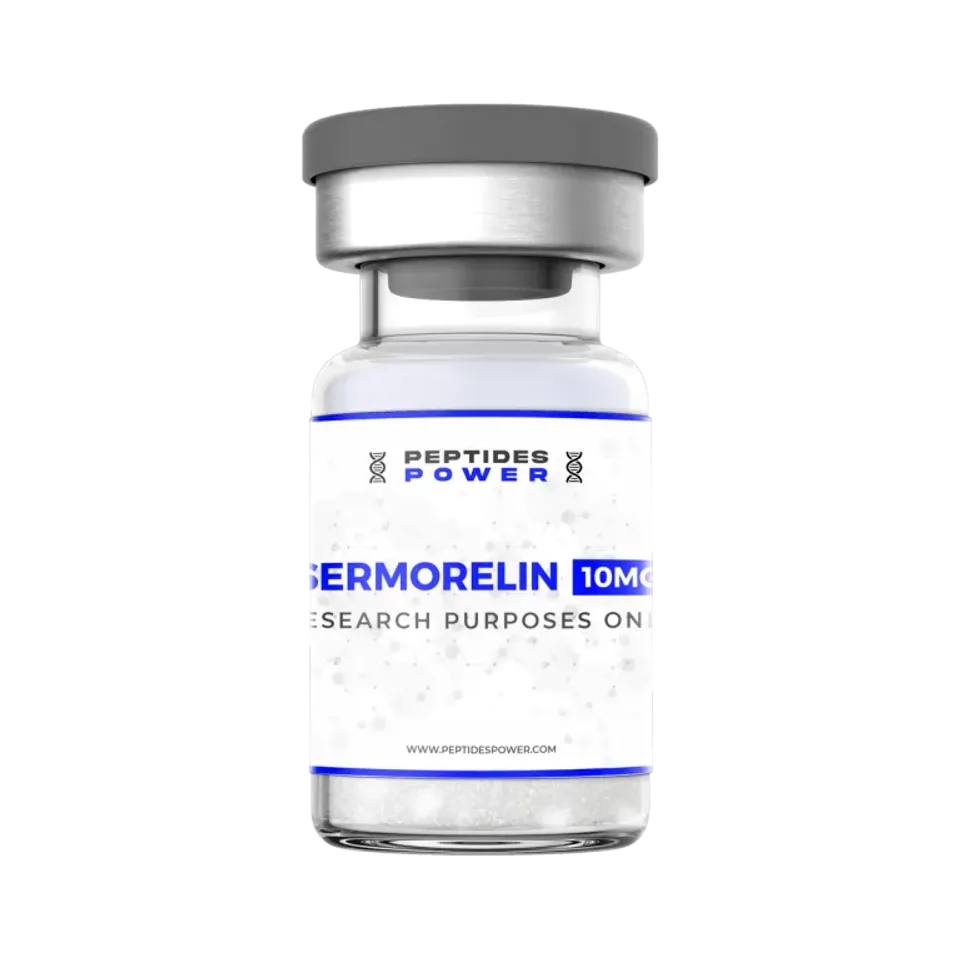
Sermorelin
$70
In stock
View product
Reconstitution and storage
Freeze-dried sermorelin is dissolved by adding a measured volume of a sterile diluent such as bacteriostatic water, with aseptic technique and gentle swirling, not shaking.1112 No current label sets the volume, so the volume chosen sets the concentration.23 This page covers supplies, lab steps, concentration math for a 10 mg vial and storage.
This page summarizes published sources for information only. It is not medical advice and does not tell anyone to use a product. Questions about your own health belong with a licensed clinician. For questions about an order or a product, contact us.
The vial sold here holds 10 mg of sermorelin as a dry powder; the diluent is a separate catalog item. The approved Geref diagnostic was also a freeze-dried powder, at 50 mcg per vial, so a 10 mg vial holds 200 times that amount.1 No current label gives a mixing volume: Drugs@FDA offers no Geref label, and DailyMed lists no sermorelin labels.23 The diluent volume is therefore a lab choice, and the math below shows what each choice gives.
This page covers lab handling only. The compound itself is described in What is Sermorelin?, and the general method for any peptide vial is in How to reconstitute a peptide vial.
These are separate items in the catalog:
Each supplies page covers that item's storage and disposal. The full range is under Peptide supplies.
One maker's label describes Bacteriostatic Water for Injection, USP, as sterile water with 0.9% or 1.1% benzyl alcohol as a preservative, in a multiple-dose container.11 The same label warns that some drugs are incompatible with benzyl alcohol; no compatibility data for sermorelin were found.11
Sterility matters at every step: the bacteriostatic water label calls for aseptic technique on every entry into and withdrawal from a container.11 Compounded lyophilized sermorelin has been recalled for lack of sterility assurance.7
Three formulas cover the arithmetic:
Worked example for a 10 mg vial, arithmetic only:
| Diluent added | Concentration | Amount in 0.1 mL |
|---|---|---|
| 1 mL | 10 mg/mL (10,000 mcg/mL) | 1 mg (1,000 mcg) |
| 2 mL | 5 mg/mL (5,000 mcg/mL) | 0.5 mg (500 mcg) |
| 2.5 mL | 4 mg/mL (4,000 mcg/mL) | 0.4 mg (400 mcg) |
| 3 mL | 3.33 mg/mL (3,333 mcg/mL) | 0.33 mg (333 mcg) |
| 5 mL | 2 mg/mL (2,000 mcg/mL) | 0.2 mg (200 mcg) |
More diluent gives a weaker solution and a larger volume for the same amount. A volume above 3 mL takes more than one draw with the 3 mL syringe. If a syringe is marked in units rather than mL, the Peptide units converter converts between them. The Reconstitution calculator and Peptide calculator run these formulas for any vial and volume. None of these numbers is a dose.
The third formula runs the other way. At 5 mg/mL (10 mg in 2 mL), a 2.5 mg portion, one quarter of the vial, is 2.5 / 5 = 0.5 mL. At 4 mg/mL (10 mg in 2.5 mL), the same portion is 2.5 / 4 = 0.625 mL. A lab that splits a vial into equal portions can check the plan the same way: four portions of 0.5 mL add back to the full 2 mL.
Concentration times volume should return the vial amount: 5 mg/mL x 2 mL = 10 mg. Rounding adds small errors. Ten divided by 3 is 3.333 and repeating, and 3.33 mg/mL x 3 mL = 9.99 mg, so keep the unrounded value in the records.
The math assumes the vial holds its labeled amount of peptide. A peptide maker notes that peptide content must be considered when preparing a solution of defined concentration, because a powder may be only 70 to 90% peptide by weight, the rest being counter-ions and moisture.13
Sermorelin-specific storage data exist only for the approved product. FDA accepted stability data supporting a 24-month shelf life for Geref powder stored at 7 C, up from 12 months.1 Storage after mixing is unconfirmed, because the Geref label is not available.2 No independent stability data for the research vial were found.
General peptide guidance fills part of the gap. One peptide maker advises storing freeze-dried peptides below -15 C, and keeping peptide solutions in frozen aliquots, since long-term storage in solution is not recommended.13 It adds that peptides containing methionine, asparagine or glutamine have a limited shelf life; sermorelin's sequence contains all three.1314 Record the mixing date and concentration on the vial, and follow How to store peptides for general handling.
On the common question of sermorelin injection sites, this is what the studies report. Human studies gave sermorelin by injection under the skin, by injection into a vein, by continuous infusion and as a nasal spray.489 In the 110-child Geref trial, the injection was given under the skin once daily at bedtime.5 None of the studies reviewed here compared sites on the body. Sermorelin has no current FDA approval, so no approved instructions for use exist.10
Reported effects and warnings: Sermorelin side effects. Doses used in studies: Sermorelin dosage. What studies found: Sermorelin benefits and uses. The 10 mg research vial: Sermorelin for sale.
Side effects of Sermorelin as reported in clinical trials and published studies, with links to the full profile. Reviewed by a qualified reviewer.
Published dosing information for Sermorelin from clinical trials and published studies, with its source, and why it is not advice for you.
What published sources report about Sermorelin and its uses, with the evidence level of each finding. No promises.
$70
In stock
View productSermorelin for sale: strengths, stock and shipping are on the product page.
For research use only. Not for human or veterinary use. Read the research use policy.
In published human studies, sermorelin was injected under the skin, or given into a vein for testing.4 The Geref International Study Group trial in children used once-daily injections under the skin at bedtime.5 The studies reviewed here do not compare injection sites on the body. This page covers lab reconstitution only and gives no injection instructions for a research compound.
There is no label answer, because no current sermorelin label exists.23 The volume is a choice that sets the concentration. Divide the vial amount by the diluent volume: 1 mL gives 10 mg/mL, 2 mL gives 5 mg/mL and 5 mL gives 2 mg/mL. The reconstitution calculator does this arithmetic for any volume.
The only regulator data are for Geref. FDA accepted a 24-month shelf life for its freeze-dried powder stored at 7 C, which is refrigerator temperature.1 The Geref label is not available, so storage directions after mixing are unconfirmed.2 As general guidance, one peptide maker advises storing freeze-dried peptides below -15 C and does not recommend long-term storage in solution.13 Keep records of the mixing date and concentration, and see How to store peptides for general handling.
Because the concentration depends on the powder fully dissolving in the stated volume. In a 2022 recall of compounded injectables that included sermorelin, the recall notice, posted by FDA, warned that products which reconstitute at a different rate than intended can lead to too much or too little being given.6 Recording the volume added and checking that no powder remains are part of the lab steps below.
Written by D2C Peptides Editorial Team.
Pending qualified review.
Updated .
D2C Peptides sells peptides for laboratory research. Please confirm both statements to continue.