NAD+
$75
In stock
View product
Reconstitution and storage
NAD+ is reconstituted by dissolving the vial's white freeze-dried solid in a measured volume of sterile diluent, then labeling the vial and storing it cold and dark. No FDA-approved preparation exists.1 Registered studies used 100 mg in 2 mL of bacteriostatic water or 500 mg in 500 mL of saline.23 FDA reports NAD degrades with light, moisture and room temperature.4
This page summarizes published sources for information only. It is not medical advice and does not tell anyone to use a product. Questions about your own health belong with a licensed clinician. For questions about an order or a product, contact us.
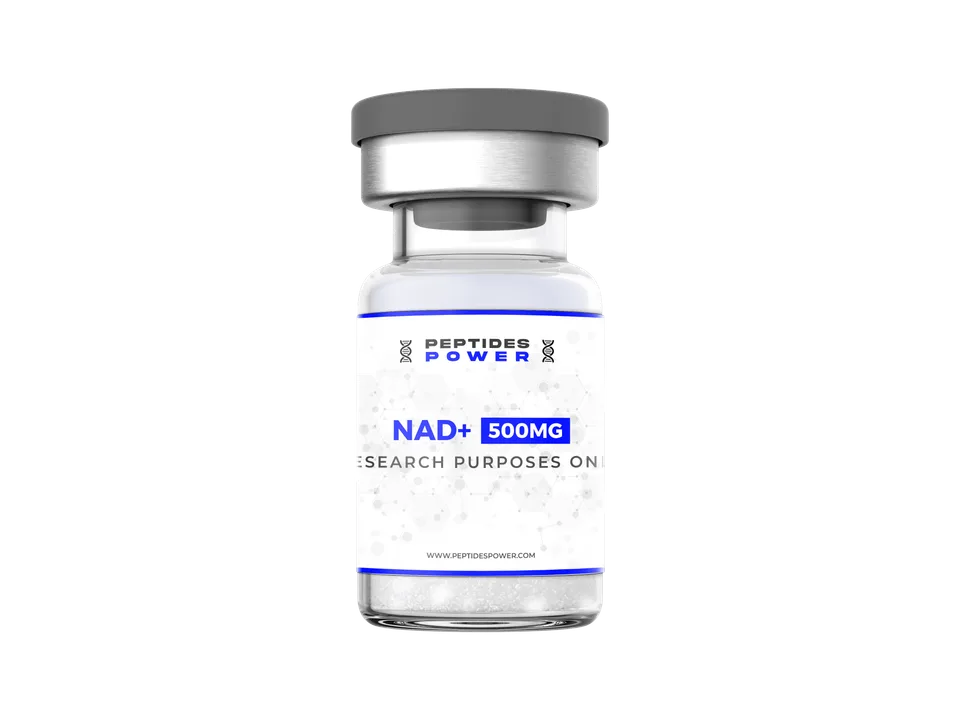
The vial is sold as 500 mg of NAD+, supplied as a white lyophilized (freeze-dried) solid. No diluent is included; bacteriostatic water is sold separately. Before any math, check the vial label, and the lot's certificate of analysis where available, to confirm the total amount. The worked numbers below assume 500 mg in total per vial. Freeze-drying is also how the NAD+ injection approved in China is supplied: a white to off-white powder or cake in 5 mg vials.7 Vial details and supplies: NAD+ for sale.
The supplies listed with the NAD+ vial are Bacteriostatic Water, the 3mL Syringe, Luer-Lok Tip, the 18G 1-Inch Needle, Insulin Syringes and Alcohol Swabs. Bacteriostatic water is the diluent one registered NAD+ study used.2 Each supply page describes the item and how it is handled. General vial technique is in How to reconstitute a peptide vial, and storage basics are in How to store peptides.
Concentration is the amount in the vial divided by the volume of diluent added:
concentration (mg per mL) = mg in the vial ÷ mL of diluent
For a vial holding 500 mg in total:
| Diluent added | Concentration | NAD+ in 0.1 mL |
|---|---|---|
| 2 mL | 250 mg/mL | 25 mg |
| 2.5 mL | 200 mg/mL | 20 mg |
| 5 mL | 100 mg/mL | 10 mg |
| 10 mL | 50 mg/mL | 5 mg |
To find the volume that holds a set amount, divide that amount by the concentration. At 100 mg/mL, for example, 0.25 mL holds 25 mg. The study preparations follow the same arithmetic. One trial's 100 mg in 2 mL is 50 mg/mL.2 Another's 500 mg in 500 mL of saline is 1 mg/mL.3 A 750 mg infusion over 6 hours works out to about 2 mg per minute.5 The table is arithmetic only. The sources do not say how concentrated NAD+ can be made or how long any concentration stays stable. The reconstitution calculator and the peptide calculator run these steps for any vial size.
Human data on subcutaneous NAD+ injections come from one small trial. A registered pilot (NCT06919328) gave 100 mg of NAD+ in 2 mL of bacteriostatic water by subcutaneous injection, by intramuscular injection or by IV push.2 Its 2026 preprint reported 4 to 6 adults per NAD+ group and similar tolerability for subcutaneous NAD+ and nicotinamide riboside.11 It found no attributable unexpected adverse events.11 The trial's registered title includes absorption, but the preprint reports a preliminary safety analysis that is not yet peer reviewed.211 No route or dose of NAD+ is FDA-approved,1 and this page covers lab preparation only, not how to give an injection.
Related pages: What is NAD+?, NAD+ dosage, NAD+ side effects and NAD+ benefits and uses.
What published sources report about NAD+ and its uses, with the evidence level of each finding. No promises.
Side effects of NAD+ as reported in clinical trials and published studies, with links to the full profile. Reviewed by a qualified reviewer.
Published dosing information for NAD+ from clinical trials and published studies, with its source, and why it is not advice for you.
$75
In stock
View productNAD+ for sale: strengths, stock and shipping are on the product page.
For research use only. Not for human or veterinary use. Read the research use policy.
NAD+ is not an FDA-approved drug, so there is no approved method, and the diluent volume is a lab choice.1 The math is the amount in the vial divided by the diluent volume. One registered study dissolved 100 mg of NAD+ in 2 mL of bacteriostatic water, which gives 50 mg per mL.2 By the same arithmetic, 1,000 mg in 10 mL gives 100 mg per mL, and in 20 mL, 50 mg per mL. Confirm the total amount on the vial label first.
Keep it cold, dry and away from light. FDA has reported that NAD degrades with light, moisture, alkaline pH and room temperature.4 FDA added that NAD needs several protective measures to stay stable in ordinary storage.4 The sources reviewed here give no verified shelf life or storage temperature for this vial, so follow the label.
In the studies reviewed here, bacteriostatic water for 2 mL preparations and saline for IV drips. A registered trial prepared 100 mg of NAD+ in 2 mL of bacteriostatic water.2 Another diluted 500 mg in 500 mL of saline,3 and a 2019 pilot infused 750 mg in normal saline across 6 hours.5 These show how studies prepared NAD+; they are not instructions for people.
No tested answer exists: the sources reviewed here contain no stability data for reconstituted research NAD+. The bacteriostatic water label says to use dissolved drugs promptly and not to store them unless the drug's maker directs otherwise.12 FDA has reported that NAD breaks down at room temperature.4 In 2022, a pharmacy's 500 mg NAD+ vials were recalled as subpotent or past their reconstitution time.6 Record the date and time of mixing on every vial.
Written by D2C Peptides Editorial Team.
Pending qualified review.
Updated .
D2C Peptides sells peptides for laboratory research. Please confirm both statements to continue.