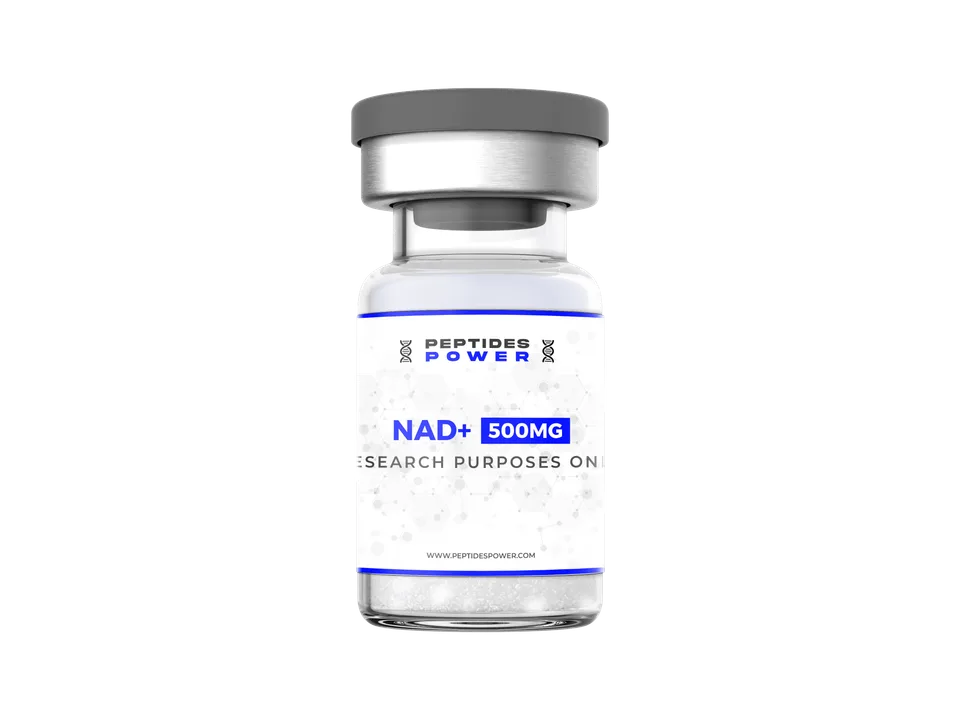
NAD+
$75
In stock
View product
Dosage information
No human dose of NAD+ injection is established or approved in the US.123 Small studies gave 750 mg by IV over 6 hours once, or 500 mg by IV daily for 4 days.45 Another gave 100 mg daily for 3 days under the skin, into muscle or by IV push.6 These figures describe research, not guidance for people.
This page summarizes published sources for information only. It is not medical advice and does not tell anyone to use a product. Questions about your own health belong with a licensed clinician. For questions about an order or a product, contact us.
There is no approved NAD+ injection dosage in the US. NAD+ is not an FDA-approved drug, so there is no US drug label with a dose.1 Compounded versions are not FDA-approved either.2 In 2019, FDA said it did not find enough clinical data to evaluate whether NAD is safe in compounded drugs.3 It also found no published studies supporting NAD for the one use it reviewed, fatigue in multiple sclerosis.3 The figures below are study doses: the amounts, routes and schedules researchers used, in the people they studied.
| Study | Who | Route | Amount and schedule | What happened |
|---|---|---|---|---|
| 2019 randomized pilot | 8 healthy men aged 30 to 55 (3 more got saline) | IV | 750 mg in normal saline over 6 hours (about 2 mg per minute), once | No adverse events4 |
| 2026 retrospective review | 6 adult clients of a US wellness clinic | IV | 500 mg in 500 mL of saline, once a day for 4 days in a row | Moderate to severe symptoms in all 6; infusions averaged about 97 minutes as clients slowed the drip5 |
| Registered trial NCT06382688 | Healthy adults aged 40 and over | IV | 500 mg in 500 mL of saline | No results posted9 |
| Registered pilot NCT06919328 (2026 preprint) | 4 to 6 adults per NAD+ group | Subcutaneous, intramuscular or IV push | 100 mg in 2 mL of bacteriostatic water, once a day for 3 days in a row | No attributable unexpected adverse events reported106 |
| Phase 1 trial NCT06558253, China | Patients with blood cancers after cord blood transplant | IV | 10, 20 or 50 mg once a day for 21 days | Listed as recruiting at its last update (December 2024); no results7 |
Two of these five studies have no results yet, one is a preprint, and one is a retrospective review of clinic records.9765 None has reported a comparison of doses on a health outcome. The Chinese trial raises the daily amount from one group of patients to the next, and its results are not yet posted.7
The two IV reports with results differ in rate as well as in amount. The 2019 infusion ran at about 2 mg per minute and caused no adverse events.4 That pilot was run at a Louisiana wellness center that uses IV NAD as a clinical therapy, and one of the authors is its medical director.4 In the 2026 review, clients controlled their own infusion rate based on how well they tolerated it. Their 500 mg over the average of about 97 minutes works out to about 5 mg per minute.5 Every client in that review reported moderate to severe symptoms, which stopped when the drip ended.5 The two studies differ in design and size (8 and 6 people on NAD+), so they do not establish a safe rate for anyone.
The amounts span a wide range. The NAD+ injection marketed in China is supplied in 5 mg vials.11 The phase 1 trial there gives 10 to 50 mg a day. Its first 3 patients received 10 mg a day, and patients 7 to 12 received 50 mg.7 The other studies used 100 mg per injection or 500 to 750 mg per IV session.654 Only the 750 mg pilot reported a change in NAD+ blood levels: plasma NAD+ did not rise for at least the first 2 hours and was 398% above baseline at the 6 hour mark.4 The 2026 clinic review tried to measure whole-blood NAD+, but its assays could not detect changes because of insufficient sampling.5
These amounts were given to adults who were mostly healthy. People who were pregnant, or who had conditions such as heart, kidney or liver disease, were kept out of one registered IV trial.9
Trials of NAD+ precursors gave daily amounts by mouth for weeks. They are separate compounds, and their doses do not carry over to injected NAD+:
| Precursor | Daily amount by mouth | Length | People |
|---|---|---|---|
| Nicotinamide riboside | 1,000 mg | 6 weeks | 30 adults aged 55 to 7912 |
| Nicotinamide riboside | 100, 300 or 1,000 mg | 8 weeks | 140 overweight adults aged 40 to 6013 |
| Nicotinamide riboside | 2,000 mg | 12 weeks | 40 obese men aged 40 to 7014 |
| Nicotinamide mononucleotide | 250 mg | 10 weeks | 25 postmenopausal women with prediabetes15 |
| Nicotinamide mononucleotide | 300, 600 or 900 mg | 60 days | 80 adults aged 40 to 6516 |
Oral and injected amounts are not interchangeable. Because of its negative charge, NAD+ does not cross cell membranes passively.4 Outside cells, the precursor NMN is first converted to NR by the enzyme CD73, and only then taken up.8 FDA has also noted nonclinical data suggesting that NADH taken by mouth is unstable in acid and likely degraded before it is absorbed.3
The WADA Prohibited List in force from January 1, 2026 bans IV infusions or injections of more than 100 mL per 12 hours. Exceptions cover hospital treatment, surgical procedures and clinical diagnostic investigations, and the cap holds whatever the drip contains.17 The registered trial above diluted 500 mg of NAD+ in 500 mL of saline, five times that volume.9
Related pages: What is NAD+?, NAD+ side effects, NAD+ benefits and uses and How to reconstitute NAD+.
What published sources report about NAD+ and its uses, with the evidence level of each finding. No promises.
Side effects of NAD+ as reported in clinical trials and published studies, with links to the full profile. Reviewed by a qualified reviewer.
How NAD+ is reconstituted, the supplies used, and the calculator, step by step. Sourced and reviewed.
$75
In stock
View productNAD+ for sale: strengths, stock and shipping are on the product page.
For research use only. Not for human or veterinary use. Read the research use policy.
It has been, in small studies. A 2019 pilot gave 750 mg over 6 hours to 8 healthy men with no adverse events.4 A 2026 clinic review covered 500 mg a day for 4 days in 6 clients, all of whom reported moderate to severe symptoms during the drip.5 No IV dose is FDA-approved, because NAD+ is not an approved drug.1 Pharmacy-compounded NAD+ for a patient needs a valid patient-specific prescription.2
Most published human data are for IV infusion.45 A 2026 preprint added three other routes, IV push, intramuscular and subcutaneous, each tested at 100 mg a day for 3 days in groups of 4 to 6 adults.6 The preprint reported no attributable unexpected adverse events; it has not yet passed peer review.6 No route is FDA-approved, because NAD+ is not an approved drug.1
There are no long-term human data to answer this. Published NAD+ infusion studies lasted a single session (2019) or 4 days (2026),45 and a 2026 preprint gave injections on 3 days.6 A phase 1 trial in China plans 21 days of daily infusions at 10 to 50 mg; it was recruiting at its last registry update (December 2024), and no results are posted.7 A 2021 review states that the long-term side effects of NAD+ precursors are still unknown.8
Written by D2C Peptides Editorial Team.
Pending qualified review.
Updated .
D2C Peptides sells peptides for laboratory research. Please confirm both statements to continue.