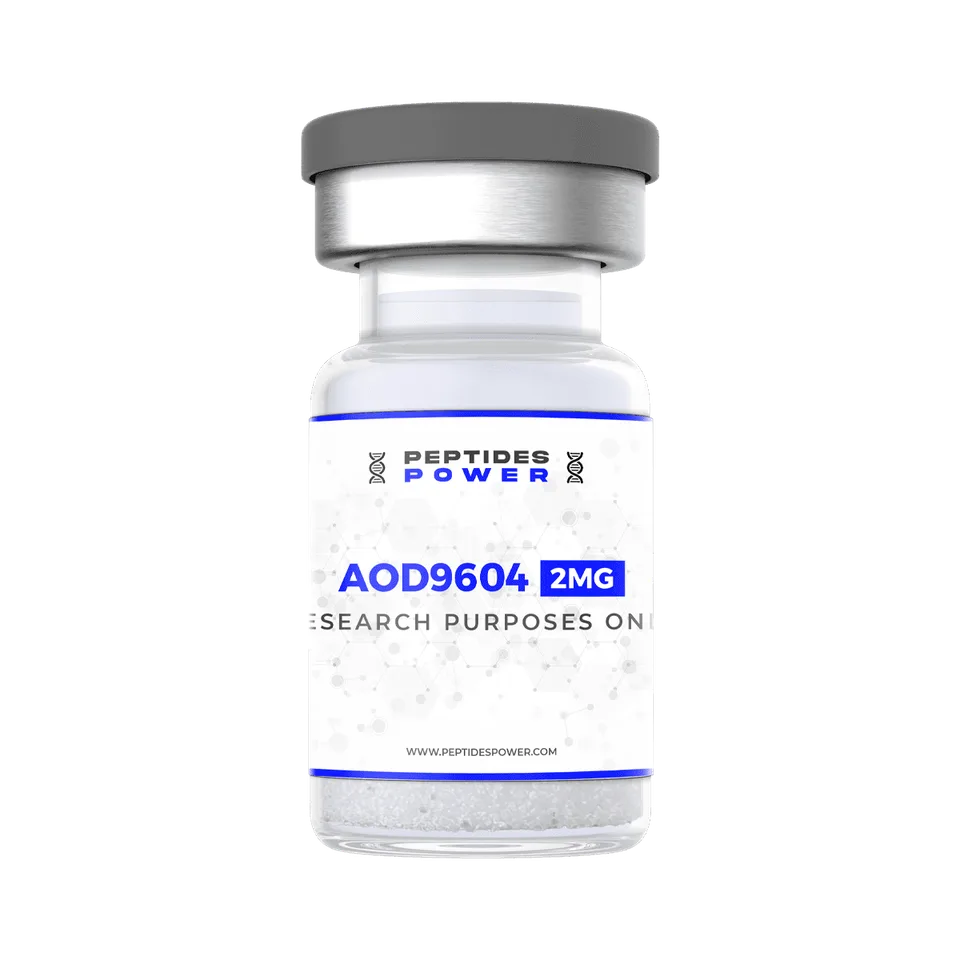
AOD-9604
$25
In stock
View product
Reconstitution and storage
Reconstituting AOD-9604 means dissolving the freeze-dried solid in a measured volume of liquid so the vial holds a known concentration. No USP monograph or approved label sets an official method for AOD-9604.1 A supplier certificate that FDA cites puts the free base's solubility in water at up to 2 mg per mL.1
This page summarizes published sources for information only. It is not medical advice and does not tell anyone to use a product. Questions about your own health belong with a licensed clinician. For questions about an order or a product, contact us.
Learning how to use AOD-9604 in a lab starts with dissolving the solid in a measured volume, so any volume drawn later holds a known amount. AOD-9604 has no USP or National Formulary monograph and is not part of any FDA-approved product, so no label sets a diluent, a volume or a use-by time.1 The steps below are general lab handling around the few published AOD-9604 figures, not directions for use in people.
The vial holds 2 mg of AOD-9604 as a white lyophilized (freeze-dried) solid, with no diluent included.3 Three details matter before any math:
The vial listing and its supplies are on the AOD-9604 for sale page.
FDA is concerned that AOD-9604 may trigger immune reactions, because the peptide can aggregate and carry peptide-related impurities.1 It notes that pH, heat, concentration, impurities and added ingredients can drive aggregation and degradation, and that the disulfide bridge holding the peptide's loop can break down.1
Its sequence (YLRIVQCRSVEGSCGF) contains cysteine, glutamine, arginine and glutamic acid.15 Peptide makers link the first two to limited shelf life, cysteine to oxidation, and the last two to pulling moisture from the air, so they advise warming a cold vial to room temperature before opening it.101112
The supplies listed with this vial are bacteriostatic water, a 3 mL Luer-Lok syringe, an 18G 1-inch needle, insulin syringes and alcohol swabs. Technique common to all freeze-dried vials is covered in How to reconstitute a peptide vial.
The basic formula:
concentration (mg per mL) = mg in the vial ÷ mL of diluent
For cell or tissue work, a molar concentration is often more useful. PubChem gives a molar mass of 1815.1 g/mol for the free base,7 so 2 mg is about 1.10 micromoles (0.002 g ÷ 1815.1 g/mol).
| Diluent added to 2 mg | Concentration | Micrograms per mL | Molar concentration, free base |
|---|---|---|---|
| 1 mL | 2 mg/mL | 2,000 | about 1.10 mM (1,102 µM) |
| 2 mL | 1 mg/mL | 1,000 | about 551 µM |
| 3 mL | 0.67 mg/mL | 667 | about 367 µM |
Less than 1 mL would take a 2 mg vial past the 2 mg per mL solubility figure.1 If the solid is the acetate salt, at 1,875.1 g/mol, every molar value is about 3% lower: 1,067 µM at 1 mL.1 The table assumes 2 mg of peptide, so correct it when a certificate reports a lower peptide content.
To dilute a stock, use C1 × V1 = C2 × V2. For 1 mL of a 100 µM working solution from the 551 µM stock, take 0.18 mL of stock (100 × 1 ÷ 551) and add 0.82 mL of diluent. The reconstitution calculator and the peptide calculator run these numbers for any vial. All of this is lab arithmetic, not an amount for a person.
Before mixing. Published figures come from suppliers and differ:
After mixing. No published stability study of reconstituted AOD-9604 was found, so there is no tested use-by time. The only data in solution come from blood and urine samples: a half-life of about 4 minutes in rat plasma, with breakdown from the peptide's starting end,8 one breakdown fragment, CRSVEGSCG, that is more stable in serum than the parent peptide,9 and extensive degradation in serum and plasma after one week at 4 °C or 22 °C, against at least two months of stability at -20 °C.4 Blood is not a vial of peptide in water, so these figures set no shelf life.
Peptide makers advise against storing peptides in solution; when that cannot be avoided, they suggest single-use aliquots kept frozen at -20 °C and no repeated freeze-thaw cycles.1012 In approved tesamorelin, the sterile-water version is used at once and the bacteriostatic-water version is discarded 7 days after mixing, and the newer label notes that the two versions differ in reconstitution and storage and are not substitutable.1314 See How to store peptides for general practice.
Back to What is AOD-9604?. Study doses are in AOD-9604 dosage, recorded adverse events in AOD-9604 side effects, and reported outcomes in AOD-9604 benefits and uses. Related fragment: What is HGH Fragment 176-191?.
Published dosing information for AOD-9604 from clinical trials and published studies, with its source, and why it is not advice for you.
What published sources report about AOD-9604 and its uses, with the evidence level of each finding. No promises.
Side effects of AOD-9604 as reported in clinical trials and published studies, with links to the full profile. Reviewed by a qualified reviewer.
$25
In stock
View productAOD-9604 for sale: strengths, stock and shipping are on the product page.
For research use only. Not for human or veterinary use. Read the research use policy.
No official diluent is set: AOD-9604 has no USP monograph and belongs to no approved product.1 In the developer's two IV trials, the freeze-dried drug was mixed with sterile water for injection before use.2 This vial comes without diluent, and bacteriostatic water is sold separately.3 Bacteriostatic water contains benzyl alcohol as a preservative.14
There is no standard volume, because the volume you add simply sets the concentration: 2 mg in 1 mL gives 2 mg per mL, and 2 mg in 2 mL gives 1 mg per mL. Because FDA cites a water solubility of up to 2 mg per mL for the free base, 1 mL is the smallest volume that keeps a 2 mg vial within that figure.1 The reconstitution calculator works out other volumes.
No published stability study of mixed AOD-9604 was found for this page. The supplier lists 30 days at 2 to 8 °C without saying whether that applies before or after mixing.3 In blood samples, AOD-9604 was extensively degraded after one week at 4 °C, while frozen samples stayed stable for at least two months.4 Peptide makers advise against keeping any peptide in solution for long.1012
People received it only by mouth or by vein: four of the developer's six trials used oral capsules or tablets, and two gave single IV doses made up from freeze-dried powder and sterile water for injection.2 Animal studies gave it by mouth, by implanted pump, by injection into the abdominal cavity or into a knee joint.516 FDA found no human data for injection under the skin.1 Study doses are in AOD-9604 dosage.
Written by D2C Peptides Editorial Team.
Pending qualified review.
Updated .
D2C Peptides sells peptides for laboratory research. Please confirm both statements to continue.