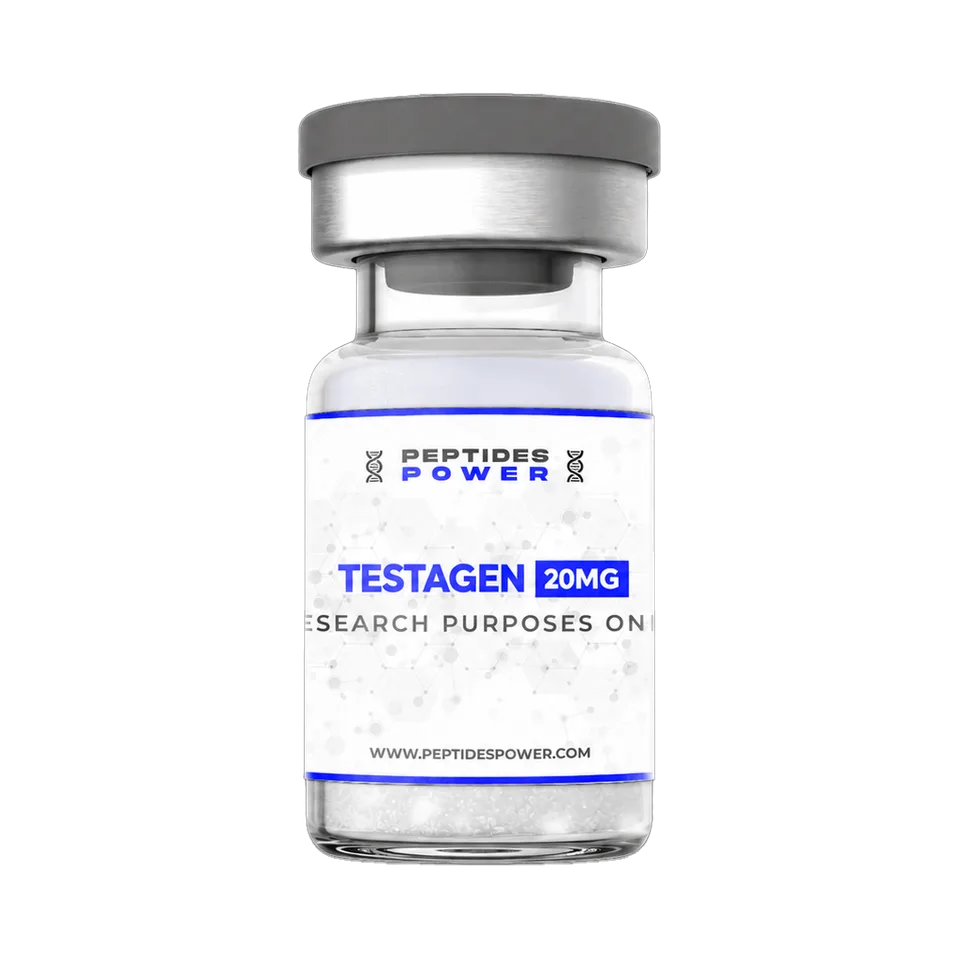
Testagen
$60
In stock
View product
Profile
Testagen is a lab-made tetrapeptide, Lys-Glu-Asp-Gly (KEDG), from the Russian peptide bioregulator family.210 Its developers tie it to male reproductive function,3 but peer-reviewed studies cover only cells, chemistry and birds.24812 The only human data located come from an unreplicated developer report on oral capsules, and it is not FDA approved.101214
This page summarizes published sources for information only. It is not medical advice and does not tell anyone to use a product. Questions about your own health belong with a licensed clinician. For questions about an order or a product, contact us.
| Class | Synthetic tetrapeptide (four amino acids) from the Russian peptide bioregulator family23 |
|---|---|
| Also known as | KEDG, Lys-Glu-Asp-Gly, H-Lys-Glu-Asp-Gly-OH24 |
| Forms we sell | 20 mg research vial (freeze-dried powder)23 |
| Regulatory status | Not FDA approved (no DailyMed label); sold in Russia as an oral dietary supplement1411 |
| WADA status | Not named on the 2026 list; may fall under class S0, which bans non-approved substances at all times20 |
| Registered human trials | None for the peptide (ClinicalTrials.gov, checked October 2026)13 |
Testagen is four amino acids long: lysine, glutamic acid, aspartic acid and glycine, in that order.2 PubChem files it as H-Lys-Glu-Asp-Gly-OH, with the formula C17H29N5O9 and a molar mass of 447.4 g/mol.1 A 2021 review from Vladimir Khavinson's group lists KEDG (Testagen) in a table of short peptides and assigns it to regulation of male reproductive system function.3 Bird studies from another Russian group describe the same sequence differently, as a peptide synthesized from the amino acid makeup of anterior pituitary extracts.8 The sources we reviewed do not reconcile the two accounts.
In a 2011 study, fluorescent-labeled Testagen entered the cytoplasm, nucleus and nucleolus of HeLa cells, and in test-tube work it appeared to bind preferentially to short DNA strands containing CAG.2 The authors propose that this kind of peptide and DNA binding is a form of epigenetic control.2 In 2013 fluorescence experiments, KEDG bound wheat histones H1, H2B, H3 and H4, the proteins DNA is wound around; the developers suggest histone binding can make genes more available for transcription.53 A 2023 computer docking study predicted that KEDG is among the strongest binders of the transporters LAT1, LAT2 and PEPT1, a possible route into cells, though this was modeling only.6 One more paper is materials chemistry, not biology: KEDG reduced copper corrosion in salt water with about 86% efficiency.4
The peer-reviewed animal studies we located for KEDG are bird studies.789 In chickens whose pituitary gland was removed soon after hatching, 40 days of KEDG or AEDG was followed by higher thyroid-stimulating hormone and thyroid hormone levels and recovery of thyroid structure; the abstract does not separate the two peptides.7 A 2011 follow-up in young chickens and old hens found that KEDG or AEDG (Epithalon's sequence2) reduced thyroid hormone and structural disturbances, with a weaker hormonal effect in old hens.8 In a 2013 study of young and old birds, both peptides aided recovery of thymus structure, KEDG more than AEDG.9
The developers' own report, published in a Russian drug reference rather than a peer-reviewed journal, adds rat data.10 In organ cultures, Testagen enlarged the growth zone of testis tissue explants by 54.1% from young rats and 40.6% from old rats, with no significant effect on 16 other tissues tested.10 In male rats made sterile by whole-body irradiation, Testagen given before irradiation partly preserved fertility: 40% of females housed with treated males were pregnant by day 45 and 59% by day 90, against 0% with untreated males.10
No peer-reviewed human study of Testagen appears in PubMed, and no trial of the peptide is registered on ClinicalTrials.gov.1213 The only human data located is the same developer report. It describes 48 men aged 54 to 68 with "male climacteric" who were randomized to standard care with oral Testagen capsules (27 men) or without them (21 men) for 20 days.10 Mean testosterone rose from 6.1 to 7.3 ng/mL in the Testagen group, against 6.5 ng/mL after standard care alone, and sperm count rose from 16 to 22 million per mL after one course.10 The report names no original journal and gives no full methods or statistics.10 It is the only source of testosterone data for Testagen, and none of it concerns injected Testagen.1012
Peptides and testosterone and Peptides and men's health set this evidence beside other compounds. Labs that work with the compound itself will find it on the product page: Buy Testagen.
Human safety data for Testagen are minimal.1012 The developers reported no side effects, complications or dependence in their 48-man oral capsule study.10 They also reported that preclinical testing found no general toxicity or accumulation at doses 10,000 to 15,000 times the recommended dose, and no allergic, immune-toxic, embryo-toxic or birth-defect effects.10 Those data were not published in a peer-reviewed journal, and no independent safety study was found.1012
Broader cautions from regulators and reviewers:
No human dose of Testagen is established: it has no FDA label and no registered trial, and the only human report used oral capsules in an unreplicated developer study.141310 No dose for injection has been studied in people.1012 The table records what published studies used; these figures describe the studies and are not doses for people.
| Study | Subjects | Route and schedule | Amount |
|---|---|---|---|
| Thyroid studies, 2008 and 2011 | Pituitary-removed young and old birds | Given for 40 days; route not stated in the English abstracts78 | Not stated78 |
| Thymus study, 2013 | Pituitary-removed young and old birds | Schedule and route not stated in the English abstract9 | Not stated9 |
| Irradiation fertility study (developer report) | Male rats | Given before irradiation; route not given10 | A "therapeutic dose" and a 10-fold higher dose; amounts not given10 |
| "Male climacteric" study (developer report, not peer reviewed) | 48 men aged 54 to 68 | By mouth, 1 to 2 capsules twice daily with meals for 20 days10 | Each capsule of the Russian supplement holds 100 micrograms of peptide complex11 |
Injection schedules quoted on seller pages have no published study or drug label behind them.121314
The research vial holds freeze-dried Testagen powder.23 The supplier says to keep the dry vial refrigerated and away from light, and to keep a vial mixed with bacteriostatic water cold and use it within 30 days.23 Those are supplier statements; we found no published stability data for Testagen in solution.12 For comparison, the Russian oral supplement, a capsule rather than a vial, is labeled for storage in a dry, dark place at 2 to 25 °C with a 5-year shelf life.11
General guidance from peptide makers fits this sequence. GenScript lists Lys, Glu and Asp among residues that draw moisture from the air, and KEDG contains all three; it recommends a tightly capped vial kept in a desiccator.24 GenScript also names Asp among residues that shorten a peptide's life in solution.24 Bachem advises against storing peptides in solution and says that solutions kept for storage should be split into portions and frozen below -15 °C.25 The lab steps (diluent choice, sterile technique, concentration math) are in the reconstitution guide, the reconstitution calculator does the arithmetic, and How to store peptides covers storage in more depth.
Testagen is not an approved drug in the United States, and a DailyMed search returns no label for it.14 It is not on FDA's list of compounding substances that may present significant safety risks (Category 2), or on that page's list of withdrawn nominations, in the version current as of April 22, 2026.15 Under 21 CFR 312.160, an unapproved new drug may be shipped only for test-tube or laboratory animal research, labeled "Not for use in humans", and the shipper must use due diligence to confirm that the buyer regularly does such research.19
$60
In stock
View productTestagen for sale: strengths, stock and shipping are on the product page.
For research use only. Not for human or veterinary use. Read the research use policy.
No peer-reviewed study shows that it does.12 The only figures come from a developer report in a Russian drug reference: in 48 men aged 54 to 68, mean testosterone went from 6.1 to 7.3 ng/mL after 20 days of oral Testagen capsules with standard care, against 6.5 ng/mL with standard care alone.10 The report was not peer reviewed or repeated, and there are no testosterone data for injected Testagen.1012
No. DailyMed holds no Testagen label, and ClinicalTrials.gov lists no trial of the peptide (both checked October 2026).1413 FDA has not placed it on its Category 2 list of compounding substances that may present significant safety risks either.15 Outside the US, the only formal status found is in Russia, where a Testagen product is sold as an oral dietary supplement rather than as a drug.11
No. Testagen TDS-Testosterone is a testosterone product. Its ClinicalTrials.gov record, NCT02733133, is a product-transference study that was still listed as not yet recruiting in October 2026.13 The Testagen peptide is the tetrapeptide KEDG, PubChem formula C17H29N5O9, and it contains no testosterone.1 Because the two share a name, check which product a study or article describes before drawing any conclusion from it.
Its safety in people is unknown: the developers reported no side effects in their 48-man oral capsule study, but that report was not peer reviewed, and injected Testagen has never been studied in people.1012 Health Canada warns that unauthorized injectable peptide drugs may cause infection, allergic reactions and other poor outcomes, and may contain high-risk ingredients or contaminants that are not listed on the label.16
WADA's 2026 Prohibited List does not name it, but class S0 bans at all times any pharmacological substance not covered elsewhere on the List that has no current approval by any government health authority for human therapeutic use.20 Testagen's only known status is a Russian supplement, so athletes should treat it as possibly prohibited and ask their anti-doping organization.2011 The 2027 list, in force from January 1, 2027, adds "peptides" to the S0 examples.2122
Only developer reports address it. In male rats sterilized by irradiation, Testagen given beforehand partly preserved fertility: 59% of females housed with treated males were pregnant by day 90, against none with untreated males.10 In the oral capsule report, sperm count rose from 16 to 22 million per mL after one course of Testagen.10 None of this has been peer reviewed or repeated by another group.1012
Written by D2C Peptides Editorial Team.
Pending qualified review.
Updated .
D2C Peptides sells peptides for laboratory research. Please confirm both statements to continue.