Staging preview: health content pending qualified review

Profile

What is Retatrutide?

Retatrutide (LY3437943) is an investigational peptide from Eli Lilly that activates three hormone receptors: GIP, GLP-1 and glucagon.12 In trials it is injected under the skin once a week to study obesity, type 2 diabetes and related conditions.34 As of October 2026, no regulator, including FDA, has approved it.2

This page summarizes published sources for information only. It is not medical advice and does not tell anyone to use a product. Questions about your own health belong with a licensed clinician. For questions about an order or a product, contact us.

Key facts

ClassLipidated peptide of 39 amino acids that acts on the GIP, GLP-1 and glucagon receptors (a triple agonist)51
Also known asLY3437943 (Lilly research code); PubChem titles its compound record "Triple G"16
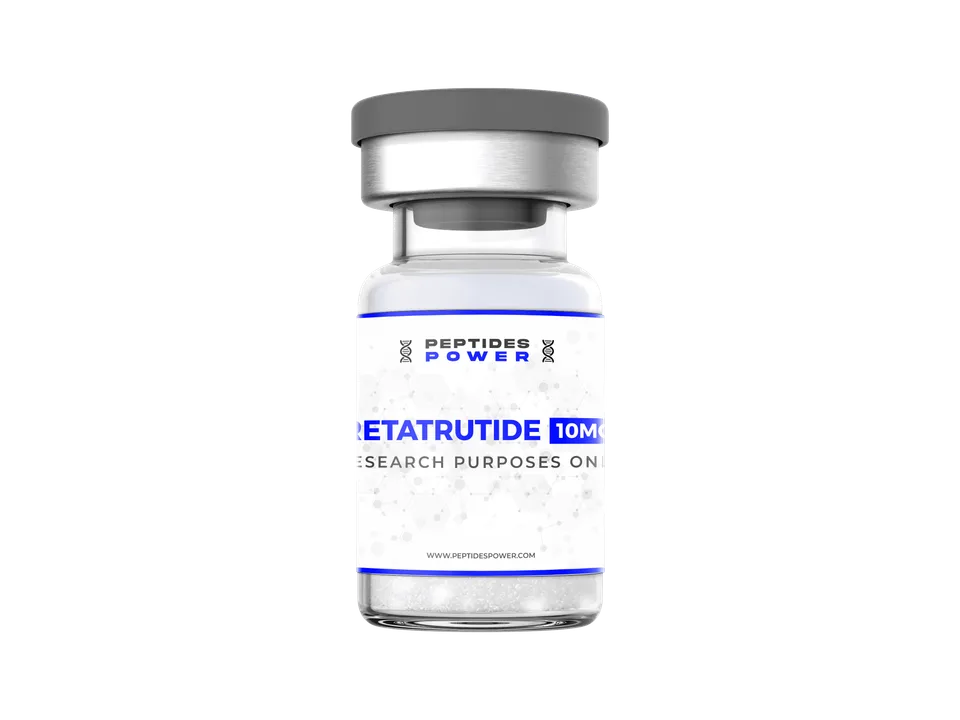
Forms we sellResearch vial of freeze-dried powder (10 mg, 30 mg), labeled for research use only7
Regulatory statusInvestigational, in phase 3. Not approved by FDA or any other regulator as of October 20262
WADA statusNot named on the 2026 Prohibited List. Class S0 bans at all times any substance not covered elsewhere on the List that has no current approval for human therapeutic use, and retatrutide has none82

What sources report

One molecule, three receptors

Retatrutide is a single peptide that activates the GIP, GLP-1 and glucagon receptors.1 In cell tests, its glucagon and GLP-1 receptor activity was balanced, and its GIP receptor activity was higher.1 In obese mice, GIP and GLP-1 receptor activity reduced food intake, and glucagon receptor activity raised energy expenditure, which added to the weight loss.1 In a phase 1b trial of 72 adults with type 2 diabetes, its half-life was about 6 days.9 For the wider drug family, see What is GLP-1?.

Results from the trials

Lilly's phase 2 obesity trial (338 adults, 48 weeks) reported average weight loss of up to 24.2%, versus 2.1% on placebo.10 The four phase 3 TRIUMPH registration trials were designed to enroll over 5,800 people.11 Main results so far:

Trial Who took part Length Main result
TRIUMPH-1 2,339 adults with obesity, no diabetes 80 weeks Weight fell 17.6% (4 mg), 23.7% (9 mg) and 25.0% (12 mg), versus 3.9% on placebo3
TRIUMPH-2 1,152 adults with BMI 27 or higher and type 2 diabetes 80 weeks Weight fell 11.9%, 16.8% and 18.8%, versus 5.1% on placebo12
TRANSCEND-T2D-1 537 adults with type 2 diabetes 40 weeks HbA1c fell 1.69, 1.86 and 1.94 percentage points, versus 0.81; weight fell 11.5% to 15.3%, versus 2.6%4
TRIUMPH-3 (company topline) 1,949 adults with severe obesity and cardiovascular disease 80 weeks Weight fell 21.6% (9 mg) and 22.6% (12 mg), versus 3.2% on placebo13
TRIUMPH-4 (company topline) 445 adults with knee osteoarthritis and excess weight 68 weeks Weight fell 20.0% (9 mg) and 23.7% (12 mg), versus 4.6% on placebo14

Trials can report two kinds of average. The treatment-regimen estimand counts everyone randomized, whether or not they kept taking the drug; TRIUMPH-1 and TRIUMPH-2 use it.312 The efficacy estimand reflects people who stayed on treatment, so its figures run higher.14 In TRIUMPH-4, 12 mg gave 28.7% by the efficacy estimand and 23.7% by the treatment-regimen estimand.14 Lilly's TRIUMPH-3 figures above use the efficacy estimand.13

These are results for Lilly-made drug given to adults enrolled in trials.3 They do not describe products sold outside trials.2 Related overviews: Peptides and weight loss and Peptides and blood sugar.

Other measured effects

  • Sleep apnea: two 80-week phase 3 trials enrolled adults with moderate to severe obstructive sleep apnea and a BMI of 27 or higher.15 In 243 adults without diabetes, breathing interruptions during sleep fell by 22.9 to 34.3 events per hour, versus 9.9 on placebo.15 In 448 adults with type 2 diabetes they fell by 19.2 to 25.4, versus 10.3.15 Average starting values were 58.6 and 55.9 events per hour.15 See Peptides and sleep.
  • Knee osteoarthritis pain: among 574 TRIUMPH-1 participants with knee osteoarthritis, WOMAC pain scores fell 3.2 to 3.6 points, versus 1.9 on placebo.3 Lilly's TRIUMPH-4 topline reported falls of 3.7 to 4.0 points, versus 2.1 on placebo, counting everyone randomized (4.4 to 4.5 versus 2.4 by the efficacy estimand).14
  • Liver fat: a phase 2a substudy followed 98 adults with fatty liver disease (at least 10% liver fat) for 48 weeks.16 At 24 weeks, liver fat fell 82.4% on 12 mg, versus a 0.3% rise on placebo.16 On 12 mg, 86% reached normal liver fat (under 5%), versus 0% on placebo.16
  • Against an active comparator: a phase 2 trial in 281 adults with type 2 diabetes included dulaglutide 1.5 mg.17 Retatrutide 12 mg lowered HbA1c and weight more than dulaglutide did.17 Figures by dose: Retatrutide dosage.
  • Body composition: in a phase 2 substudy of adults with type 2 diabetes, total fat mass fell 23.2% on 12 mg at 36 weeks, versus 4.5% on placebo.18 Lean mass was lost too, in a share of total weight loss similar to other obesity treatments.18

How it compares with semaglutide and tirzepatide

Semaglutide (Wegovy) is a GLP-1 receptor agonist approved for chronic weight management.19 Tirzepatide (Zepbound), approved by FDA in 2023, activates the GLP-1 and GIP receptors.20 Retatrutide also activates the glucagon receptor, and it is not approved.12 Two head-to-head phase 3 trials are underway.2122 TRIUMPH-5 compares it with tirzepatide in about 800 adults with obesity.21 TRANSCEND-T2D-2 compares it with semaglutide in about 1,250 adults with type 2 diabetes.22 Neither had posted results on ClinicalTrials.gov as of October 2026.2122 More on each: What is Semaglutide? and What is Tirzepatide?.

What is not yet known

  • Heart and kidney outcomes: in Lilly's TRIUMPH-3 topline, major cardiovascular events were less frequent than anticipated in both the retatrutide and placebo groups.13 For pooled retatrutide versus placebo, Lilly reported a hazard ratio of 0.82 for MACE-5 and 1.12 for MACE-3 (cardiovascular death, heart attack or stroke).13 Both 95% confidence intervals (0.55 to 1.22 and 0.64 to 1.96) include no difference, so the trial did not show a lower or higher risk.13 The 10,000-person TRIUMPH-Outcomes trial is not expected to finish until about February 2029.23
  • Longer use: the longest published trials ran 80 weeks.312
  • Who was studied: published phase 3 trials enrolled adults aged 18 or older.124
  • Type 1 diabetes: retatrutide has no established role in it.24

Side effects

In trials, the most common side effects were digestive, including nausea, diarrhea, vomiting and constipation, and they were dose-related.1017 In the 80-week TRIUMPH-2 trial, nausea affected 28% of people on 12 mg, versus 8% on placebo.12 Abnormal skin sensations (dysesthesia) and low blood pressure were more frequent than with placebo.12 Heart rate rose in the phase 2 obesity trial, peaking at 24 weeks.10 Full list: Retatrutide side effects.

Dosage information

No retatrutide dose is approved or established for any person.225 Phase 3 trials gave 4 mg, 9 mg or 12 mg once a week by injection under the skin.312 In phase 2, higher doses were reached in steps from a lower starting dose.1017 These were study doses for screened adults in trials, not guidance.2 Full detail: Retatrutide dosage.

Reconstitution and storage

No retatrutide product is approved, so there is no FDA-approved label with mixing or storage directions.25 The supplier's listing describes a freeze-dried powder in 10 mg and 30 mg vials, labeled for research use only.7 Its storage directions conflict.7 A specification table gives a shelf life of 36 months at -20°C and 30 days at 2 to 8°C.7 The description says to keep the powder at room temperature before mixing, then refrigerate it at 2 to 8°C once mixed with bacteriostatic water.7 These supplier statements have not been independently verified. Peptide makers' general guidance is to store freeze-dried peptides at -20°C, away from bright light, while noting that stability depends on each peptide's sequence.42

Vial contents can differ from the label.26 In a 2026 study of three vials labeled 10 mg and sold in Australia, all contained retatrutide.26 They held 5.13 mg, 16.5 mg and 19.0 mg, or 51% to 190% of the label, and sterility and endotoxin were not tested.26

Lab steps and concentration math are in How to reconstitute a peptide vial and the reconstitution calculator. Storage practice is in How to store peptides. Strengths and handling notes for the research vial: Retatrutide for sale.

Regulatory status

  • Approval: as of October 2026, no regulator has approved retatrutide.2 Lilly calls it a phase 3 investigational molecule that cannot legally be sold or marketed for human use.2 Lilly also says any product claiming to be retatrutide that is offered to consumers is unlawful.2
  • FDA: its page on unapproved GLP-1 drugs says retatrutide cannot be used in compounding under federal law.25 It is not a component of any FDA-approved drug and has not been found safe and effective for any condition.25
  • Compounding: FDA wrote to the National Association of Boards of Pharmacy on March 31, 2025.27 It explained that compounded retatrutide does not qualify for the 503A or 503B exemptions.27 Retatrutide has no USP or NF monograph and is not part of an approved drug.27 It is not on the bulks lists or the drug shortage list.27 FDA repeated this in a September 9, 2025 warning letter to GLP-1 Solution.28
  • Research-labeled sellers: FDA sent warning letters to online sellers of retatrutide labeled for research only.293031 They include Prime Peptides (December 10, 2024) and Gram Peptides and Mile High Compounds (both March 31, 2026).293031 In each letter, FDA said the sellers' own websites showed the products were meant for people, which made them unapproved new drugs.293031 In the Gram Peptides letter, FDA also treated bacteriostatic water sold with the peptides as a drug meant for injection.30
  • Wider enforcement: FDA says it has warned companies that sold unapproved retatrutide falsely labeled "for research purposes" directly to consumers with dosing instructions.25 It has also warned telehealth companies, ingredient distributors and outsourcing facilities over retatrutide.25
  • Next steps: Lilly plans to submit retatrutide for US review in the first quarter of 2027.13 It says there is no guarantee of approval or of that timeline.132
  • United Kingdom: on October 15, 2026, the MHRA said retatrutide is not authorized in the UK.32 It said products sold as retatrutide outside legitimate trials are supplied illegally.32 Over 12,000 fake retatrutide and tirzepatide pens were seized in Birmingham the day before.32
  • Australia: a Victorian health alert of June 19, 2026 called retatrutide an experimental drug.33 It reported six cases of acute liver toxicity linked to unapproved products labeled retatrutide.33 It added that unapproved peptides such as retatrutide have not been assessed by Australia's Therapeutic Goods Administration for safety, quality or effectiveness.33
  • Sport: WADA's class S0 bans non-approved substances at all times, which covers retatrutide (see the questions below).82

More on Retatrutide

  • Retatrutide dosage

    Published dosing information for Retatrutide from clinical trials, with its source, and why it is not advice for you.

  • Retatrutide side effects

    Side effects of Retatrutide as reported in clinical trials, case reports and health alerts, with links to the full profile.

Retatrutide in the store

Retatrutide for sale: strengths, stock and shipping are on the product page.

For research use only. Not for human or veterinary use. Read the research use policy.

Frequently asked questions

Is retatrutide a peptide?

Yes. PubChem's systematic name describes a chain of 39 amino acids, with a fatty-acid side chain attached to one lysine.5 Lilly's discovery paper calls it a triple agonist peptide, because one molecule acts on the GIP, GLP-1 and glucagon receptors.1 In trials it is given by injection under the skin.3

Can I get retatrutide prescribed?

Not in the usual way. No retatrutide product is approved, and FDA says it cannot be used in compounding.25 Lilly lists a single-patient pre-approval expanded access program (ClinicalTrials.gov NCT07629401) that a treating physician must request.34 It is for adults with a BMI of 35 or higher despite the highest available dose of approved weight therapy.34 They also need two or more serious or life-threatening obesity-related complications and must be unable to join an ongoing trial.34 Availability depends on geography, supply and individual review.34

How do I get on a retatrutide trial?

Lilly points people to Lilly.com and ClinicalTrials.gov for its retatrutide studies.2 As of October 2026, ClinicalTrials.gov lists two recruiting studies.35 One is SYNERGY-Outcomes (NCT07165028), a phase 3 fatty liver disease study with sites in the United States and other countries.35 The other is a phase 2 obesity study in China (NCT07467447).35 TRIUMPH-1 and TRIUMPH-4 have completed, and TRIUMPH-5 is no longer recruiting.363721

Where are people getting retatrutide?

Victoria's health department said products linked to its liver injury cases were obtained online, through friends and through social media accounts.33 A 2026 case report describes injections given in a wellness setting by a self-described life coach.39 A 2026 study analyzed 148,640 Reddit posts and comments about non-approved retatrutide use.38 FDA says it has warned companies that sold retatrutide falsely labeled for research directly to consumers, with dosing instructions.25 It warns that such products are of unknown quality and may be harmful.25

Can you take Ipamorelin and retatrutide together?

No study of the combination has been published: a PubMed search on October 24, 2026 for retatrutide and ipamorelin returned zero records.40 On its own, retatrutide has not been found safe and effective for any condition, according to FDA.25 So there is no established safe use of it alone or combined with other peptides such as Ipamorelin.25

Is retatrutide banned in sports?

WADA's 2026 Prohibited List does not name it.8 Its class S0 bans, at all times, any substance not covered elsewhere on the List that has no current approval by any government health regulator for human therapeutic use.8 Drugs in clinical development are one example.8 Retatrutide has no such approval as of October 2026.2 A 2026 anti-doping study of 4 people found it in blood plasma for about 56 days after a first dose, but not in urine.41

Written by D2C Peptides Editorial Team.

Pending qualified review.

Updated .

Sources

  1. LY3437943, a novel triple glucagon, GIP, and GLP-1 receptor agonist for glycemic control and weight loss: From discovery to clinical proof of concept. Cell Metabolism (PubMed record, National Library of Medicine), 2022.
  2. Is retatrutide available in the consumer market? (Lilly Medical answer, last reviewed August 4, 2026). Eli Lilly and Company (Lilly Medical), 2026.
  3. Retatrutide, a Triple Hormone Receptor Agonist, for Treatment of Obesity (TRIUMPH-1). New England Journal of Medicine (PubMed record, National Library of Medicine), 2026.
  4. Efficacy and safety of retatrutide, a GIP, GLP-1, and glucagon receptor agonist, in people with type 2 diabetes and inadequate glycaemic control with diet and exercise (TRANSCEND-T2D-1): a double-blind, randomised, phase 3 trial. The Lancet (PubMed record, National Library of Medicine), 2026.
  5. PubChem Substance SID 474492335 (Retatrutide): synonyms. PubChem, National Library of Medicine (NIH), 2026.
  6. PubChem Compound CID 171390338: computed properties. PubChem, National Library of Medicine (NIH), 2026.
  7. Supplier product specification.
  8. World Anti-Doping Code International Standard: Prohibited List 2026. World Anti-Doping Agency (copy hosted by the Czech National Sports Agency), 2025.
  9. LY3437943, a novel triple GIP, GLP-1, and glucagon receptor agonist in people with type 2 diabetes: a phase 1b, multicentre, double-blind, placebo-controlled, randomised, multiple-ascending dose trial. The Lancet (PubMed record, National Library of Medicine), 2022.
  10. Triple-Hormone-Receptor Agonist Retatrutide for Obesity: A Phase 2 Trial. New England Journal of Medicine (PubMed record, National Library of Medicine), 2023.
  11. Retatrutide for the treatment of obesity, obstructive sleep apnea and knee osteoarthritis: Rationale and design of the TRIUMPH registrational clinical trials. Diabetes, Obesity and Metabolism (PubMed record, National Library of Medicine), 2026.
  12. Retatrutide in adults with obesity and type 2 diabetes (TRIUMPH-2): a double-blind, parallel-group, randomised, placebo-controlled, phase 3 trial. The Lancet (PubMed record, National Library of Medicine), 2026.
  13. What are the results of retatrutide from TRIUMPH-3 in adults with severe obesity and established cardiovascular disease? (Lilly Medical answer, last reviewed July 23, 2026). Eli Lilly and Company (Lilly Medical), 2026.
  14. Lilly's triple agonist, retatrutide, delivered weight loss of up to an average of 71.2 lbs along with substantial relief from osteoarthritis pain in first successful Phase 3 trial (press release, December 11, 2025; PR Newswire copy on Finviz). Eli Lilly and Company via PR Newswire, 2025.
  15. Retatrutide Once Weekly for Treatment of Obstructive Sleep Apnea. New England Journal of Medicine (PubMed record, National Library of Medicine), 2026.
  16. Triple hormone receptor agonist retatrutide for metabolic dysfunction-associated steatotic liver disease: a randomized phase 2a trial. Nature Medicine (PubMed record, National Library of Medicine), 2024.
  17. Retatrutide, a GIP, GLP-1 and glucagon receptor agonist, for people with type 2 diabetes: a randomised, double-blind, placebo and active-controlled, parallel-group, phase 2 trial conducted in the USA. The Lancet (PubMed record, National Library of Medicine), 2023.
  18. Effects of retatrutide on body composition in people with type 2 diabetes: a substudy of a phase 2, double-blind, parallel-group, placebo-controlled, randomised trial. The Lancet Diabetes & Endocrinology (PubMed record, National Library of Medicine), 2025.
  19. WEGOVY (semaglutide) injection, prescribing information (2021 approval label). U.S. Food and Drug Administration (Drugs@FDA), 2021.
  20. FDA Approves New Medication for Chronic Weight Management (Zepbound). U.S. Food and Drug Administration, 2023.
  21. ClinicalTrials.gov NCT06662383 (TRIUMPH-5): retatrutide compared to tirzepatide in adults with obesity. ClinicalTrials.gov, National Library of Medicine, 2026.
  22. ClinicalTrials.gov NCT06260722 (TRANSCEND-T2D-2): retatrutide compared with semaglutide in type 2 diabetes. ClinicalTrials.gov, National Library of Medicine, 2026.
  23. ClinicalTrials.gov NCT06383390 (TRIUMPH-Outcomes). ClinicalTrials.gov, National Library of Medicine, 2026.
  24. Online-Sourced Retatrutide Complicating Impending Diabetic Ketoacidosis in a Patient With Type 1 Diabetes and Concurrent Shigella Gastroenteritis. Cureus (PubMed record, National Library of Medicine), 2026.
  25. FDA's Concerns with Unapproved GLP-1 Drugs Used for Weight Loss. U.S. Food and Drug Administration, 2026.
  26. Composition and Labelling Accuracy of Products Sold as Retatrutide in Australia. Drug and Alcohol Review (PubMed Central full text), 2026.
  27. FDA letter to the National Association of Boards of Pharmacy on compounded retatrutide (March 31, 2025), with NABP cover memo (April 3, 2025), posted by the Ohio Board of Pharmacy. U.S. Food and Drug Administration (hosted by the State of Ohio Board of Pharmacy), 2025.
  28. Warning Letter to GLP-1 Solution (MARCS-CMS 715883), September 9, 2025. U.S. Food and Drug Administration, 2025.
  29. Warning Letter to Prime Vitality, Inc. dba Prime Peptides (MARCS-CMS 695156), December 10, 2024. U.S. Food and Drug Administration, 2024.
  30. Warning Letter to Gram Peptides (MARCS-CMS 721806), March 31, 2026. U.S. Food and Drug Administration, 2026.
  31. Warning Letter to Mile High Compounds LLC (MARCS-CMS 721600), March 31, 2026. U.S. Food and Drug Administration, 2026.
  32. Counterfeit weight loss pens worth £2 million seized by MHRA and West Midlands Police. Medicines and Healthcare products Regulatory Agency (GOV.UK), 2026.
  33. Toxicity linked to unapproved peptide product labelled Retatrutide (health alert, issued 19 June 2026). Department of Health, Victoria (Australia), 2026.
  34. ClinicalTrials.gov NCT07629401: Pre-approval Expanded Access of Retatrutide (LY3437943). ClinicalTrials.gov, National Library of Medicine (sponsor: Eli Lilly and Company), 2026.
  35. ClinicalTrials.gov query: recruiting studies with retatrutide as an intervention. ClinicalTrials.gov, National Library of Medicine, 2026.
  36. ClinicalTrials.gov NCT05929066 (TRIUMPH-1). ClinicalTrials.gov, National Library of Medicine, 2026.
  37. ClinicalTrials.gov NCT05931367 (TRIUMPH-4). ClinicalTrials.gov, National Library of Medicine, 2026.
  38. Self-Reported Adverse Effects Among Social Media Users Taking Nonapproved Retatrutide. JAMA Network Open (PubMed Central full text), 2026.
  39. Emerging risks of health optimisation: refractory nausea associated with peptide injections reported to contain retatrutide. BMJ Case Reports (PubMed record, National Library of Medicine), 2026.
  40. PubMed search for retatrutide AND ipamorelin (NCBI E-utilities). PubMed, National Library of Medicine, 2026.
  41. Detection and Excretion Profile of Retatrutide in Human Plasma and Urine by LC-HRMS: Implications for Antidoping Analysis. Rapid Communications in Mass Spectrometry (PubMed record, National Library of Medicine), 2026.
  42. Peptide Storage and Handling Guidelines. GenScript.
