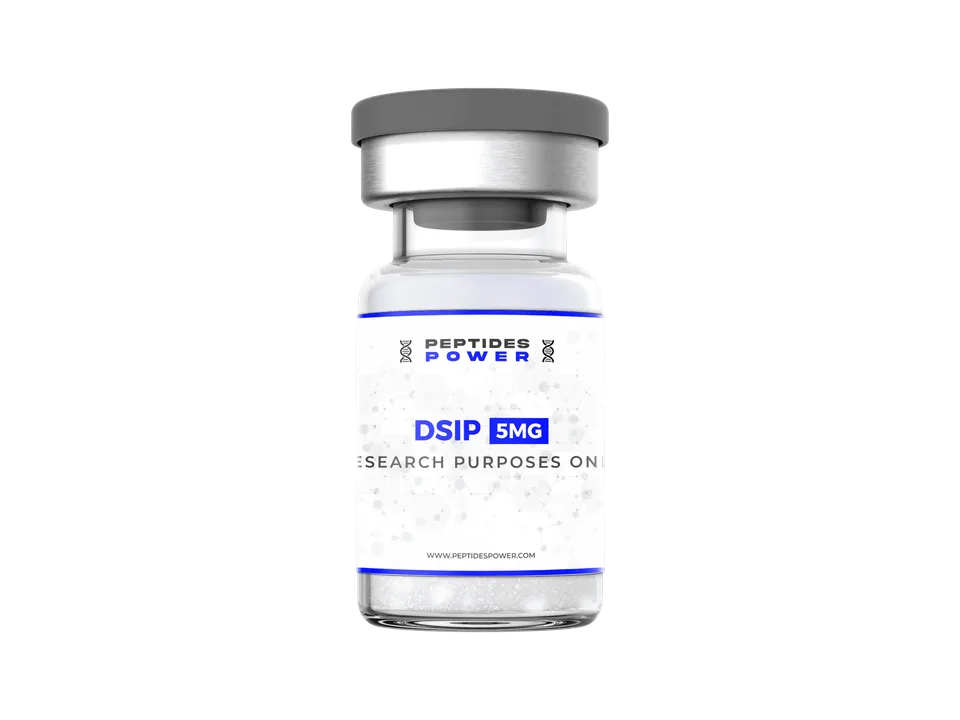
DSIP
$35
In stock
View product
Profile
DSIP (delta sleep-inducing peptide, international name emideltide) is a chain of 9 amino acids first isolated in Basel in 1977 from the blood of rabbits given electrical stimulation of the thalamus.12 Small human studies from 1981 to 1992 gave mixed results for insomnia, which FDA called inconclusive in 2026.2 It is not an FDA-approved drug.2
This page summarizes published sources for information only. It is not medical advice and does not tell anyone to use a product. Questions about your own health belong with a licensed clinician. For questions about an order or a product, contact us.
| Class | Peptide of 9 amino acids (a nonapeptide), described by MeSH as a neuropeptide3 |
|---|---|
| Also known as | Delta sleep-inducing peptide, emideltide (WHO international name)42 |
| Forms we sell | 5 mg research vial |
| Regulatory status | Not FDA-approved and not on FDA's 503A bulks list; FDA's advisory committee voted 7 to 6 against recommending it in July 202626 |
| WADA status | Not named on the 2026 Prohibited List; class S0 covers unlisted substances with no current government approval for human therapeutic use78 |
DSIP was first isolated in Basel in 1977, from blood draining the brains of rabbits given electrical stimulation of the thalamus.12 When the team infused 9 synthetic peptides into the brain ventricles of rabbits under double-blind conditions, only synthetic DSIP specifically enhanced slow-wave (delta) and spindle EEG patterns.9 Later animal work was less consistent: rat and cat studies found longer non-REM sleep in some cases and no change in delta power in others.2 The DSIP studied and sold today is made synthetically.2
The mechanism is not settled.1 A 2006 review notes that no DSIP gene, protein or receptor had been isolated, and calls the evidence for DSIP as a natural sleep factor extremely poorly documented and weak.1 Animal and lab work points to the opioid system. In rats, the opioid blocker naloxone stopped DSIP from lengthening sleep, and in lab tests DSIP did not bind opioid receptors directly but was reported to release enkephalins, the brain's own opioid peptides.2 DSIP crosses the blood-brain barrier in animal studies.223 It is also broken down fast: FDA reports a plasma half-life of 8 minutes, and a dog study found 3 to 6 minutes.2
Across published studies, FDA tallied 209 people who received DSIP by vein, for 1 to 15 days each.2 Sleep studies by Schneider-Helmert and colleagues reported faster sleep onset, longer sleep and better daytime alertness.210 Two double-blind, placebo-controlled studies by other groups, with 6 and 16 people, did not reach the same conclusions: one judged the improvement of little clinical significance, and the other found DSIP not likely to be of major benefit.21617 FDA's 2026 review called the evidence inconclusive and at best preliminary, with no information on long-term use.2
Other uses rest on small open studies.2 In 107 inpatients withdrawing from alcohol or opiates, symptoms disappeared or improved markedly in most of those evaluated, but the study had no blinding and no comparison group.112 A pilot in 7 people with chronic pain episodes and a single narcolepsy case also reported improvement, without a control group.24252 A ClinicalTrials.gov search in October 2026 found no registered DSIP study.26 Each finding, with its evidence level, is set out in DSIP benefits and uses.
Researchers who need the compound itself can find DSIP for sale as a research vial. FDA's advisory committee reviewed DSIP at the same July 2026 meeting as epitalon, another peptide studied for sleep, and recommended epitalon for the bulks list while voting against DSIP.276 See What is Epithalon? for that compound and Peptides and sleep for the wider picture.
Human safety data are thin and short-term.2 Reported effects include warmth, heaviness, dry mouth and headache after single infusions in healthy volunteers, and mild drowsiness in one insomnia study.2829 In 107 withdrawal patients, 9 had minor, short-lived effects such as sweating, headache, nausea or vertigo, and 3 had serious reactions, including 2 with low blood pressure at the first injection.2 FDA calls safety for repeated use insufficiently characterized and found no safety data for injection under the skin.2 Full list: DSIP side effects.
No human dose of DSIP is established, and there is no approved label to set one.2 The human studies FDA reviewed all gave DSIP by slow intravenous injection, mostly 25 or 30 nmol/kg per injection, on 1 to 15 days, and FDA found no study of the peptide injected under the skin.230 These figures describe supervised research, not guidance for people. Full details: DSIP dosage.
There are no official mixing instructions, because no approved DSIP product or label exists.2 FDA's review, citing chemical suppliers, reports that the free base dissolves poorly in water and the acetate salt far better, and FDA questioned whether the 1 mg/mL injection it evaluated could be made from the free base at all.2 Supplier data in the same review report the free-base powder stable for 3 years at -20 °C, and the freeze-dried powder for about 3 weeks at room temperature.2 The lab steps are in How to reconstitute a peptide vial, and storage basics are in How to store peptides.
No FDA-approved drug contains DSIP, and it has no USP or NF monograph.2 No form of it appears in the European, Japanese or International Pharmacopoeia, and FDA found it was not a registered drug in any country it searched.2
On September 29, 2023, FDA placed emideltide in category 2 of bulk substances nominated for pharmacy compounding, the group FDA says raises significant safety risks.31 The nominations were later withdrawn, but FDA's safety note stays posted: compounded emideltide may trigger immune reactions, may have impurity problems, and FDA lacks the information to know whether it would harm people.19 Leaving category 2 did not make it a lawful ingredient, because a 503A pharmacy may compound only with substances that have a monograph, are part of an approved drug or are on the bulks list.18
FDA staff then evaluated DSIP as a 1 mg/mL injection under the skin for chronic insomnia, narcolepsy and opioid withdrawal, and proposed not adding it to the bulks list.2 On July 24, 2026, the advisory committee voted 7 to 6, with 1 abstention, against recommending it.6 The vote is advisory and non-binding, and adding any substance to the bulks list requires notice-and-comment rulemaking.27
FDA also found US integrative neurology clinics, med spas, wellness clinics and online retailers marketing DSIP injections and nasal sprays, none stating whether the product held the free base or a salt.2 Citing a U.S. Attorney press release, FDA reports that a Kentucky pharmacy compounded and distributed emideltide products from October 2018 to April 2020.2 Citing a 2003 paper, FDA describes a product designed in Russia, Deltaran, sold in ampoules of 0.3 mg DSIP and 3.0 mg glycine, yet FDA found no country where emideltide is a registered drug.2 A 2022 review of Russian peptide drugs disagrees: it lists Deltaran among 14 peptide products registered in Russia, as a stress protector and treatment for alcohol addiction.32 In sport, WADA's 2026 Prohibited List does not mention DSIP by name; its class S0 bans, at all times, any substance not covered elsewhere on the List that has no current government approval for human therapeutic use.78
Published dosing information for DSIP from clinical trials and published studies, with its source, and why it is not advice for you.
Side effects of DSIP as reported in clinical trials and published studies, with links to the full profile. Reviewed by a qualified reviewer.
What published sources report about DSIP and its uses, with the evidence level of each finding. No promises.
$35
In stock
View productDSIP for sale: strengths, stock and shipping are on the product page.
For research use only. Not for human or veterinary use. Read the research use policy.
In animals, DSIP increased slow-wave (delta) and spindle EEG patterns: in the 1977 rabbit study, it was the only one of 9 synthetic peptides with that specific effect.9 Small human studies in the 1980s reported effects on sleep, daytime alertness, withdrawal symptoms and a stress hormone (ACTH), but results were mixed.1011122 How it works is not settled, in part because no DSIP gene, protein or receptor has been isolated.1
DSIP is the nonapeptide Trp-Ala-Gly-Gly-Asp-Ala-Ser-Gly-Glu, written WAGGDASGE in one-letter code.135 PubChem lists the formula C35H48N10O15, a molar mass of 848.8 g/mol, CAS number 62568-57-4 and compound ID 68816.1415 Its WHO international nonproprietary name is emideltide, from INN Proposed List 70 (1993), and it has no United States Adopted Name.2
The evidence is mixed. Small intravenous studies by one research group, led by Schneider-Helmert, reported faster sleep onset and longer sleep, but double-blind, placebo-controlled studies by two other groups found little or no meaningful benefit.21617 FDA's 2026 review called the insomnia data inconclusive and at best preliminary, found no long-term data, and found no study of injection under the skin.2
DSIP is not an FDA-approved drug, and it does not meet the rules for a pharmacy compounding ingredient: it has no USP or NF monograph, is not part of any approved drug and is not on FDA's 503A bulks list.218 FDA staff proposed against adding it, and FDA's advisory committee voted 7 to 6 against it on July 24, 2026.26 FDA also says it lacks the information to know whether emideltide would harm people.19
There is very little evidence.2 FDA found US clinics, med spas and online retailers marketing DSIP nasal sprays, but its 2026 review found effectiveness data only for intravenous use.2 A 2001 letter, titled as showing that nasal DSIP increases the P300 brain response, has no published abstract, so its dose, size and design are not known.20
DSIP-like material has been measured in human blood.21 In 12 healthy volunteers sampled every 30 minutes for 24 hours, levels followed a daily rhythm, highest around 3 pm and lowest around 1 am.21 In 7 healthy men, levels fell at the transition from waking to sleep.22 But no DSIP gene, protein or receptor has been isolated, so its natural role is still unclear.1
Written by D2C Peptides Editorial Team.
Pending qualified review.
Updated .
D2C Peptides sells peptides for laboratory research. Please confirm both statements to continue.