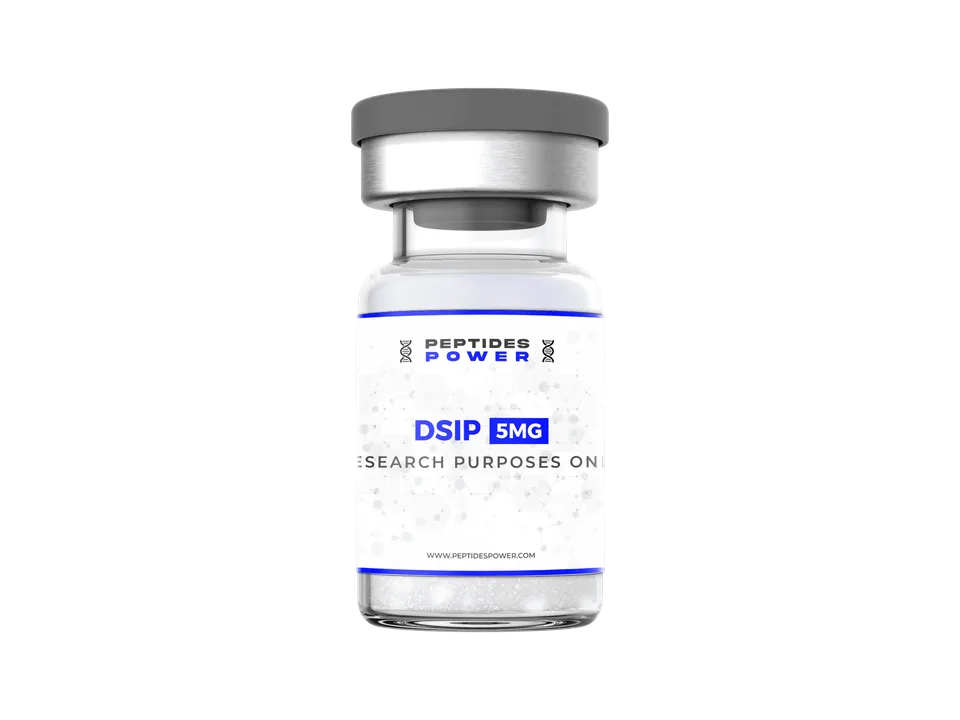
DSIP
$35
In stock
View product
Dosage information
No human dose of DSIP is established, and no approved label exists.1 Published human studies gave it intravenously, most often 25 or 30 nmol/kg, and FDA found no study of injection under the skin.12 The doses on this page come from those studies and from animal work, and they are not guidance for people.
This page summarizes published sources for information only. It is not medical advice and does not tell anyone to use a product. Questions about your own health belong with a licensed clinician. For questions about an order or a product, contact us.
DSIP has no FDA-approved label, so there is no labeled dose, schedule or route.1 FDA evaluated a proposed 1 mg/mL injection under the skin, but found no study supporting effectiveness by that route and no safety data for it.1 Across published studies, FDA counted 209 people given intravenous doses of 25 to 150 nmol/kg, for 1 to 15 days.1 Every dose below comes from a published study and is listed for context only.
Doses are written per kilogram of body weight. FDA's summary gives 25 nmol/kg as 21.23 micrograms per kilogram.1
| Study | People | Route and dose | Schedule |
|---|---|---|---|
| Healthy volunteers, 1981 | 6 | IV infusion, 25 nmol/kg8 | One morning infusion, given over 20 minutes per FDA's summary1 |
| Chronic insomnia, 1981 | 6 middle-aged adults | IV, 25 nmol/kg9 | Once or twice over 3 test nights (randomized crossover), each over 4 minutes right before bedtime1 |
| Chronic insomnia, Monti 1987 | 6 | IV, 25 nmol/kg or placebo10 | 4 nights, double-blind crossover |
| Chronic insomnia, Bes 1992 | 16 | IV, 25 nmol/kg11 | Afternoons before nights 3, 4 and 5 |
| Chronic insomnia, 1986 | 18 | IV, 30 nmol/kg2 | 6 doses in one week |
| Chronic insomnia, 1987 | 14 middle-aged adults | IV, 30 nmol/kg112 | 7 nights in a row |
| Alcohol and opiate withdrawal, 1984 | 107 inpatients | IV, 25 nmol/kg1 | Up to 6 injections a day for up to 6 days |
| Opioid withdrawal, 1998 | 7 | IV, 35 nmol/kg1 | Fixed schedule over 7 days |
| Chronic pain episodes, 1984 | 7 | IV, dose not stated in the abstract13 | 5 days in a row, then 5 injections every 48 to 72 hours |
| Stress hormones, healthy men, 1989 | 11 | IV, 25 nmol/kg or saline14 | Single dose, randomized crossover |
| Growth hormone, healthy women, 1993 | 5 | IV, 25 micrograms/kg over 30 minutes15 | Single dose |
| Stress hormones, healthy men, 1995 | 10 in hormone-challenge (CRH) tests, 10 in a meal test | IV infusion, total 3 or 4 mg16 | One infusion against placebo, about 2 hours in the CRH tests |
| Isoflurane anesthesia, 2009 | 12 women given DSIP (12 more given saline) | IV bolus, 25, 50 or 100 nmol/kg7 | Two doses: one awake, one under anesthesia |
Speed of infusion mattered in the early work.171 Researchers reported in 1983 that slow injection proved essential, with sleep starting about 1 hour after injection.17 FDA's summary adds that, in healthy volunteers, DSIP was completely ineffective when infused over 1 minute, and total sleep time rose most with infusions over 4 to 8 minutes.1 DSIP also clears fast: FDA reports a plasma half-life of 8 minutes, with blood enzymes cutting it into shorter peptides.1
These details matter when reading claims about other routes. The studies that reported sleep effects used timed intravenous infusions in sleep laboratories. No study has tested whether those results hold for injection under the skin or for nasal sprays, and FDA found human data only for intravenous use.1
Animal doses are not human doses, and none of these studies was designed to find a dose for people.
Read the full DSIP profile, the safety record in DSIP side effects, and what the studies found in DSIP benefits and uses. General background on study doses and units is in Peptide dosage basics.
Side effects of DSIP as reported in clinical trials and published studies, with links to the full profile. Reviewed by a qualified reviewer.
What published sources report about DSIP and its uses, with the evidence level of each finding. No promises.
$35
In stock
View productDSIP for sale: strengths, stock and shipping are on the product page.
For research use only. Not for human or veterinary use. Read the research use policy.
No safe duration has been established for anyone.1 Published human studies lasted 1 to 15 days, and FDA found no information on benefit with long-term use.1 FDA also calls safety for long-term intermittent use insufficiently characterized.1 In the early insomnia studies, effects were reported to build up, with sleep structure normalizing after four injections, but those studies were small and supervised.3
No approved instructions exist for a DSIP nasal spray, and none of the studies reviewed here gives a nasal dose.1 FDA found US clinics and retailers marketing DSIP sprays, yet all the human data in its 2026 review came from intravenous use.1 The only nasal report found, a 2001 letter, has no published abstract, so its dose is not known.4 The DSIP listed in this store is a freeze-dried vial for lab research, not a spray.
Not in a simple way.6 In rats, intravenous doses of 30, 40 and 80 nmol/kg raised delta-wave power, with larger effects at higher doses.1 But a 1984 review reports a U-shaped activity curve for both the dose and the infusion time, so more did not reliably mean more effect.6 In a 2009 trial in 12 women under isoflurane anesthesia, DSIP at 25 to 100 nmol/kg made anesthesia lighter, not deeper, as measured by the bispectral index.7
Written by D2C Peptides Editorial Team.
Pending qualified review.
Updated .
D2C Peptides sells peptides for laboratory research. Please confirm both statements to continue.