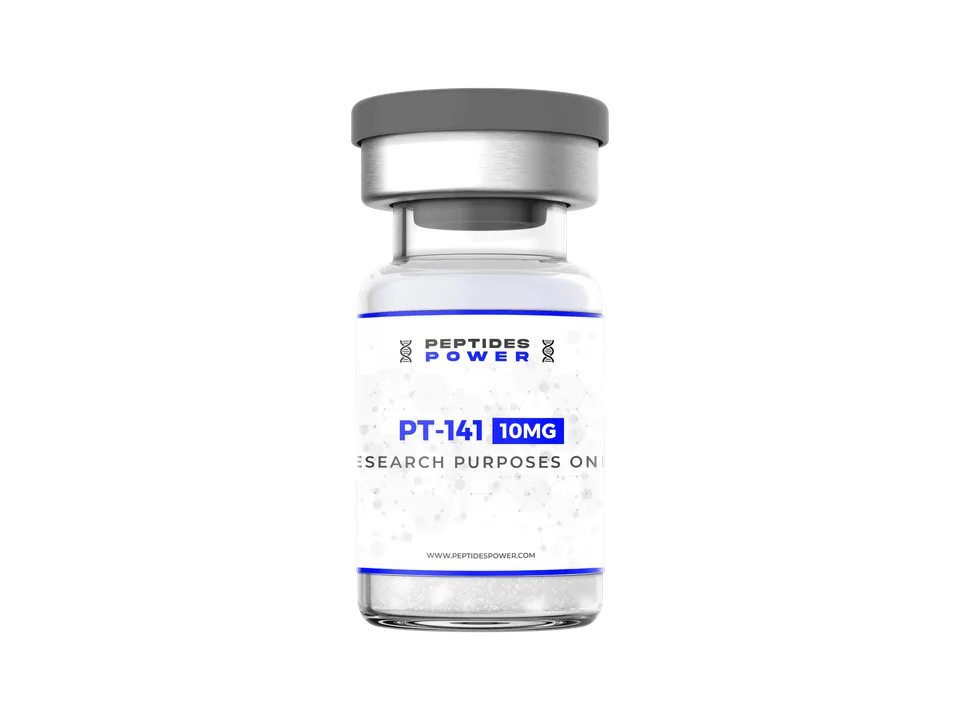
PT-141
$40
In stock
View product
Profile
PT-141 is the development code for bremelanotide, a synthetic ring-shaped peptide of seven amino acids that activates melanocortin receptors.81 FDA approved it in 2019 as Vyleesi, a prescription autoinjector for premenopausal women with acquired, generalized hypoactive sexual desire disorder (HSDD).21 It is not approved for men, and research-labeled vials have no approved application.13
This page summarizes published sources for information only. It is not medical advice and does not tell anyone to use a product. Questions about your own health belong with a licensed clinician. For questions about an order or a product, contact us.
| Class | Synthetic cyclic heptapeptide; melanocortin receptor agonist and alpha-MSH analog14 |
|---|---|
| Also known as | Bremelanotide, bremelanotide acetate, PT 141, PT141; brand name Vyleesi51 |
| Forms we sell | 10 mg freeze-dried (lyophilized) vial, labeled for research use |
| Approved form | Vyleesi 1.75 mg/0.3 mL single-dose autoinjector, prescription only12 |
| Regulatory status | FDA approved as Vyleesi on June 21, 2019 (NDA 210557) for premenopausal women with HSDD; not approved for men; research vials have no approved application213 |
| WADA status | Not confirmed in our sources |
PT-141 was the development code Palatin Technologies used for bremelanotide, which it made as an analog of melanotan II (MT-II).8 The FDA label describes bremelanotide acetate as a synthetic cyclic heptapeptide: seven amino acids, part of them closed into a ring, with the sequence Ac-Nle-cyclo-(Asp-His-D-Phe-Arg-Trp-Lys-OH).1 PubChem lists the free base as C50H68N14O10, with a molar mass of 1025.2 g/mol, under CID 9941379.9 Its CAS number is 189691-06-3.5 In the approved drug, 1.75 mg of bremelanotide equals 1.89 mg of the acetate salt.1
Bremelanotide activates several melanocortin receptors without selectivity.1 In order of potency, these are MC1R, MC4R, MC3R, MC5R and MC2R.1 The label states that the mechanism by which Vyleesi improves HSDD in women is unknown.1 MedlinePlus describes it as activating natural substances in the brain that control mood and thinking.14 A 2022 review proposes that it acts on MC4 receptors in the medial preoptic area of the hypothalamus, raising dopamine release, a model that rests mainly on animal studies.7 In 2003, researchers reported that it caused penile erections when given to rats and nonhuman primates.4 After an injection under the skin, bioavailability is about 100%, blood levels peak at a median of about 1 hour, and the half-life is about 2.7 hours (label).1
The strongest evidence comes from two identical 24-week phase 3 trials, called RECONNECT, in 1,267 premenopausal women with acquired, generalized HSDD.20 Women used 1.75 mg by autoinjector as needed.1 Compared with placebo, desire scores rose 0.30 and 0.42 points more, and distress about low desire fell 0.37 and 0.29 points more.20 The number of satisfying sexual events did not differ significantly from placebo.1 Independent re-analyses published in 2021 and 2024 judged the effects small to nil.2425 The trial investigators published a commentary disputing the 2021 re-analysis.26
Evidence in men comes from small studies, mostly of a nasal form, and from a 2008 trial that now carries an expression of concern.151618 FDA has not approved any use in men.1 Full list: PT-141 benefits and uses. The goal pages cover PT-141 and women's health and PT-141 and men's health.
In the phase 3 trials, nausea affected 40% of women on bremelanotide versus 1.3% on placebo.1 Flushing (20.3%), injection site reactions (13.2%) and headache (11.3%) came next.1 Each dose briefly raises blood pressure, by up to 6 mmHg systolic, and lowers heart rate by up to 5 beats per minute.1 Darker patches of skin appeared in 1% of women using up to 8 doses a month and in 38% given daily doses for 8 days.1 Full list: PT-141 side effects.
The only established human dose is the Vyleesi label dose for premenopausal women with HSDD, and the prescriber sets the dose for each patient.1 It is 1.75 mg under the skin of the abdomen or thigh, as needed, at least 45 minutes before anticipated sexual activity, and no more than once in 24 hours.1 The label advises against more than 8 doses a month and says to stop after 8 weeks without improvement.1 No dose is approved for men or postmenopausal women, and research vials have no FDA-reviewed directions.13 Full details: PT-141 dosage.
Vyleesi needs no mixing. It is a clear 1.75 mg/0.3 mL solution in a single-dose autoinjector, with 2.5% glycerin and sterile water for injection among its inactive ingredients.1 Its label calls for storage at or below 25°C (77°F), no freezing and protection from light.1
Research PT-141 is a different product. The 10 mg research vial sold here holds a white freeze-dried solid, and bacteriostatic water is a separate item. No FDA-reviewed reconstitution or storage directions exist for such vials.3 General lab steps are in How to reconstitute a peptide vial and How to store peptides. The reconstitution calculator works out concentration from vial mass and diluent volume. The research vial is listed as PT-141 for sale, labeled for research use.
FDA approved bremelanotide as Vyleesi (NDA 210557) on June 21, 2019, as a new molecular entity.2 The approval letter went to AMAG Pharmaceuticals.6 As of October 2026, Drugs@FDA lists Cosette as the application holder, and the label says Cosette Pharmaceuticals markets the drug.21 The approved use is acquired, generalized HSDD in premenopausal women.6 The label excludes men, postmenopausal women and use to enhance sexual performance.1
At approval, FDA required a trial in breastfeeding women and two pregnancy outcome studies; the pregnancy studies are scheduled to finish in May 2030.6 On October 23, 2026, FDA approved a labeling supplement (S-005) that updates the label section on specific populations, based on the breastfeeding trial.222 As of October 24, 2026, the updated text was not posted on Drugs@FDA.2
No approved application covers PT-141 sold for research.3 On August 24, 2026, FDA warning letters to TXP Innovations (Tex Peptides) and NuScience Peptides named PT-141 among unapproved new drugs under section 505(a) of the FD&C Act.133 FDA said research-use labeling, such as "research use only", did not change its conclusion, because the sellers' websites showed the products were intended for human use.133 The same letters treated bacteriostatic water sold for reconstituting peptides as a drug.313 Our sources did not confirm the status of bremelanotide on the WADA Prohibited List or any approval outside the United States.
Published dosing information for PT-141 from labels and studies, with its source, and why it is not advice for you.
Side effects of PT-141 as reported in labels, trials and published studies, with links to the full profile. Reviewed by a qualified reviewer.
What published sources report about PT-141 and its uses, with the evidence level of each finding. No promises.
$40
In stock
View productPT-141 for sale: strengths, stock and shipping are on the product page.
For research use only. Not for human or veterinary use. Read the research use policy.
PT-141 is bremelanotide. FDA approved it in 2019, as Vyleesi, for premenopausal women with acquired, generalized hypoactive sexual desire disorder: low desire that causes marked distress or interpersonal difficulty and is not explained by another condition, relationship problems or a medicine.26 The approved form is a 1.75 mg injection under the skin, used as needed.1 The label excludes men, postmenopausal women and use to enhance sexual performance.1
It activates melanocortin receptors, most potently MC1R and then MC4R.1 A 2022 review proposes that its effect on desire runs through MC4 receptors in the hypothalamus that raise dopamine release, a model based mainly on animal studies.7 The label says the exact mechanism in women with HSDD is unknown.1 Each dose also briefly raises blood pressure and slows heart rate, and repeated use can darken patches of skin.1
Melanotan II is its closest relative. PT-141 was developed as an analog of it, and PubChem's chemical names for the two differ only at one end: a free acid in bremelanotide, an amide in melanotan II.8910 Setmelanotide is another melanocortin drug, an MC4 receptor agonist used for obesity caused by certain inherited conditions.11 FDA's compounding safety page cites case reports of serious adverse events, including melanoma, for melanotan II.12
They share one molecule, bremelanotide, but they are different products.5 Vyleesi is the FDA-approved prescription form: a 1.75 mg/0.3 mL ready-to-use solution in a single-dose autoinjector.12 PT-141 sold online as a research peptide, such as a 10 mg freeze-dried vial, has no approved application.3 In August 2026 warning letters to two online peptide sellers, FDA called the PT-141 they sold an unapproved new drug.133
Vyleesi, the only FDA-approved bremelanotide product, is prescription only.2 Research-labeled PT-141 is not an approved drug.3 FDA warning letters dated August 24, 2026 said research-use labels, such as "research use only", did not stop such products from being unapproved new drugs when the sellers' websites showed they were meant for human use.133 No use outside the Vyleesi label is FDA approved.1
No FDA-reviewed directions exist for mixing research PT-141 vials, which have no approved application, so this page gives no mixing or dosing protocol.3 The approved product, Vyleesi, needs no mixing: it comes as a 1.75 mg/0.3 mL solution in an autoinjector.1 General lab steps for freeze-dried vials are in our reconstitution guide. In August 2026 FDA also treated bacteriostatic water sold for mixing peptides as a drug.3
Written by D2C Peptides Editorial Team.
Pending qualified review.
Updated .
D2C Peptides sells peptides for laboratory research. Please confirm both statements to continue.