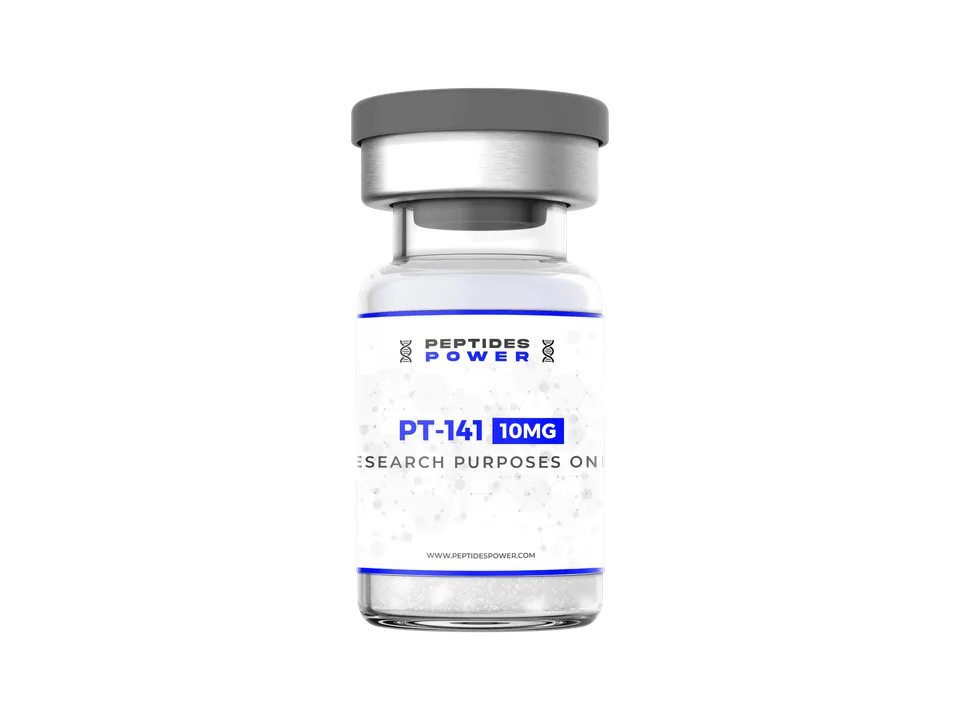
PT-141
$40
In stock
View product
Side effects
In the phase 3 trials of bremelanotide (PT-141, approved as Vyleesi), nausea affected 40% of women versus 1.3% on placebo, ahead of flushing, injection site reactions and headache.1 Each dose briefly raises blood pressure, repeated use can darken patches of skin, and 18% of women stopped because of side effects.1
This page summarizes published sources for information only. It is not medical advice and does not tell anyone to use a product. Questions about your own health belong with a licensed clinician. For questions about an order or a product, contact us.
The figures below come from the two 24-week phase 3 trials summarized in the Vyleesi label. They compared bremelanotide 1.75 mg, used as needed, with placebo in premenopausal women.1
| Side effect | Bremelanotide | Placebo |
|---|---|---|
| Nausea | 40.0% | 1.3% |
| Flushing | 20.3% | 0.3% |
| Injection site reactions | 13.2% | 8.4% |
| Headache | 11.3% | 1.9% |
Nausea is covered in its own section below. No flushing events were serious, and fewer than 1% were severe.1 Injection site reactions included pain, redness, bruising, bleeding, itching, tingling and numbness at the site.1
| Side effect | Bremelanotide | Placebo |
|---|---|---|
| Vomiting | 4.8% | 0.2% |
| Cough | 3.3% | 1.3% |
| Fatigue | 3.2% | 0.5% |
| Hot flush | 2.7% | 0.2% |
| Tingling or prickling skin | 2.6% | 0% |
| Dizziness | 2.2% | 0.5% |
| Nasal congestion | 2.1% | 0.5% |
These rates also come from the label's adverse reaction table.1
Less common reactions, each in under 2% of users and more often than with placebo, included upper abdominal pain, diarrhea, muscle pain and joint pain.1 The label also lists restless legs syndrome, runny nose, raised creatine phosphokinase, raised blood pressure and pain in a limb.1
The label reports a median onset within one hour of a dose and a duration of about two hours.1 The published trial report gives a median onset of 30 minutes and a median duration of 2.4 hours, with about 98% of cases mild to moderate.2 Nausea was most frequent after the first dose, at 21% of patients, and fell to about 3% after later doses.1 In the trials, 13% of women on the drug needed anti-nausea medicine.1 The patient information says it usually goes away by itself, though it can last longer in some people.1 For persistent or severe nausea, the label advises considering stopping, or anti-nausea medicine for patients who want to continue.1
After each dose, systolic blood pressure rose by up to 6 mmHg and diastolic by up to 3 mmHg, while heart rate fell by up to 5 beats per minute.1 Both usually returned to baseline within 12 hours.1 In a 397-woman trial using ambulatory (wearable) blood pressure monitoring, the 1.75 mg dose raised systolic pressure about 3 mmHg more than placebo in the 4 hours after a dose, with peaks that usually lasted less than 15 minutes.4 A 2022 review of the whole development program found small, short-lived but statistically significant rises and advised caution in anyone at risk of cardiovascular disease.5 The label contraindicates bremelanotide in uncontrolled high blood pressure or known cardiovascular disease.1
Bremelanotide can cause focal hyperpigmentation: darker patches on the face, gums or breasts.1 It appeared in 1% of women using up to 8 doses a month, with no cases on placebo, and in 38% of people given a dose daily for 8 days.1 Across the development program it developed in more than one third of people given up to 16 daily doses in a row.5 People with dark skin were more likely to be affected, and the patches did not always fade after stopping.1 The label links this to MC1 receptors on pigment cells, whose activation raises melanin.1
In the phase 3 trials, 18% of women on bremelanotide stopped because of side effects, versus 2% on placebo.1 Nausea was the leading reason, at 8%.1 Serious adverse reactions occurred in 1.1% of women on the drug versus 0.5% on placebo.1 One case of acute hepatitis was reported in the open-label extension, in a woman who had used 10 doses over a year.1 Her liver tests returned to normal 4 months after stopping.1 The drug could not be ruled out as the cause, and the program showed no wider liver signal.1 A 2022 pooled review of 43 studies with about 3,500 people found no deaths.5 In the 52-week open-label extension of 684 women, the most common side effects judged related to the drug were nausea (40.4%), flushing (20.6%) and headache (12.0%), with no new safety signals.6
In small studies of men, mostly with a nasal form, flushing and nausea were the most common side effects.10 A 19-man study that combined nasal PT-141 with sildenafil reported no new adverse events.11 A 2026 review of peptides in sexual medicine raises concerns about product quality, dosing variability and incompletely characterized adverse effects for melanotan II and related peptides sold through unregulated markets.12 Research-labeled PT-141 vials have no approved application, so FDA has not reviewed their content or quality, and no reviewed source characterizes their side effects.13
Related pages: What is PT-141?, PT-141 dosage and PT-141 benefits and uses.
Published dosing information for PT-141 from labels and studies, with its source, and why it is not advice for you.
What published sources report about PT-141 and its uses, with the evidence level of each finding. No promises.
$40
In stock
View productPT-141 for sale: strengths, stock and shipping are on the product page.
For research use only. Not for human or veterinary use. Read the research use policy.
Yes, often. Nausea was the most common side effect in the phase 3 trials, reported by 40% of women on Vyleesi versus 1.3% on placebo.1 It was most common after the first injection and improved for most women by the second dose.1 In a study of 228 healthy women described in the label, taking ondansetron 30 minutes beforehand did not reduce it, so the label does not recommend pre-treatment.1
The effects women noticed most in the phase 3 trials were side effects: nausea (40%), flushing (20%), injection site reactions (13%) and headache (11%).1 Blood pressure rises a little and heart rate slows after each dose, usually settling within 12 hours.1 On average, women reported somewhat more desire and less distress about low desire than on placebo, but no more satisfying sexual events.21
The label says Vyleesi must not be used with uncontrolled high blood pressure or known cardiovascular disease, and it is not recommended for people at high cardiovascular risk.1 It should be avoided with oral naltrexone and stopped if pregnancy is suspected.1 It is not indicated for men, for postmenopausal women or to enhance sexual performance, so none of these groups has an approved dose.1
It is not a tanning product, but it can darken patches of skin. Focal darkening of the face, gums or breasts occurred in 1% of women using up to 8 doses a month and in 38% given daily doses for 8 days.1 It was more common in people with dark skin and did not always fade after stopping.1 Bremelanotide activates the MC1 receptor most potently, and that receptor raises melanin in pigment cells (melanocytes).1
In a phase 1 study of 24 healthy adults, a single 20 mg nasal dose of bremelanotide taken with alcohol caused no significant drug-related drops in blood pressure, and no clinically significant interaction was found.3 Drops in standing blood pressure were similar to those with alcohol alone.1 That study used a nasal dose, not the approved injection; the label notes this nasal dose gave peak blood levels about 2.5 times those of Vyleesi.1
Written by D2C Peptides Editorial Team.
Pending qualified review.
Updated .
D2C Peptides sells peptides for laboratory research. Please confirm both statements to continue.